
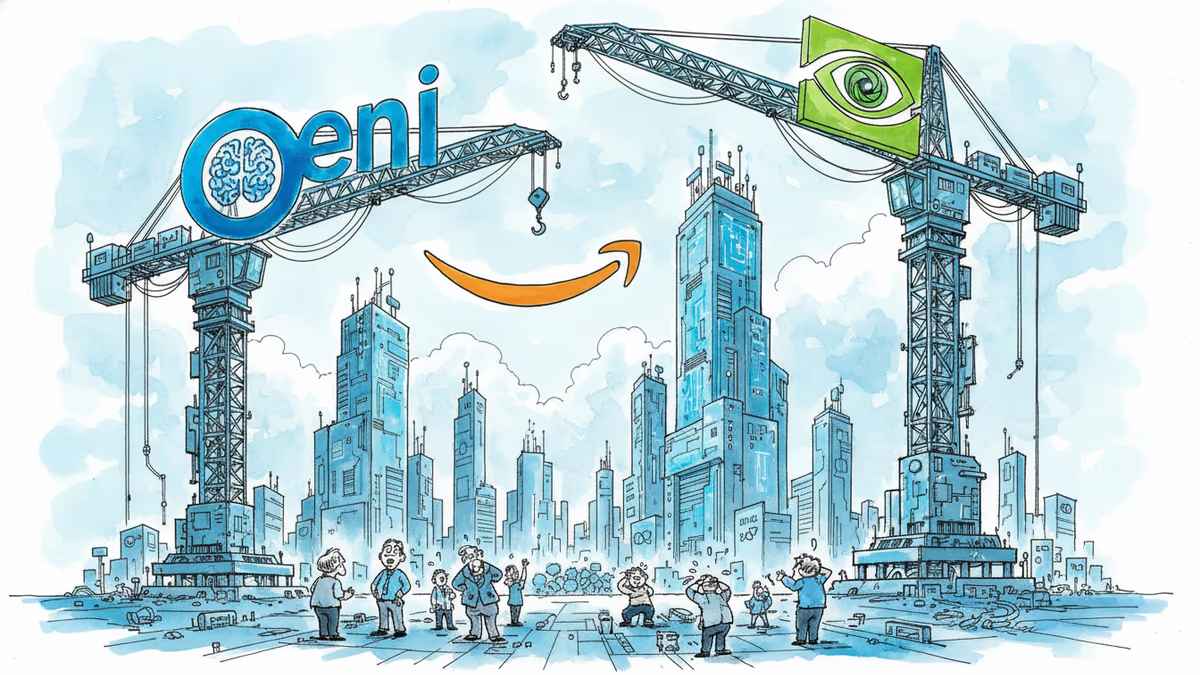
OpenAI's $110B Raise Signals the Start of AI Infrastructure Wars
OpenAI secured $110 billion in funding with strategic partnerships from Amazon and Nvidia, marking a shift from AI research to infrastructure dominance. What does this mean for the competitive landscape?
$110 Billion Just Rewrote the AI Playbook
OpenAI announced Friday it has raised $110 billion in what could become the largest private funding round in history. The breakdown tells a story: Amazon committed $50 billion, while Nvidia and SoftBank each put in $30 billion, valuing the company at $730 billion pre-money. But here's the kicker—the round isn't even closed yet.
Just 11 months ago, OpenAI's $40 billion round was considered record-breaking. Now that looks quaint. But the real story isn't the dollar amount—it's what this money represents. Much of it comes as services rather than cash, signaling a fundamental shift from traditional VC funding to strategic infrastructure partnerships.
"We are entering a new phase where frontier AI moves from research into daily use at global scale," OpenAI stated. Translation: the research phase is over. Now it's about who can scale fastest.
Amazon and Nvidia: Why They're Going All-In
Amazon's involvement goes far beyond writing a check. The companies are developing a "stateful runtime environment" where OpenAI models will run on Amazon's Bedrock platform. They're also expanding their existing $38 billion AWS partnership by $100 billion, with OpenAI committing to consume at least 2GW of AWS Trainium compute.
Amazon CEO Andy Jassy framed it perfectly: "Our unique collaboration with OpenAI to provide stateful runtime environments will change what's possible for customers building AI apps and agents." This isn't just about cloud services—it's about creating an entirely new computing paradigm.

Nvidia's deal is equally strategic, committing 3GW of dedicated inference capacity and 2GW of training on Vera Rubin systems. After months of speculation about Nvidia potentially backing away, CEO Jensen Huang made it clear in January: "We will invest a great deal of money. I believe in OpenAI."
The Conditional Bet That Changes Everything
Here's where it gets interesting: $35 billion of Amazon's investment is conditional on OpenAI either achieving AGI or going public by year-end. This isn't just an investment—it's a bet on OpenAI hitting specific milestones that could reshape the entire industry.
But who decides when AGI is achieved? OpenAI has been promising AGI is "soon" for years, but concrete definitions remain elusive. By tying funding to these milestones, investors are essentially forcing OpenAI to put measurable stakes in the ground.
What This Means for Everyone Else
For developers and startups, this creates both opportunity and anxiety. The 40% price reduction in API costs will democratize access to advanced AI capabilities. But it also raises questions about vendor lock-in and the concentration of AI power among a few massive players.
Traditional tech giants like Google, Microsoft, and Meta now face a different competitive landscape. OpenAI isn't just building better models—it's building an entire ecosystem with the world's largest cloud provider and chip manufacturer as partners.
For consumers, the implications are still unfolding. OpenAI plans to build custom models to support Amazon consumer products, potentially bringing AI deeper into everyday shopping, entertainment, and home automation experiences.
The real question isn't whether OpenAI can achieve AGI—it's whether the path to AGI should be controlled by just a handful of companies with the deepest pockets.
Authors
Related Articles
Samsung and SK unveiled a chip and AI investment package worth thousands of trillions of won on June 29. The headline number swings wildly by outlet, but the real contest isn't capital — it's water and power.
Lucra Sports CEO Dylan Robbins landed Cathie Wood's ARK Invest as a Series B lead without building AI. The story behind his unconventional fundraising playbook.
SolarSquare is raising $55-60M at a $450-500M valuation, more than doubling its worth in 18 months. Here's what's driving investor conviction in India's residential solar market.
Viral videos show 2026 graduates jeering executives who praise AI at commencement ceremonies. It's not just rudeness — it's a signal about who pays for technological optimism.
Samsung and SK unveiled a chip and AI investment package worth thousands of trillions of won on June 29. The headline number swings wildly by outlet, but the real contest isn't capital — it's water and power.
Lucra Sports CEO Dylan Robbins landed Cathie Wood's ARK Invest as a Series B lead without building AI. The story behind his unconventional fundraising playbook.
SolarSquare is raising $55-60M at a $450-500M valuation, more than doubling its worth in 18 months. Here's what's driving investor conviction in India's residential solar market.
Viral videos show 2026 graduates jeering executives who praise AI at commencement ceremonies. It's not just rudeness — it's a signal about who pays for technological optimism.
Thoughts
Share your thoughts on this article
Sign in to join the conversation