
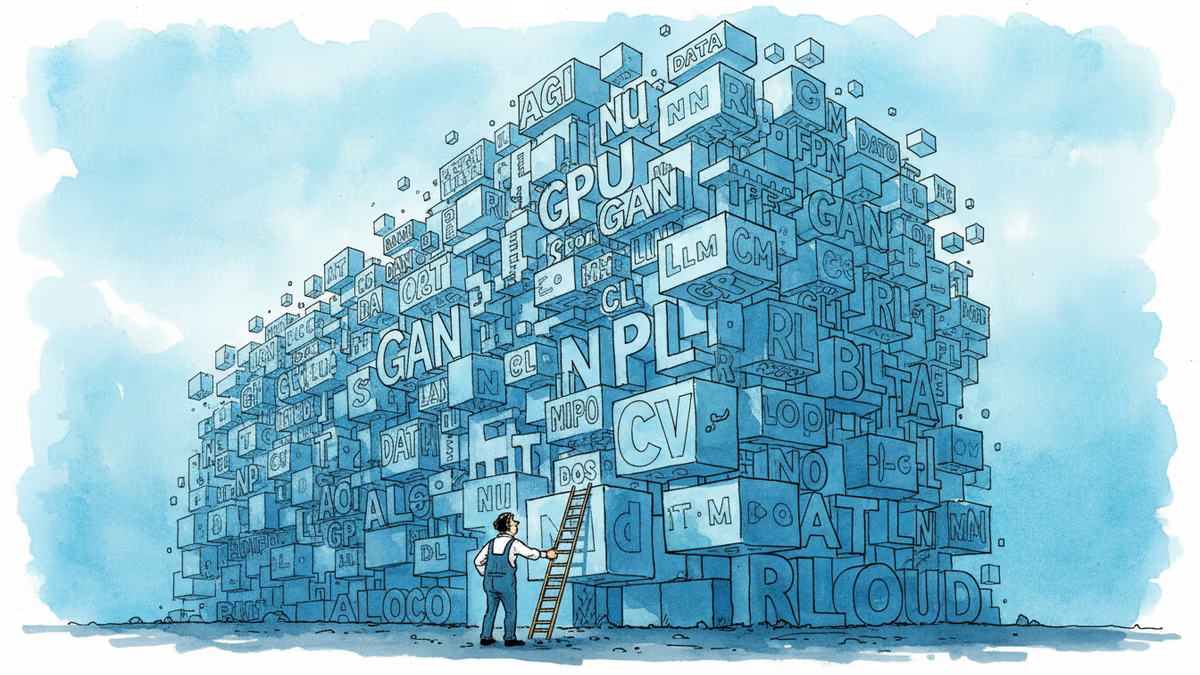
AI Jargon Is a Power Game. Here's How to Play It.
AGI, hallucination, inference, LLMs — AI's vocabulary isn't just technical shorthand. It shapes who holds power in the conversation. A clear-eyed glossary with the questions behind the terms.
Ask ten AI researchers what AGI means and you'll get eleven answers. OpenAI calls it "systems that outperform humans at most economically valuable work." Google DeepMind prefers "AI at least as capable as humans at most cognitive tasks." OpenAI CEO Sam Altman has described it more casually as "a median human you could hire as a co-worker." Same three letters. Three different finish lines. And billions of dollars riding on which definition wins.
This isn't a vocabulary problem. It's a power problem.
Why the Words Matter More Than You Think
AI is no longer a research curiosity. It's reviewing your job application, helping decide your loan, summarizing your medical records, and increasingly — acting on your behalf without you lifting a finger. The language used to describe these systems isn't neutral. It shapes how regulators write laws, how investors allocate capital, and how ordinary people understand what's being done to them — or for them.
So let's cut through it. Not with a dry dictionary, but with the questions the definitions tend to leave out.
The Terms, and What's Actually Going On
Hallucination is the industry's polite word for AI making things up. A model confidently cites a paper that doesn't exist, prescribes a drug interaction that's dangerous, or fabricates a legal precedent. The term is telling: "hallucination" sounds like a glitch in perception, something almost forgivable — a vision, not a lie. If the industry called it "fabrication" or "error generation," the liability conversation might look very different. Most AI tools bury a disclaimer in their terms of service: verify AI-generated answers. Few users read it. Fewer still see it prominently displayed.
Chain-of-thought reasoning is how AI models slow down to think. Instead of jumping to an answer, a model breaks a problem into intermediate steps — the way you'd work through a math problem on paper rather than in your head. The result is more accurate, especially for logic and code. The tradeoff: it takes longer. This is the engine behind what the industry now calls reasoning models — a new generation of LLMs trained specifically to think in steps rather than react in instants.

AI agents are the next frontier, and the term is still being defined in real time. The basic idea: an AI that doesn't just answer questions but does things — books your flight, files your expenses, writes and deploys code. OpenAI, Google, and Anthropic are all racing toward this. The infrastructure isn't fully there yet, but the direction is clear. When agents arrive at scale, the question shifts from "what can AI tell me?" to "what can AI do without me?"
Fine-tuning is how a general-purpose model gets specialized. A startup takes a foundation model — say, GPT-4 or Llama — and trains it further on domain-specific data: legal contracts, medical literature, financial filings. This is how most AI startups actually build products. They're not training from scratch; they're customizing someone else's foundation. The question that follows: who owns the expertise when the base model changes?
Distillation is where it gets legally and ethically thorny. The technique involves training a smaller "student" model using the outputs of a larger "teacher" model. Efficient, effective — and potentially a way to absorb a competitor's intelligence without paying for it. Most AI providers explicitly ban distillation from their models in their terms of service. The suspicion that some companies have done it anyway hangs over the industry like an open secret.
Compute is the fuel. GPUs, TPUs, custom AI chips — the hardware that makes training and running models possible. It's why Nvidia's valuation became a proxy for AI optimism, and why the US export controls on advanced chips to China became a geopolitical flashpoint. The AI race is, at its foundation, a compute race. Whoever controls the hardware controls the ceiling.
Deep learning and diffusion are the underlying mechanics behind most of what you interact with. Deep learning — modeled loosely on how neurons connect in the brain — lets models find patterns in data without being explicitly told what to look for. Diffusion is how image generators work: they learn to reconstruct images from noise, which means they can generate new ones from scratch. The art you see AI produce, the music it composes — diffusion is the engine.
The Definitions Are Never Just Definitions
Here's the detail worth sitting with: OpenAI's contract with Microsoft reportedly changes when AGI is achieved. Meaning the legal and financial stakes of defining AGI are enormous — and OpenAI gets to define it. That's not a conspiracy; it's a structural incentive. When a company both pursues a goal and holds the power to declare it reached, the definition of that goal is never purely technical.
The same dynamic plays out across the glossary. "Hallucination" softens accountability. "Agent" implies trustworthy autonomy before the trust has been earned. "Foundation model" suggests permanence and reliability that may not yet exist. Language in AI isn't just descriptive — it's persuasive.
For regulators in Washington, Brussels, and London, this matters enormously. The EU AI Act, for instance, applies different rules depending on how AI systems are classified. If the industry gets to write the classification dictionary, it also gets to write the rules.
Authors
Related Articles
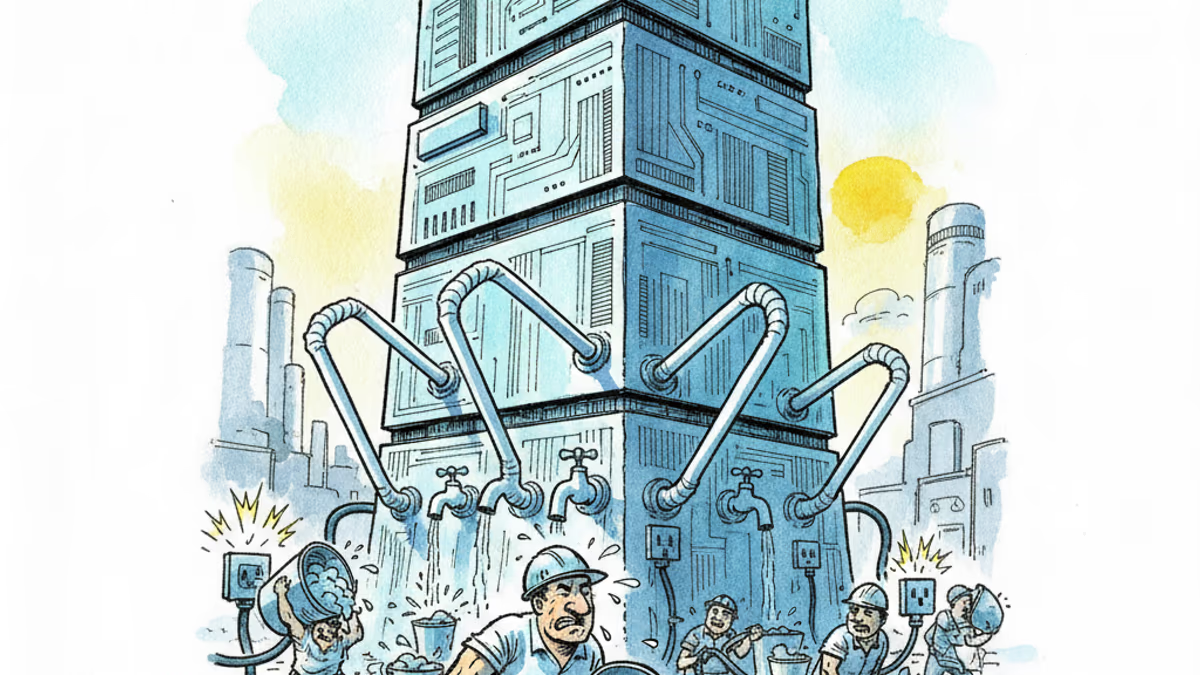
Samsung and SK unveiled a chip and AI investment package worth thousands of trillions of won on June 29. The headline number swings wildly by outlet, but the real contest isn't capital — it's water and power.
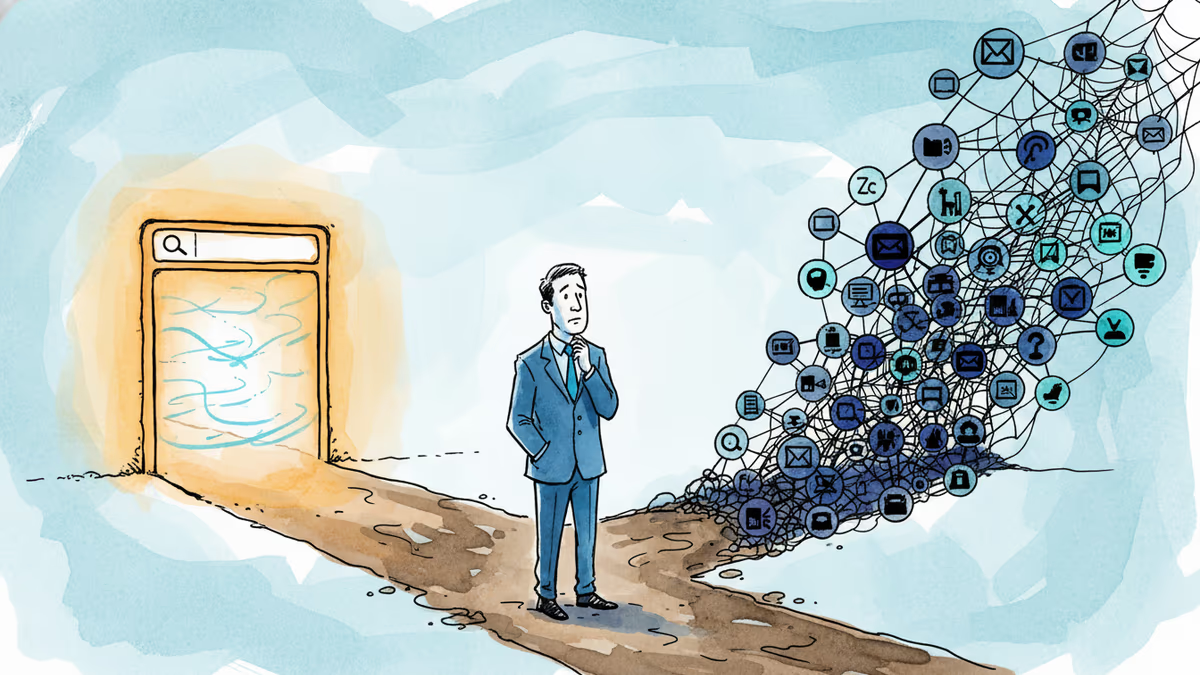
In a post-Google I/O interview, Sundar Pichai acknowledged flawed search results, real AI anxiety, and an AGI timeline that makes the label irrelevant. Here's what he said — and what it means.
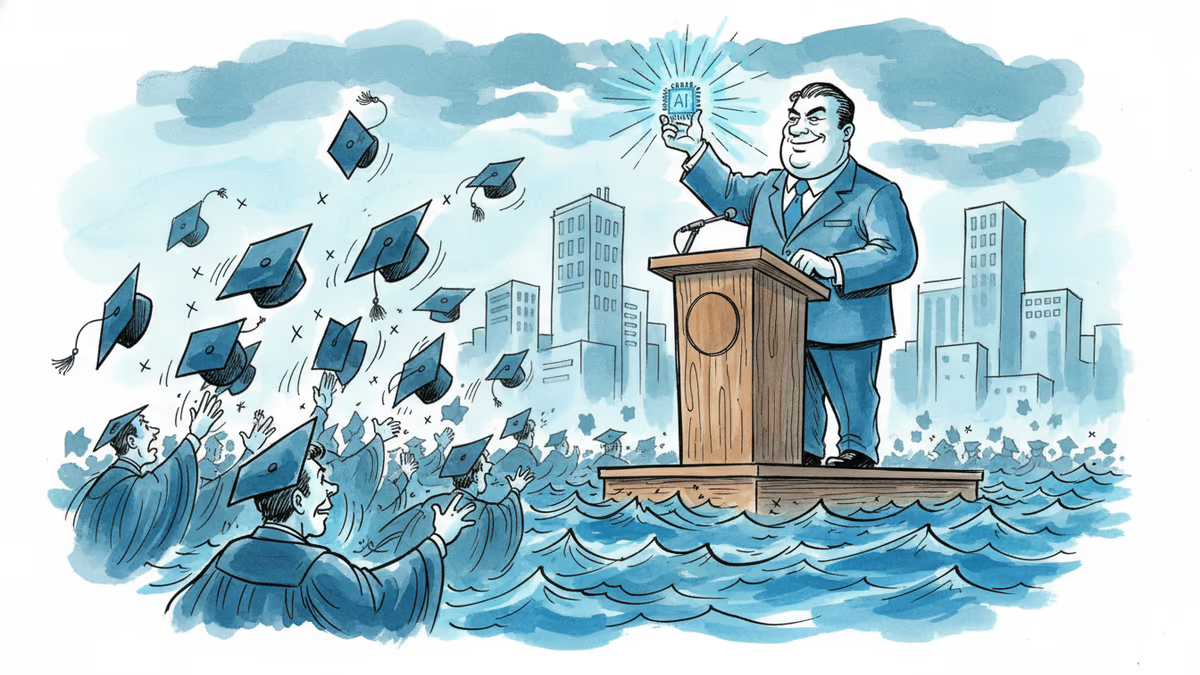
Viral videos show 2026 graduates jeering executives who praise AI at commencement ceremonies. It's not just rudeness — it's a signal about who pays for technological optimism.
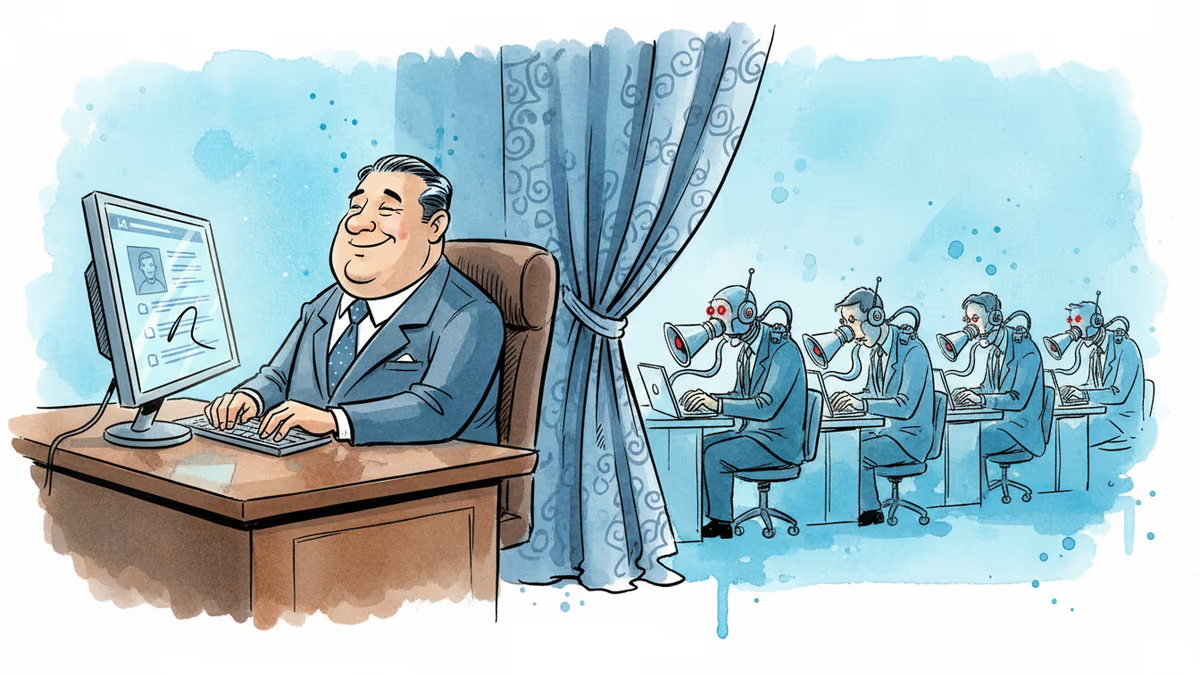
Filipino virtual assistants using AI to ghost-manage LinkedIn profiles for executives is now a structured industry. 30 comments a day, fake engagement rings, and a platform struggling to tell real from fabricated.
Samsung and SK unveiled a chip and AI investment package worth thousands of trillions of won on June 29. The headline number swings wildly by outlet, but the real contest isn't capital — it's water and power.
In a post-Google I/O interview, Sundar Pichai acknowledged flawed search results, real AI anxiety, and an AGI timeline that makes the label irrelevant. Here's what he said — and what it means.
Viral videos show 2026 graduates jeering executives who praise AI at commencement ceremonies. It's not just rudeness — it's a signal about who pays for technological optimism.
Filipino virtual assistants using AI to ghost-manage LinkedIn profiles for executives is now a structured industry. 30 comments a day, fake engagement rings, and a platform struggling to tell real from fabricated.
Thoughts
Share your thoughts on this article
Sign in to join the conversation