
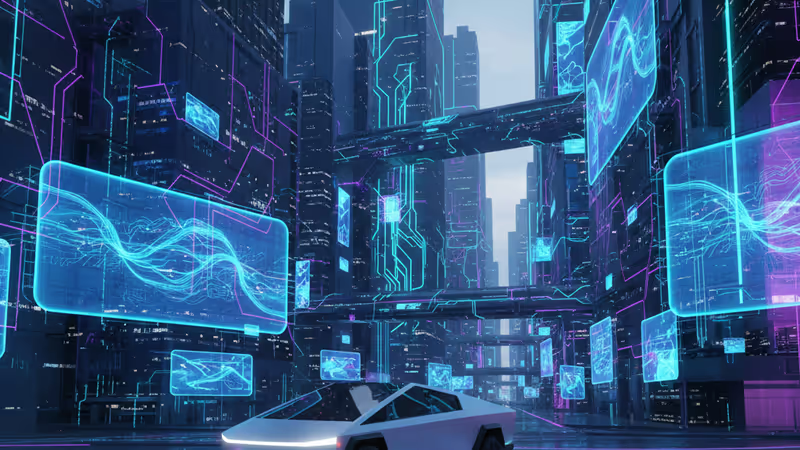
Tesla Robotaxi Austin 2026: First Driverless Rides Launch Without Safety Monitors
Tesla has officially launched its fully driverless robotaxi service in Austin. Explore the Tesla Robotaxi Austin 2026 strategy, including pricing and the roadmap to AGI.
The driver's seat is empty, but the race for autonomy is heating up. Tesla has officially launched its robotaxi service in Austin, Texas, without human safety drivers in the front seat. This marks a pivotal shift for the automaker as it transitions from supervised testing to a fully autonomous commercial service.
Tesla Robotaxi Austin 2026: Removing the Human Factor
On January 22, 2026, CEO Elon Musk announced via X that the company just started its robotaxi drives in Austin with "no safety monitor in the car." Musk took the opportunity to pitch for new engineering talent, stating that solving real-world AI is a path that will likely lead to Artificial General Intelligence (AGI).

Business Model and Market Strategy
Unlike competitors like Waymo or Zoox, which often provided free rides during initial deployments, Tesla is already charging for its driverless service. Ashok Elluswamy, Tesla’s AI lead, clarified that the rollout will be gradual. The current fleet is a mix of unsupervised and supervised vehicles, with the ratio of driverless cars expected to increase as the AI demonstrates consistent safety.
Starting with a few unsupervised vehicles mixed in with the broader robotaxi fleet... the ratio will increase over time.
Authors
Related Articles
Waymo's new Ojai robotaxi isn't just a vehicle upgrade. It's the company's most serious attempt yet at cracking the cost problem that has kept autonomous vehicles from scaling. Here's what's really at stake.
SpaceX's IPO filing puts AI at the center, claiming a $26.5 trillion market opportunity. But can Grok compete with OpenAI and Anthropic for enterprise customers?
SpaceX filed a nearly 400-page S-1 with the SEC, targeting an IPO as early as June 12. Here's what the filing reveals—and what it doesn't.
SpaceX has filed its S-1 with the SEC, targeting the Nasdaq under ticker SPCX. With $18.67B in revenue but a $4.9B loss, the IPO forces investors to answer one hard question.
Waymo's new Ojai robotaxi isn't just a vehicle upgrade. It's the company's most serious attempt yet at cracking the cost problem that has kept autonomous vehicles from scaling. Here's what's really at stake.
SpaceX's IPO filing puts AI at the center, claiming a $26.5 trillion market opportunity. But can Grok compete with OpenAI and Anthropic for enterprise customers?
SpaceX filed a nearly 400-page S-1 with the SEC, targeting an IPO as early as June 12. Here's what the filing reveals—and what it doesn't.
SpaceX has filed its S-1 with the SEC, targeting the Nasdaq under ticker SPCX. With $18.67B in revenue but a $4.9B loss, the IPO forces investors to answer one hard question.
Thoughts
Share your thoughts on this article
Sign in to join the conversation