
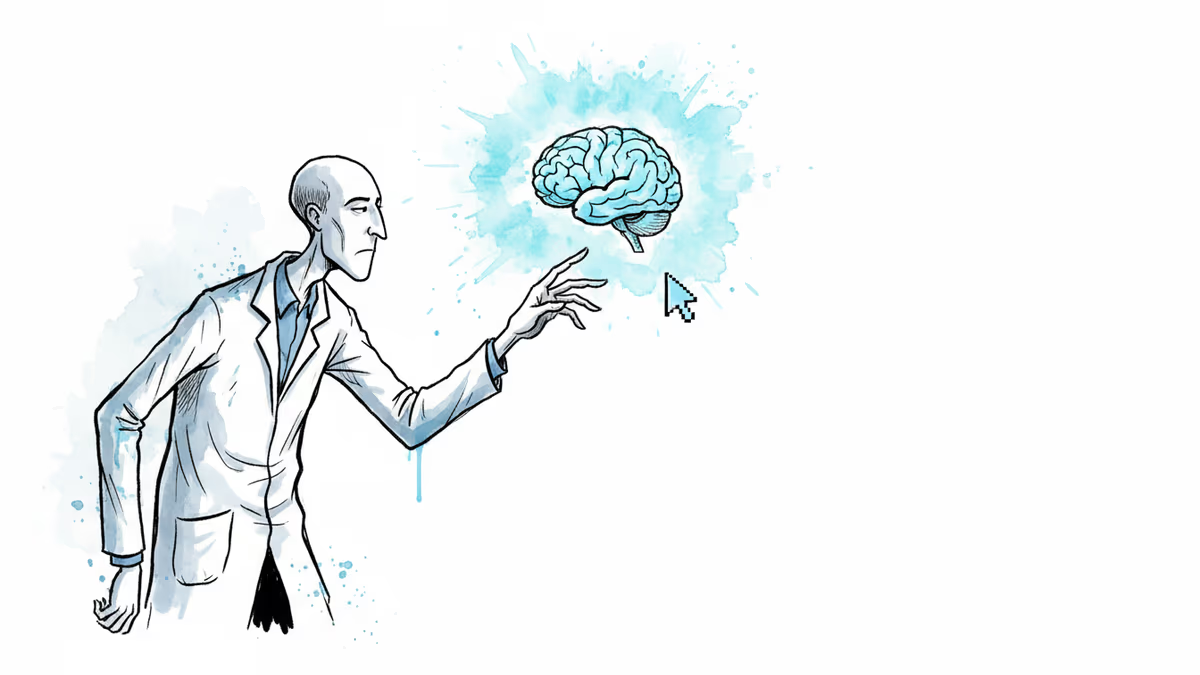
Neuralink's Reality Check: When Ambition Meets Biology
Elon Musk promised minds merged with AI. Neuralink delivered a brain-controlled cursor. The gap between the two reveals something important about how Silicon Valley sells the future.
The cursor moved. Slowly, deliberately, across the screen — controlled entirely by thought. For Noland Arbaugh, a 29-year-old paralyzed from the shoulders down, that moment in early 2024 was genuinely life-changing. For Elon Musk, it was a footnote to a much grander promise.
This is the central tension at the heart of Neuralink right now.
What Neuralink Actually Does — And What It Doesn't
Strip away the press releases and the late-night X posts, and Neuralink's technology is, at its core, a brain-to-cursor interface. Patients with paralysis can control a computer mouse with their thoughts. That's real, meaningful, and genuinely difficult to build. But it is a long way from what Musk has been selling since 2017: memories stored and retrieved on demand, human cognition fused with artificial intelligence, a species-level upgrade to compete with AI.
The gap isn't a matter of engineering iteration. It's structural. The human brain contains roughly 86 billion neurons firing in patterns of staggering complexity. Neuralink's current implant reads signals from approximately 1,024 electrodes — a resolution so limited that neuroscientists compare it to trying to understand a city's traffic patterns by watching a single intersection.
The animal testing record made headlines for the wrong reasons. Reports of adverse outcomes in primate subjects drew sharp criticism from animal welfare groups and raised uncomfortable questions about the pace at which Neuralink was pushing toward human trials. The company has since moved into human implantation, with early subjects showing modest but real progress in controlling digital interfaces. Still, the line from "cursor control" to "cognitive enhancement" remains undrawn.
Why This Moment Matters

Neuralink isn't the only player in this space — it's just the loudest. Synchron, an Australian-American company, has been quietly implanting its Stentrode device in patients with ALS and has accumulated clinical data with a notably lower surgical risk profile, since its device doesn't require open-brain surgery. Blackrock Neurotech has decades of research behind it. The academic BCI community has been doing this work, carefully, for years.
What Musk brought to the field wasn't scientific breakthroughs — it was capital and attention. Neuralink has raised over $700 million. That money, and the media oxygen that came with it, accelerated the entire sector. Competitors got funded. Regulators got engaged. The FDA approved Neuralink's first human trial in 2023, a milestone that required the entire regulatory apparatus to develop new frameworks for evaluating permanent brain implants.
The timing of this reckoning matters too. Musk's attention is fractured across Tesla, SpaceX, xAI, and his role in Washington. Neuralink is not his most urgent priority. And in a field where the pace of progress is measured in years of careful clinical data, divided attention is a liability.
Three Ways to Read This Story
For patients and clinicians, the picture is cautiously optimistic — but not in the way Musk describes it. BCI technology is showing real promise for people with ALS, spinal cord injuries, and stroke-related paralysis. The medical community's concern isn't whether the technology works; it's whether the hype is distorting patient expectations and rushing timelines that should be governed by safety data, not investor sentiment. A brain implant is not something you can easily undo.
For investors, the calculus is a familiar Musk bet: tolerate years of overpromising in exchange for exposure to a potentially enormous market. The global neurotechnology market is projected to exceed $21 billion by 2030. If BCI moves from medical devices into consumer applications — think next-generation AR interfaces or hands-free computing — the addressable market expands by orders of magnitude. The question is whether Neuralink will be the company that gets there, or whether it will have paved the road for someone else.
For regulators and ethicists, the hardest questions haven't been asked yet in public. Who owns your neural data? If a company goes bankrupt, what happens to the chip in your skull? Will cognitive enhancement technology be accessible only to those who can afford it — and what does that mean for equality? The FDA has frameworks for medical devices. It does not yet have frameworks for technologies that blur the line between treatment and enhancement.
Authors
Related Articles
SpaceX's IPO filing puts AI at the center, claiming a $26.5 trillion market opportunity. But can Grok compete with OpenAI and Anthropic for enterprise customers?
SpaceX filed a nearly 400-page S-1 with the SEC, targeting an IPO as early as June 12. Here's what the filing reveals—and what it doesn't.
SpaceX has filed its S-1 with the SEC, targeting the Nasdaq under ticker SPCX. With $18.67B in revenue but a $4.9B loss, the IPO forces investors to answer one hard question.
Over 50 researchers and engineers have left SpaceXAI since February's merger. With the pre-training team nearly gutted, questions mount about whether Musk's AI ambitions can survive his management style.
SpaceX's IPO filing puts AI at the center, claiming a $26.5 trillion market opportunity. But can Grok compete with OpenAI and Anthropic for enterprise customers?
SpaceX filed a nearly 400-page S-1 with the SEC, targeting an IPO as early as June 12. Here's what the filing reveals—and what it doesn't.
SpaceX has filed its S-1 with the SEC, targeting the Nasdaq under ticker SPCX. With $18.67B in revenue but a $4.9B loss, the IPO forces investors to answer one hard question.
Over 50 researchers and engineers have left SpaceXAI since February's merger. With the pre-training team nearly gutted, questions mount about whether Musk's AI ambitions can survive his management style.
Thoughts
Share your thoughts on this article
Sign in to join the conversation