
Tesla's Revenue Drops for Second Straight Year as Musk's AI Pivot Stumbles
Tesla reports declining revenue and profits for the second consecutive year, raising questions about Elon Musk's ambitious $1 trillion AI and robotics transformation strategy.
$840 million in net income on $24.9 billion in revenue. Those are Tesla's fourth-quarter numbers for 2025, representing a 61% plunge in profits and 3% drop in revenue compared to the same period last year when the company earned $2.3 billion on $25.7 billion in sales.
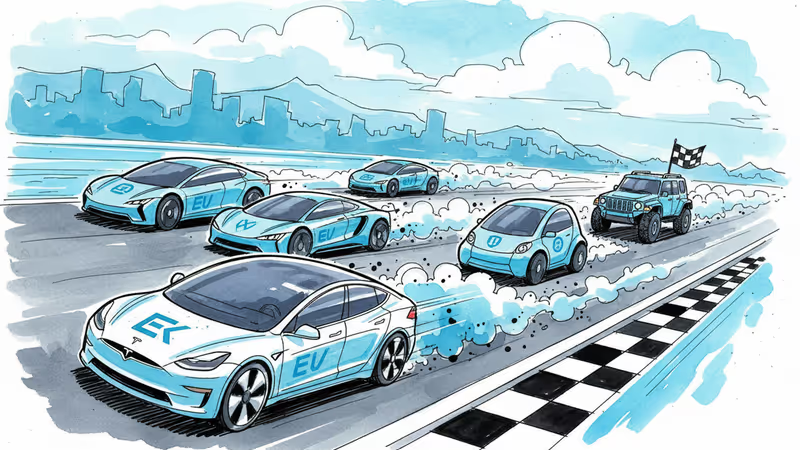
Two years of consecutive decline for a company that once seemed unstoppable. While the global EV market continues its upward trajectory, Tesla—the pioneer that sparked the electric revolution—finds itself moving in reverse.
The Trillion-Dollar Dream Hits Reality
Elon Musk has been selling investors on a grand vision: transforming Tesla from a car company into an AI and robotics powerhouse worth $1 trillion. The strategy seemed bold, forward-thinking, even inevitable given Musk's track record of turning science fiction into reality.
But here's the uncomfortable truth: you can't pivot to AI if your core business is hemorrhaging profits. Tesla's declining automotive revenue isn't just a quarterly blip—it's a fundamental challenge to Musk's entire transformation narrative. How do you convince the market you're the future of robotics when you're losing ground in the business that built your reputation?
The company's aging lineup doesn't help. The Model S, Model 3, and Model Y were revolutionary when they launched, but innovation has a shelf life. Competitors have caught up, and in some cases, surpassed Tesla's offerings in price, features, and reliability.
The EV Market Paradox
Here's what makes Tesla's struggles particularly striking: the electric vehicle market isn't shrinking—it's booming. BYD in China, Volkswagen in Europe, and even traditional automakers like Ford and GM are posting strong EV sales growth.

Chinese manufacturers, in particular, have cracked the code on affordable EVs without sacrificing quality. They're offering vehicles at price points Tesla simply can't match while maintaining competitive range and features. Meanwhile, charging infrastructure has evolved from Tesla's proprietary advantage to a broadly accessible network that works with any EV.
The company that once had the electric vehicle market virtually to itself now faces fierce competition on multiple fronts. Premium buyers have options like Lucid Air and Mercedes EQS. Budget-conscious consumers can choose from an expanding array of affordable alternatives.
Musk's Attention Deficit
Part of Tesla's challenge stems from its CEO's scattered focus. Between running X (formerly Twitter), SpaceX, Neuralink, and now government advisory roles, Musk's attention is divided across multiple ventures. Tesla, once his primary focus, now competes for mindshare with his other ambitious projects.
The company keeps promising breakthrough technologies—Optimus robots, full self-driving capabilities, revolutionary manufacturing processes—but delivery timelines keep slipping. Investors are growing weary of paying premium valuations for promises rather than products.
Tesla's stock price still reflects enormous future expectations, but the gap between those expectations and current performance continues to widen. At some point, even the most patient investors start asking hard questions about execution.
The Innovation Trap
Tesla's situation illustrates a classic business dilemma: the pioneer's curse. Being first to market provides advantages, but it doesn't guarantee long-term dominance. Often, fast followers learn from the pioneer's mistakes and execute better strategies.
Apple didn't invent the smartphone—it perfected it. Google wasn't the first search engine—it was the best. Tesla opened the door to electric vehicles, but that doesn't mean it will control the room forever.
Authors
Related Articles
SpaceX's IPO filing puts AI at the center, claiming a $26.5 trillion market opportunity. But can Grok compete with OpenAI and Anthropic for enterprise customers?
SpaceX filed a nearly 400-page S-1 with the SEC, targeting an IPO as early as June 12. Here's what the filing reveals—and what it doesn't.
SpaceX has filed its S-1 with the SEC, targeting the Nasdaq under ticker SPCX. With $18.67B in revenue but a $4.9B loss, the IPO forces investors to answer one hard question.
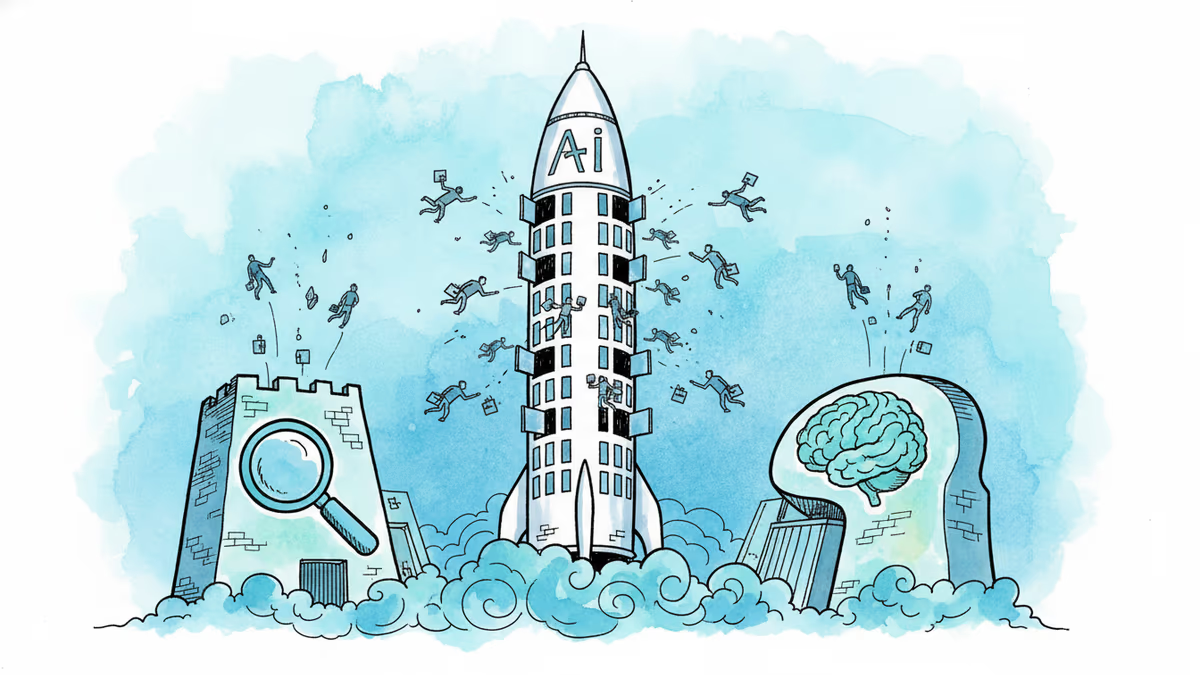
Over 50 researchers and engineers have left SpaceXAI since February's merger. With the pre-training team nearly gutted, questions mount about whether Musk's AI ambitions can survive his management style.
SpaceX's IPO filing puts AI at the center, claiming a $26.5 trillion market opportunity. But can Grok compete with OpenAI and Anthropic for enterprise customers?
SpaceX filed a nearly 400-page S-1 with the SEC, targeting an IPO as early as June 12. Here's what the filing reveals—and what it doesn't.
SpaceX has filed its S-1 with the SEC, targeting the Nasdaq under ticker SPCX. With $18.67B in revenue but a $4.9B loss, the IPO forces investors to answer one hard question.
Over 50 researchers and engineers have left SpaceXAI since February's merger. With the pre-training team nearly gutted, questions mount about whether Musk's AI ambitions can survive his management style.
Thoughts
Share your thoughts on this article
Sign in to join the conversation