
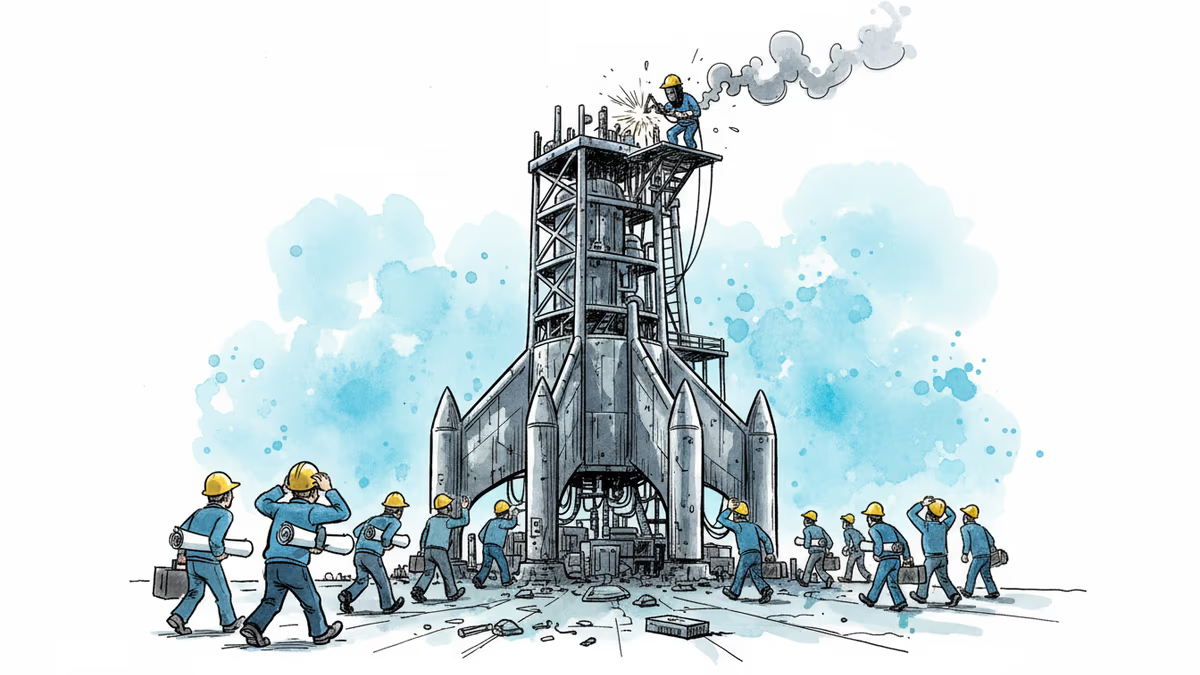
xAI Lost 9 of 11 Co-Founders. Is That a Feature or a Bug?
Elon Musk says rebuilding xAI from scratch is intentional. But with co-founders gone, key projects paused, and Tesla executives parachuting in, the line between redesign and damage control is blurring.
Nine Down, Two to Go
Of the 11 co-founders who launched xAI with Elon Musk three years ago, nine have now left. The two who remain — Manuel Kroiss and Ross Nordeen — are tasked with helping Musk rebuild what he himself called a company that "was not built right first time around."
The latest departures came this week: co-founders Zihang Dai and Guodong Zhang exited after Musk publicly complained that xAI's AI coding tools weren't keeping pace with Anthropic's Claude Code or OpenAI's Codex. Musk convened an all-hands meeting Wednesday to address the gap and predicted xAI could close it by mid-2025. Whether that timeline is realistic or aspirational is another question.
This isn't an isolated incident. A month ago, 11 senior engineers — including two other co-founders — left following what Musk described as a reorganization. That apparently wasn't enough: the Financial Times reported that SpaceX and Tesla executives have been deployed to evaluate xAI staff and cut those who don't measure up. For a company whose founder insists the overhaul is proceeding by design, there are a lot of external firefighters on site.
Why Coding Tools Are the Real Battleground
Coding assistants aren't a side feature — they're currently the clearest path to enterprise revenue in the AI industry. Since GitHub Copilot proved developers would pay for AI-assisted programming, the market has attracted serious competition. Claude Code and Codex have embedded themselves into real developer workflows, which means whoever wins that space wins recurring contracts, sticky subscriptions, and influence over the next generation of software infrastructure.
xAI's early 2025 user surge was real, but its driver — Grok's permissive stance on generating sexual and controversial imagery — isn't a foundation for enterprise growth. The gap in coding tools isn't just a PR problem. It's a revenue problem, and the timing couldn't be worse.
xAI is now part of SpaceX, and a SpaceX IPO is widely anticipated. A cash-burning AI division that can't demonstrate real enterprise traction is a liability in that story. Musk needs Grok to show numbers that justify its place in the portfolio — not just engagement metrics, but the kind of sticky commercial adoption that OpenAI's API business and Anthropic's enterprise contracts already represent.

For comparison: xAI has roughly 5,000 employees, OpenAI has over 7,500, and Anthropic around 4,700. Scale alone doesn't tell the story, but the gap in organizational depth matters when you're trying to compete on multiple fronts simultaneously.
The Macrohard Problem
Musk's longer-term bet isn't coding tools — it's Macrohard, a project aimed at building an AI agent capable of doing anything a white-collar worker can do on a computer. Musk described the name as "a funny reference to Microsoft." Whether investors find it funny may depend on what happens next.
Toby Pohlen, appointed to lead the project in February, left within weeks. This week, Business Insider reported the project is on pause. Musk's response: fold Tesla into the effort. In his framing, xAI's language model would direct Tesla's "Digital Optimus" agent — a nod to Tesla's humanoid robot — as it executes digital tasks.
The concept itself isn't novel. Perplexity's "Everything is Computer" offering targets the same enterprise use case: a dedicated digital proxy that orchestrates tasks across platforms. Entrepreneur Peter Steinberger, now at OpenAI, is working in the same direction. Musk is entering a race that's already underway, with a team that's still being assembled.
One Encouraging Signal
Amid the turbulence, there's one data point worth watching. Andrew Milich and Jason Ginsberg are joining xAI from Cursor, the AI coding tool that built its product on top of frontier models from OpenAI and Anthropic rather than training its own.
Their move to xAI — a company with its own frontier model — suggests something meaningful: direct access to LLM infrastructure may be becoming a decisive competitive variable in the coding tool market. If true, that's both a validation of xAI's core asset and a signal about where the industry is heading. Wrappers and integrations may have a ceiling; owning the model may not.
Musk is also casting a wider net. He announced Thursday that he and colleague Baris Akis are personally reviewing previously rejected job applications to identify candidates who deserved an interview. "My apologies," he added — an unusual public acknowledgment from a CEO who doesn't often traffic in contrition.
Authors
Related Articles
SpaceX's IPO filing puts AI at the center, claiming a $26.5 trillion market opportunity. But can Grok compete with OpenAI and Anthropic for enterprise customers?
SpaceX filed a nearly 400-page S-1 with the SEC, targeting an IPO as early as June 12. Here's what the filing reveals—and what it doesn't.
SpaceX has filed its S-1 with the SEC, targeting the Nasdaq under ticker SPCX. With $18.67B in revenue but a $4.9B loss, the IPO forces investors to answer one hard question.
Over 50 researchers and engineers have left SpaceXAI since February's merger. With the pre-training team nearly gutted, questions mount about whether Musk's AI ambitions can survive his management style.
SpaceX's IPO filing puts AI at the center, claiming a $26.5 trillion market opportunity. But can Grok compete with OpenAI and Anthropic for enterprise customers?
SpaceX filed a nearly 400-page S-1 with the SEC, targeting an IPO as early as June 12. Here's what the filing reveals—and what it doesn't.
SpaceX has filed its S-1 with the SEC, targeting the Nasdaq under ticker SPCX. With $18.67B in revenue but a $4.9B loss, the IPO forces investors to answer one hard question.
Over 50 researchers and engineers have left SpaceXAI since February's merger. With the pre-training team nearly gutted, questions mount about whether Musk's AI ambitions can survive his management style.
Thoughts
Share your thoughts on this article
Sign in to join the conversation