
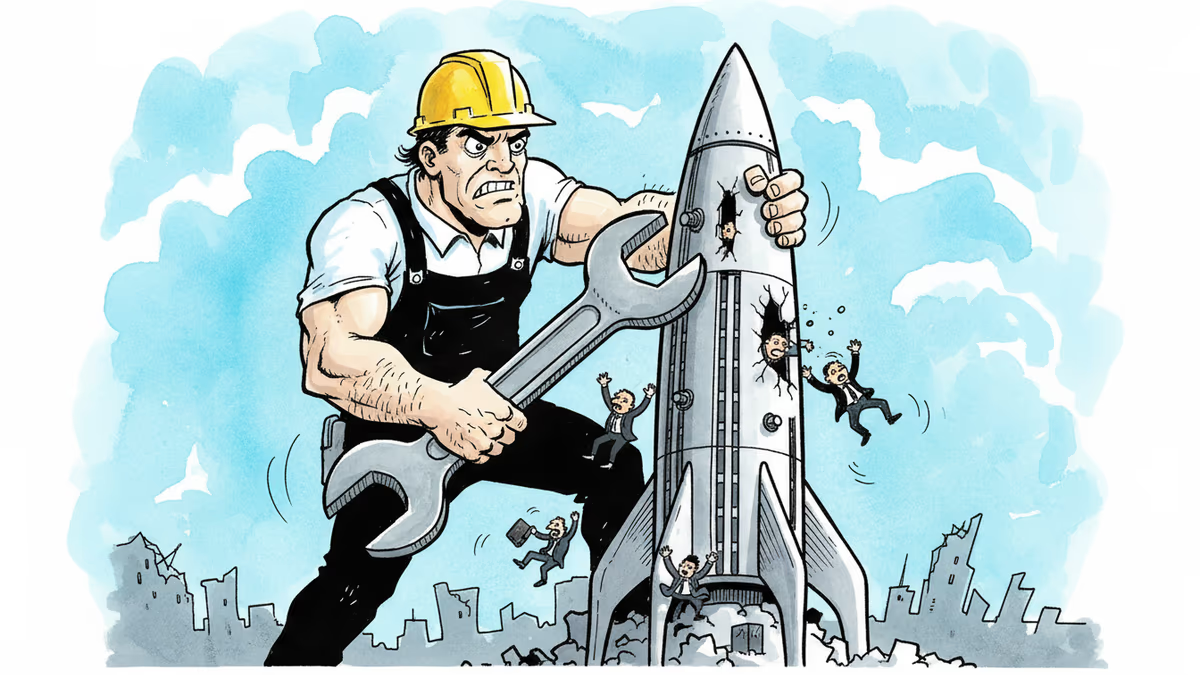
Musk Is Purging xAI's Cofounders. Again.
Elon Musk has ousted more xAI cofounders over weak coding AI performance, deploying SpaceX and Tesla "fixers" ahead of a June IPO. What does this mean for the AI coding race?
The startup is barely two years old. The cofounders are already being shown the door — for the second time.
Elon Musk has ordered another wave of job cuts at xAI, this time targeting the team behind its underperforming coding product. Multiple people familiar with the decisions say Musk grew frustrated as rivals Anthropic and OpenAI pulled ahead in the AI coding market, tools that are rapidly reshaping how software gets built. Several cofounders have been forced out. In their place: operational "fixers" parachuted in from SpaceX and Tesla to audit the company from the inside.
The June Deadline Hanging Over Everything
This isn't just about a product that missed its targets. The timing matters enormously.
Musk recently merged SpaceX with xAI in a $1.25 billion deal, and he's racing toward what could be one of the largest stock market listings in history — with a self-imposed deadline of June 2026. The world's richest man has publicly stated his ambitions: AI data centers in orbit, factories on the Moon, and eventually, colonies on Mars. All of that requires capital. And capital requires a compelling IPO story.
A coding AI that's losing ground to Claude and Codex is a problem not just for the product roadmap — it's a problem for the valuation narrative. Sending in fixers from his other companies isn't a routine HR move. It reads as a pre-IPO triage.
Who's Winning the Coding AI Race — and Why It Matters
The AI coding market has become one of the most consequential battlegrounds in tech. GitHub Copilot, Anthropic's Claude, and OpenAI's tools have already embedded themselves in developer workflows at companies ranging from early-stage startups to Fortune 500 engineering teams. Developer productivity gains of 30–50% have been reported in multiple internal studies, though the numbers vary widely depending on task complexity.

For enterprises, the implications run deeper than convenience. When AI can handle a meaningful chunk of routine coding, hiring decisions change. Team structures change. The economics of building software change. This is why Google, Meta, Microsoft, and now xAI are all fighting for this particular slice of the market — whoever wins developer trust tends to win the broader enterprise AI relationship.
xAI's stumble here isn't just a competitive setback. It's a signal that building a great large language model and building a great developer tool are two very different problems.
The Cofounder Problem
There's a pattern worth examining. Musk acquired Twitter and cut nearly 80% of its staff within months. At Tesla and SpaceX, executives who didn't meet his pace have consistently been replaced. Now, at a 2-year-old AI startup, cofounders — the people who built the foundational vision — are being cycled out.
Supporters frame this as ruthless meritocracy: if you're not delivering, you move on. Critics raise a different concern: when the people who defined a company's original direction leave, what replaces their institutional knowledge? And when the replacements come from a rocket company and an automaker, do they bring the right instincts for AI research culture?
There's a real tension here. The best AI researchers tend to be attracted by autonomy, intellectual freedom, and the ability to pursue long-horizon bets. The "fixers" Musk deploys are optimizers — people trained to find inefficiencies and eliminate them. These are not always the same skill set. Whether that friction produces better AI or just faster audits remains an open question.
What Investors and Developers Should Watch
For investors eyeing the xAI IPO, the key question isn't whether Musk can hit the June date — he probably can. The question is what the company looks like on the other side of this restructuring. An IPO achieved through rapid operational tightening looks very different from one built on compounding product momentum.
For developers and enterprise buyers, the signal is more immediate: xAI's coding tools are not yet where they need to be, and the company knows it. That's either a reason to wait, or — depending on your view of Musk's track record — a reason to watch closely for what comes next.
Authors
Related Articles
Anthropic shipped Claude Sonnet 5, its mid-tier agent model, on June 30. Behind the 'Opus-class power, budget price' headline sits a tokenizer catch and a three-horse race that's only half real. Here's what developers should actually run the numbers on.
American Airlines just signed Starlink for 500+ aircraft. It's not just about faster inflight internet — it's a calculated move in the run-up to what could be the largest IPO in history.

A small but growing group of developers has gone all-in on AI coding agents like Claude Code and OpenClaw. History suggests the rest of us won't be far behind.
SpaceX's upgraded Starship V3 completed its first test flight, deploying 20 Starlink simulators but losing the Super Heavy booster. With an IPO weeks away, the stakes just got higher.
Anthropic shipped Claude Sonnet 5, its mid-tier agent model, on June 30. Behind the 'Opus-class power, budget price' headline sits a tokenizer catch and a three-horse race that's only half real. Here's what developers should actually run the numbers on.
American Airlines just signed Starlink for 500+ aircraft. It's not just about faster inflight internet — it's a calculated move in the run-up to what could be the largest IPO in history.
A small but growing group of developers has gone all-in on AI coding agents like Claude Code and OpenClaw. History suggests the rest of us won't be far behind.
SpaceX's upgraded Starship V3 completed its first test flight, deploying 20 Starlink simulators but losing the Super Heavy booster. With an IPO weeks away, the stakes just got higher.
Thoughts
Share your thoughts on this article
Sign in to join the conversation