
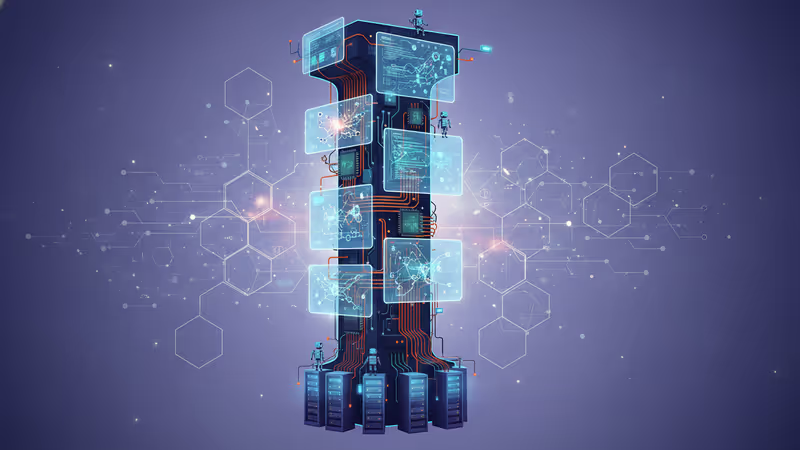
AI Bubble or Revolution? Davos CEOs Drop the Masks in Public Showdown
At Davos 2026, AI leaders traded public barbs over China, bubble concerns, and market dominance. From Anthropic vs Nvidia tensions to Microsoft's usage warnings, the gloves came off in Silicon Valley's biggest power play.
Climate change panels sat half-empty while AI discussions packed the house at this year's World Economic Forum in Davos. But behind the grand pronouncements about artificial intelligence's transformative potential, something else was happening: the mask was finally coming off Silicon Valley's biggest power players.
The most striking moment came when Anthropic CEO Dario Amodei launched a direct attack on Nvidia, criticizing the Trump administration's decision to allow chip exports to China. "An AI data center is like a country full of geniuses," he declared. "How could we possibly send all these chips to China if we're worried about China? We're essentially sending a country full of geniuses over to China and letting them control it."
The irony wasn't lost on anyone: Anthropic is one of Nvidia's biggest customers, relying heavily on Nvidia GPUs to train its AI models.
When Partners Become Predators
This wasn't just diplomatic disagreement—it was a fundamental shift in how AI companies view each other. The cozy "partnership" language that dominated previous conferences has given way to open competition and public criticism.
Microsoft CEO Satya Nadella was equally blunt, calling data centers "token factories" and warning that "more people need to be using this or else it's going to be a bubble and a popped bubble." Translation: we need customers, and we need them fast.
Nvidia'sJensen Huang countered with his own pitch disguised as economic policy: "We're not investing enough in this and we need more investment to be able to make this work." He framed it as job creation, but the subtext was clear—keep the money flowing.
The Desperation Behind the Hype

What made these exchanges particularly revealing was how they exposed the underlying anxieties driving the AI boom. Despite $200 billion+ in AI investments across the industry, these CEOs seemed almost... desperate for validation.
Nadella's focus on "equitable AI access across communities and throughout the globe" wasn't just altruism—it was market expansion strategy. The AI market needs broader adoption to justify its massive valuations, and everyone knows it.
The tension was palpable when these executives sat side by side, no longer hiding behind corporate PR speak. As one observer noted, "there is an element of him giving away the game of not really panhandling for usage and more customers... but kind of."
Beyond the Theater: Real Stakes
Beneath the corporate theater lie genuine strategic concerns. The US-China tech war has forced companies to choose sides, creating strange bedfellows and bitter enemies. Anthropic's criticism of Nvidia's China strategy reflects deeper anxieties about technological sovereignty and competitive advantage.
For investors and industry watchers, the public feuding signals a market in transition. The collaborative phase of AI development—where everyone could pretend there was room for multiple winners—is ending. Now comes the consolidation phase, where market share becomes zero-sum.
The bubble question looms large. When Microsoft's CEO publicly warns about bubble risks while simultaneously pushing for more AI adoption, it suggests even the biggest players aren't sure whether they're building the future or inflating the next tech crash.
The Missing Piece
What's notably absent from all this executive posturing? Evidence that AI is actually solving real problems for real people at scale. Sure, ChatGPT has users, and coding assistants help developers. But the gap between AI's promise and its practical impact remains vast.
The Davos discussions focused heavily on infrastructure, investment, and geopolitics—but surprisingly little on whether consumers and businesses actually need what these companies are building. That disconnect might be the most telling sign of all.
Authors
Related Articles
Samsung and SK unveiled a chip and AI investment package worth thousands of trillions of won on June 29. The headline number swings wildly by outlet, but the real contest isn't capital — it's water and power.
Viral videos show 2026 graduates jeering executives who praise AI at commencement ceremonies. It's not just rudeness — it's a signal about who pays for technological optimism.
Google's Gmail Live lets you ask your inbox questions out loud. Announced at I/O 2026, it's AI's pitch to skeptics — and a reminder of how much Google already knows about you.
Filipino virtual assistants using AI to ghost-manage LinkedIn profiles for executives is now a structured industry. 30 comments a day, fake engagement rings, and a platform struggling to tell real from fabricated.
Samsung and SK unveiled a chip and AI investment package worth thousands of trillions of won on June 29. The headline number swings wildly by outlet, but the real contest isn't capital — it's water and power.
Viral videos show 2026 graduates jeering executives who praise AI at commencement ceremonies. It's not just rudeness — it's a signal about who pays for technological optimism.
Google's Gmail Live lets you ask your inbox questions out loud. Announced at I/O 2026, it's AI's pitch to skeptics — and a reminder of how much Google already knows about you.
Filipino virtual assistants using AI to ghost-manage LinkedIn profiles for executives is now a structured industry. 30 comments a day, fake engagement rings, and a platform struggling to tell real from fabricated.
Thoughts
Share your thoughts on this article
Sign in to join the conversation