
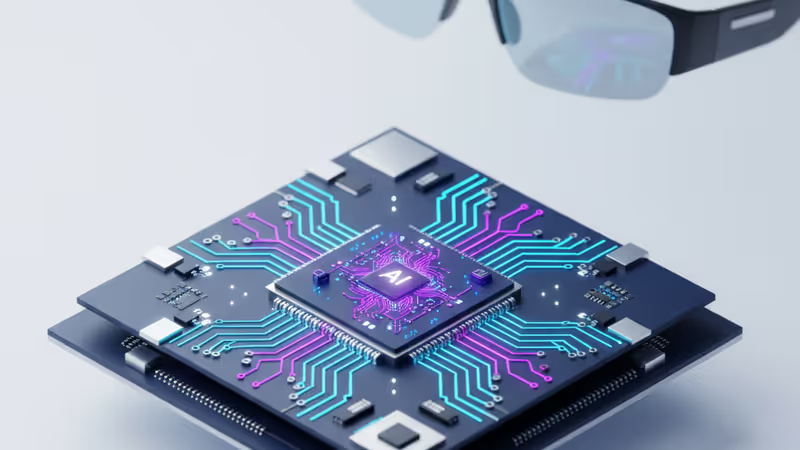
TDK AI Strategy 2026: Powering Smart Glasses and Next-Gen Data Centers
TDK CEO Noboru Saito reveals the TDK AI Strategy 2026, focusing on smart glasses and data center components to lead the AI hardware market in 2026.
It's not a question of if, but how fast the AI revolution will consume the physical world. On January 7, 2026, TDK President and CEO Noboru Saito confirmed that the Japanese electronic giant is sharpening its focus on AI-driven hardware, specifically targeting smart glasses and data center infrastructure. In an interview with Nikkei Asia, Saito emphasized that the AI ecosystem's growth is an irreversible force driving societal transformation.
TDK AI Strategy 2026: Beyond Components to AI Solutions
According to reports, TDK is ramping up investment in technologies that enhance data center efficiency. As AI models become more complex, the demand for power-efficient components has skyrocketed. TDK's move into the smart glasses market also signals a strategic shift toward wearables that could eventually rival the smartphone. Saito noted that the key challenge for the industry is managing the steepness of this growth rather than questioning its continuity.

Hardware as the New AI Bottleneck
Industry observers point out that TDK's strategy aligns with a broader trend where hardware specialists are becoming the new kingmakers. From Meta acquiring AI startups to Samsung optimizing circuit boards for AI phones, the focus is shifting to the physical layers that enable large-scale intelligence. TDK aims to capture this market by providing the essential, high-precision parts that sustain massive server farms and compact consumer devices alike.
Authors
Related Articles
Two ex-Apple engineers built an AI puck that only listens when you press it. At $179, Button is a deliberate bet that dedicated AI hardware beats the Swiss Army knife approach of smartphones.
A South Korean startup called Absolics is betting that glass substrates can cut AI chip energy consumption. Here's why that matters beyond the data center.
A material humans have shaped for thousands of years is about to become the backbone of next-gen AI chips. Here's why the semiconductor industry is betting on glass—and what's at stake.
Apple's new MacBook Pro prices jump up to $400 amid RAM shortages. What this means for the tech industry's AI ambitions and consumer wallets.
Two ex-Apple engineers built an AI puck that only listens when you press it. At $179, Button is a deliberate bet that dedicated AI hardware beats the Swiss Army knife approach of smartphones.
A South Korean startup called Absolics is betting that glass substrates can cut AI chip energy consumption. Here's why that matters beyond the data center.
A material humans have shaped for thousands of years is about to become the backbone of next-gen AI chips. Here's why the semiconductor industry is betting on glass—and what's at stake.
Apple's new MacBook Pro prices jump up to $400 amid RAM shortages. What this means for the tech industry's AI ambitions and consumer wallets.
Thoughts
Share your thoughts on this article
Sign in to join the conversation