
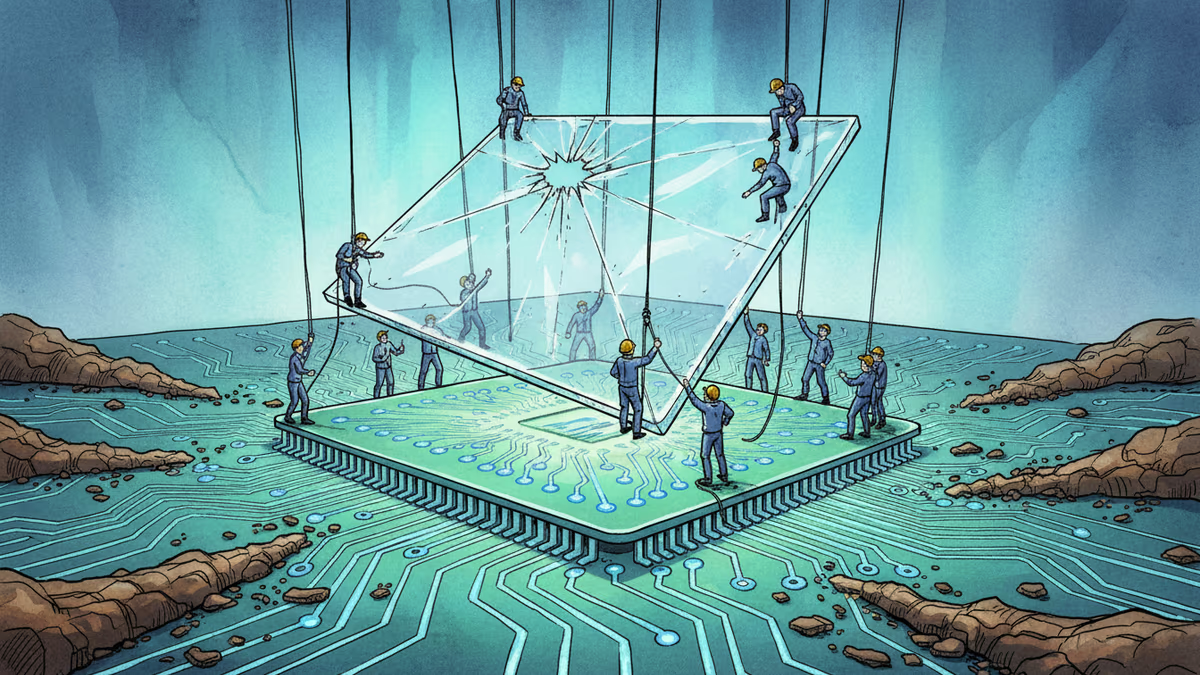
Glass Is the Unlikely Foundation of AI's Future
A material humans have shaped for thousands of years is about to become the backbone of next-gen AI chips. Here's why the semiconductor industry is betting on glass—and what's at stake.
The Chip Has a Warping Problem
A single Nvidia H100 GPU can draw up to 700 watts of power—roughly the equivalent of running six rice cookers simultaneously. Pack tens of thousands of those into an AI data center, and you don't just have a cooling problem. You have a physics problem.
As chips heat up and cool down repeatedly, the substrate beneath them—the layer that holds everything together and routes power and signals—warps. Connections shift out of alignment. Cooling becomes less efficient. Chips fail early. It's a constraint that the industry has quietly wrestled with for years, and one that's becoming harder to ignore as AI workloads keep scaling up.
The answer the semiconductor world is converging on? Glass. The same material humans have been shaping since antiquity.
Why Glass, Why Now
Since the 1990s, chip packaging has relied on organic substrates—essentially fiberglass-reinforced epoxy. They're workable, but they have limits. The material shrinks and distorts unpredictably with temperature changes, and electrochemical constraints cap how densely engineers can drill the holes that carry power and signals between chips. Intel's vice president of advanced packaging, Rahul Manepalli, puts it plainly: "We realized about a decade ago that we are going to have some limitations with organic substrates."
Glass addresses several of these limits at once. Its thermal stability allows engineers to pack in 10 times more connections per millimeter than organic substrates. That density lets chip designers cram 50% more silicon into the same package footprint—more compute, same space. The tighter power routing also reduces overall energy consumption.
Then there's smoothness. Glass can be made 5,000 times smoother than organic substrates, which cuts down on the microscopic defects that form when metal layers are deposited during manufacturing. Defects that, in current designs, can degrade performance or render a chip unusable entirely.
Longer term, glass opens a door that organic substrates can't: optical signal pathways. Because glass guides light, designers could eventually route data signals through the substrate itself using photons instead of copper wires. AMD senior fellow Deepak Kulkarni says this holds "enormous potential for the future of energy-efficient AI compute"—light-based signaling consumes far less power than the copper interconnects currently doing that job.

Fragile by Nature, Formidable by Design
None of this comes easily. Glass substrates for data center chips are only 700 micrometers to 1.4 millimeters thick—thin enough to crack or shatter under the stresses of semiconductor manufacturing. In Intel's early testing phases, hundreds of glass panels were cracking every couple of days. Years of engineering work went into developing the tools and handling techniques to make the process reliable.
By early 2025, Intel's R&D teams had reached a milestone: a functional device built on a glass core substrate that could boot the Windows operating system. It's a small-sounding achievement that represents a significant leap from the lab bench to something resembling a manufacturable product.
The Commercial Race Is Already On
The furthest along in turning this research into a real business is Absolics, a subsidiary of South Korean materials company SKC. Its factory in Covington, Georgia—built in 2024 and partly funded by $175 million in grants from the US government's CHIPS for America program—is on track to begin commercial production this year. Current capacity: up to 12,000 square meters of glass panels annually, enough to supply substrates for an estimated 2 to 3 million chip packages the size of Nvidia's H100 GPU.
But Absolics isn't running alone for long. Georgia Tech research engineer Yongwon Lee says that Samsung Electronics, Samsung Electro-Mechanics, and LG Innotek have all "significantly accelerated" their glass packaging research and pilot production over the past year. "This trend suggests that the glass substrate ecosystem is evolving from a single early mover to a broader industrial race," he says.
Smaller, specialized players are also staking out positions. JNTC, a South Korean manufacturer of electrical connectors and tempered glass, opened a facility in 2025 capable of producing 10,000 semi-finished glass panels per month. It's already taking orders and plans to expand in 2026, with an additional manufacturing line in Vietnam set for 2027.
Market research firm IDTechEx estimates the semiconductor glass market could grow from $1 billion in 2025 to $4.4 billion by 2036. Yole Group analyst Bilal Hachemi, who has tracked previous—and failed—attempts to bring glass into chip packaging, notes that "this time, the ecosystem is more solid and wider; the need for glass-based technology is sharper."
What This Means Beyond the Data Center
For now, glass substrates are aimed squarely at high-performance AI chips—a market where the economics justify the added manufacturing complexity and cost. But the trajectory points further. If production costs fall far enough, the same technology could migrate into consumer laptops and mobile devices: thinner designs, longer battery life, more computing power in less space.
For investors, the supply chain implications are worth watching closely. The winners won't just be the substrate makers themselves. Demand for specialized glass materials, precision drilling equipment, and new handling tools will ripple through the broader semiconductor supply chain. Companies that have built their business around organic substrates, on the other hand, face a longer-term question about where their market goes.
Authors
Related Articles

Five stories from late September, traced to where the paper trail stops: Korea's export record, Nvidia's Hugging Face 8-K, a US-China AI channel, the UN on AI, and rising births.

The US government invested $2 billion in quantum computing startups, but Congress says the money was never authorized for that purpose. The fate of IBM-backed Anderon hangs in the balance.

Beijing added an Nvidia gaming chip to its customs ban list the same week Jensen Huang visited China with Trump. Here's what it means for the chip war—and who actually wins.
TSMC has signed a 30-year power purchase agreement for 100% of output from Taiwan's Hai Long offshore wind project. The 1GW deal reveals how chipmakers are quietly becoming energy companies.
Five stories from late September, traced to where the paper trail stops: Korea's export record, Nvidia's Hugging Face 8-K, a US-China AI channel, the UN on AI, and rising births.
The US government invested $2 billion in quantum computing startups, but Congress says the money was never authorized for that purpose. The fate of IBM-backed Anderon hangs in the balance.
Beijing added an Nvidia gaming chip to its customs ban list the same week Jensen Huang visited China with Trump. Here's what it means for the chip war—and who actually wins.
TSMC has signed a 30-year power purchase agreement for 100% of output from Taiwan's Hai Long offshore wind project. The 1GW deal reveals how chipmakers are quietly becoming energy companies.
Thoughts
Share your thoughts on this article
Sign in to join the conversation