
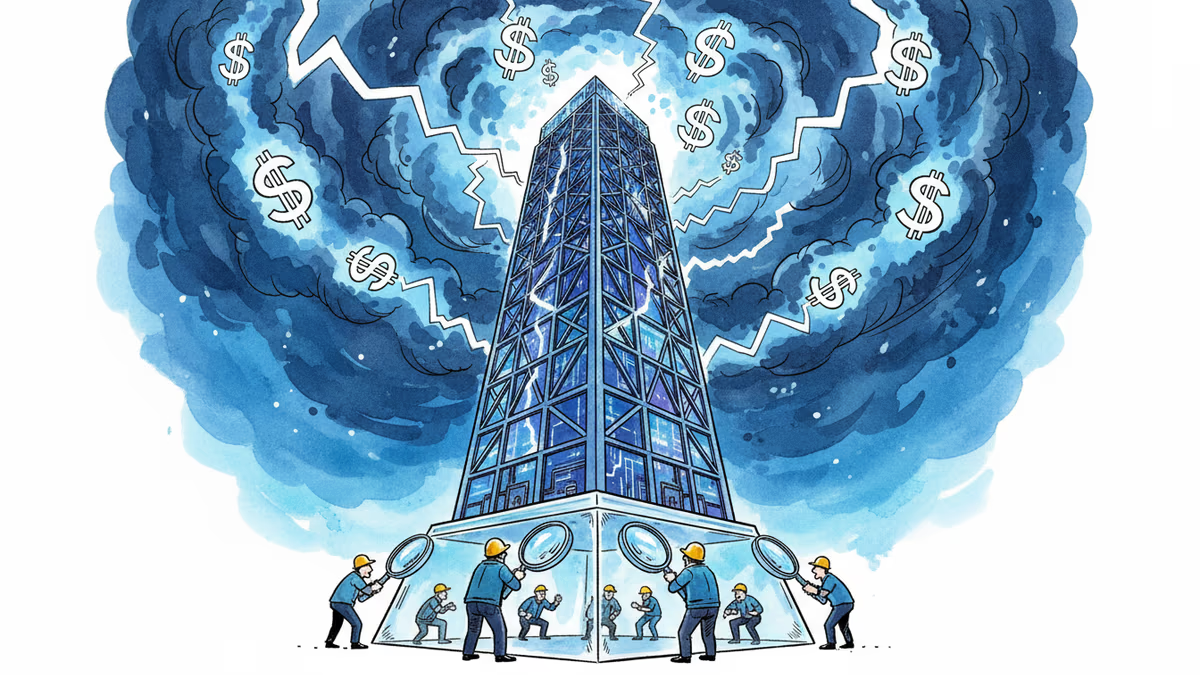
Glass Is 3,500 Years Old. It Might Just Save the AI Chip.
A South Korean startup called Absolics is betting that glass substrates can cut AI chip energy consumption. Here's why that matters beyond the data center.
Humans have been making glass since roughly 3500 BC. Now, one of civilization's oldest materials is being recruited to solve one of its newest problems: AI chips are consuming staggering amounts of energy, and the substrate they sit on might be part of the fix.
Absolics, a South Korean company, begins producing specialized glass panels for next-generation AI computing hardware this year. Intel is moving in the same direction. If the technology performs as expected, it could meaningfully reduce the energy footprint of chips in AI data centers—and eventually trickle down into laptops and smartphones.
Why Glass, and Why Now
The dominant material in chip packaging today is organic substrate—essentially a form of fiberglass laminate. It works, but it has real limitations: it warps under heat, it constrains how densely circuits can be routed, and it loses signal integrity at high frequencies. Glass addresses all three. It barely expands under thermal stress, its surface uniformity allows finer wiring, and its electrical properties reduce signal loss.
In practical terms: more computation per watt. That matters enormously right now. Training a single large AI model can consume as much electricity as thousands of average US homes use in a year. Data center operators—Microsoft, Google, Amazon—are under intense pressure to find efficiency gains wherever they can. A substrate-level improvement that doesn't require redesigning the chip itself is exactly the kind of incremental-but-scalable win the industry is hunting for.
Absolics is a subsidiary of SKC, part of South Korea's SK Group, which already has deep roots in semiconductor materials supply chains. This isn't a moonshot bet from a garage startup—it's a calculated move by an established materials player into a gap that the industry has been circling for years.
Who Wins, Who Worries

The existing organic substrate market is dominated by Japanese manufacturers like Ibiden and Shinko Electric. A successful glass transition would put direct pressure on their business. For Korean materials companies, it's an opening.
For chip designers and data center operators, the calculus is simpler: if glass substrates deliver on efficiency promises, adoption becomes a cost question, not a technology question. The energy savings at hyperscale could justify the transition even if glass panels cost more per unit.
For investors, this is a reminder that AI infrastructure plays aren't just Nvidia and TSMC. The materials and packaging layer—less glamorous, less covered—is where supply chain leverage quietly accumulates. The global semiconductor packaging market is projected to exceed $60 billion by 2030, and substrate materials are a meaningful slice of that.
There's a broader policy angle too. The same week Absolics made news, analysts in Washington were debating whether the National Semiconductor Technology Center should pursue a conservative five-year strategy to preserve America's current edge—or swing for longer-term moonshots in quantum, neuromorphic, and reversible computing. Glass substrates sit in an interesting middle ground: near-term commercializable, yet structurally significant enough to reshape the energy economics of AI at scale.
The Quiet Arms Race Beneath the Chip
Most AI coverage focuses on model benchmarks and GPU counts. But the physical stack underneath—how chips are packaged, connected, and cooled—is increasingly where competitive differentiation lives. TSMC's advanced packaging (CoWoS) is already a bottleneck for Nvidia's H100 supply. Glass substrates are the next layer of that same conversation.
The irony is worth sitting with: as AI models grow more abstract and software-defined, the physical constraints of matter—heat, signal loss, power draw—keep asserting themselves. Every generation of computing has eventually hit a materials wall. The question is always who finds the next material first.
Authors
Related Articles

Five stories from late September, traced to where the paper trail stops: Korea's export record, Nvidia's Hugging Face 8-K, a US-China AI channel, the UN on AI, and rising births.

The US government invested $2 billion in quantum computing startups, but Congress says the money was never authorized for that purpose. The fate of IBM-backed Anderon hangs in the balance.

Beijing added an Nvidia gaming chip to its customs ban list the same week Jensen Huang visited China with Trump. Here's what it means for the chip war—and who actually wins.
TSMC has signed a 30-year power purchase agreement for 100% of output from Taiwan's Hai Long offshore wind project. The 1GW deal reveals how chipmakers are quietly becoming energy companies.
Five stories from late September, traced to where the paper trail stops: Korea's export record, Nvidia's Hugging Face 8-K, a US-China AI channel, the UN on AI, and rising births.
The US government invested $2 billion in quantum computing startups, but Congress says the money was never authorized for that purpose. The fate of IBM-backed Anderon hangs in the balance.
Beijing added an Nvidia gaming chip to its customs ban list the same week Jensen Huang visited China with Trump. Here's what it means for the chip war—and who actually wins.
TSMC has signed a 30-year power purchase agreement for 100% of output from Taiwan's Hai Long offshore wind project. The 1GW deal reveals how chipmakers are quietly becoming energy companies.
Thoughts
Share your thoughts on this article
Sign in to join the conversation