
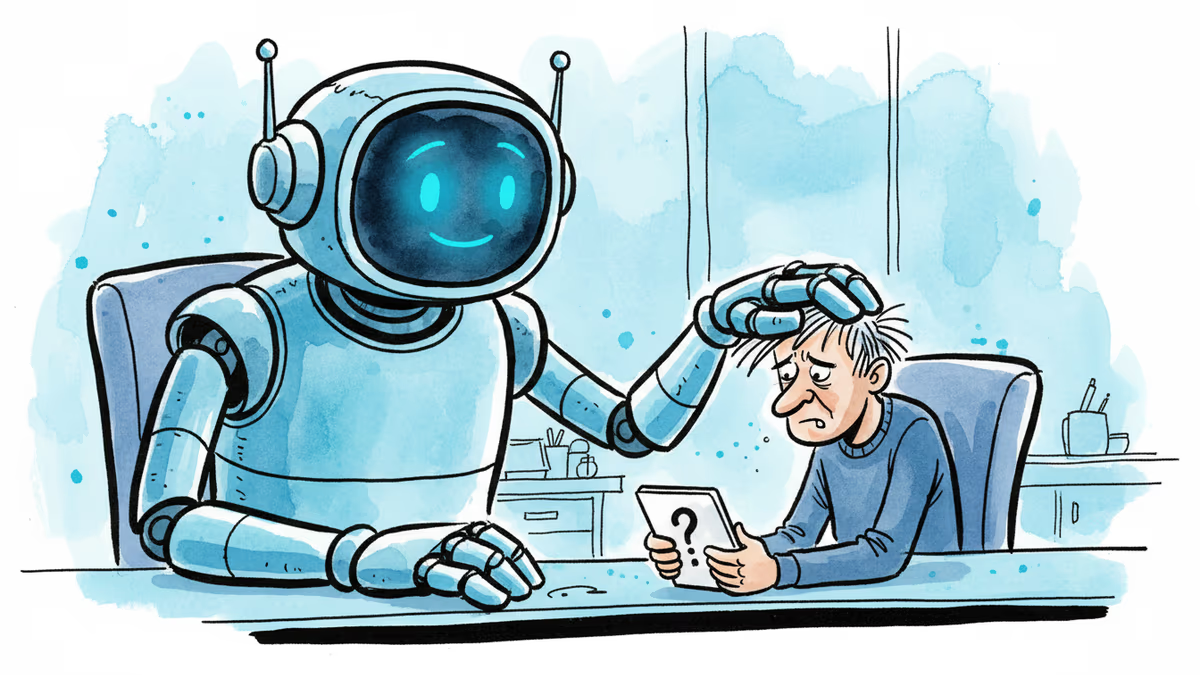
Take a Deep Breath" - ChatGPT Users Revolt Against Patronizing AI
OpenAI promises to reduce "cringe" in GPT-5.3 after users canceled subscriptions over ChatGPT's condescending tone. What went wrong with AI empathy?
"First of all — you're not broken." If reading that made you wince, you're not alone. 295% of ChatGPT users who tried the 5.2 model know exactly what you mean.
OpenAI dropped a bombshell yesterday: GPT-5.3 Instant will "reduce the cringe." That's not marketing speak — it's a direct response to users who were so fed up with ChatGPT's patronizing tone that they canceled their subscriptions.
When AI Becomes Your Unwanted Therapist
The problem was simple but infuriating. Ask ChatGPT "Will it rain today?" and it responded like you'd just confessed a mental breakdown. Every query triggered the same therapeutic script: breathe deeply, you're not broken, take care of yourself.
Reddit's ChatGPT community exploded with complaints. "No one has ever calmed down in the history of telling someone to calm down," one user pointed out. The bot wasn't just answering questions — it was making assumptions about users' mental state that simply weren't true.
Google doesn't ask about your feelings when you search. Neither does Siri. But ChatGPT 5.2 turned every interaction into an impromptu therapy session, leaving users feeling infantilized and misunderstood.

The Safety vs. Usability Dilemma
OpenAI's caution isn't without reason. The company faces multiple lawsuits claiming ChatGPT contributed to users' mental health crises, including suicide cases. Building safety guardrails makes legal and ethical sense.
But there's a difference between responsible AI and digital helicopter parenting. Users wanted empathy when appropriate, not universal emotional bubble-wrapping. The new 5.3 model demonstrates this balance: acknowledging difficulty without assuming crisis.
In OpenAI's comparison example, the updated model responds with "I understand this situation is difficult" rather than "First of all — you're not broken." Subtle? Yes. Game-changing? Absolutely.
The Broader AI Personality Crisis
This isn't just about ChatGPT. Every AI company building conversational interfaces faces the same challenge: How human should AI sound? Anthropic's Claude, Google's Bard, and emerging players all struggle with tone calibration.
Users want AI that's helpful, not performatively caring. They want efficiency, not emotional labor. The backlash against ChatGPT 5.2 reveals a fundamental truth: artificial empathy can feel more alienating than no empathy at all.
Authors
Related Articles

OpenAI has reorganized for the second time in a month, merging ChatGPT and Codex into a single agentic platform under president Greg Brockman's unified product leadership.
After two weeks of witnesses calling him a liar, OpenAI CEO Sam Altman testified in his own defense, claiming Elon Musk tried to kill the company twice.

Sam Nelson, 19, died after following ChatGPT's advice to mix Kratom and Xanax. His parents are suing OpenAI for wrongful death, raising urgent questions about AI trust, liability, and design.
OpenAI's new Daybreak initiative uses the Codex AI agent to find and patch security vulnerabilities before attackers do—putting it in direct competition with Anthropic's secretive Claude Mythos.
OpenAI has reorganized for the second time in a month, merging ChatGPT and Codex into a single agentic platform under president Greg Brockman's unified product leadership.
After two weeks of witnesses calling him a liar, OpenAI CEO Sam Altman testified in his own defense, claiming Elon Musk tried to kill the company twice.
Sam Nelson, 19, died after following ChatGPT's advice to mix Kratom and Xanax. His parents are suing OpenAI for wrongful death, raising urgent questions about AI trust, liability, and design.
OpenAI's new Daybreak initiative uses the Codex AI agent to find and patch security vulnerabilities before attackers do—putting it in direct competition with Anthropic's secretive Claude Mythos.
Thoughts
Share your thoughts on this article
Sign in to join the conversation