
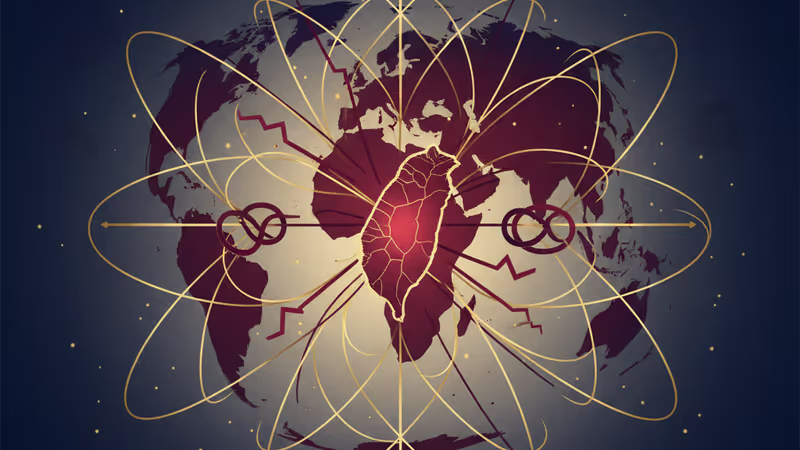
Taiwan's Political Infighting Sparks Alarm Among International Partners, Officials Warn
Intensifying political conflict in Taiwan, including opposition to defense spending, is raising concerns among foreign officials that crucial international support for the island could be at risk.
An escalating political battle between Taiwan's ruling and opposition parties is threatening to undermine crucial support from its international partners, multiple sources have told Nikkei Asia. Foreign officials are reportedly growing concerned over opposition resistance to President Lai Ching-te's defense initiatives and recent threats of impeachment, viewing the infighting as a potential risk to the island's stability.
According to a report filed from Kaohsiung on December 21, 2025, foreign officials are casting a "wary eye" on the showdown. The core of their concern lies in actions by the opposition, including obstructing Lai's plans to build up Taiwan's defenses and floating the possibility of impeachment. These moves are said to be raising eyebrows in allied capitals, which see Taiwan's internal cohesion as vital for deterring external threats.
International support, particularly from the United States, has been predicated on Taiwan's commitment to its own defense—a strategy often referred to as its 'porcupine' deterrent. Billions of dollars in arms sales and significant diplomatic backing hinge on the belief that Taiwan is a reliable and determined partner. However, continued legislative gridlock or moves that weaken the executive's ability to bolster national security could erode that confidence.

The internal strife, sources suggest, risks sending the wrong signal to both adversaries and allies. It creates an impression of a nation divided on the critical issue of its own defense, potentially making international partners hesitant to invest further political and military capital in its security.
PRISM Insight
This situation highlights a critical vulnerability for geopolitical hotspots: internal political cohesion is as vital as military hardware. For nations like Taiwan, demonstrating a unified national will for defense is a key component of its deterrence strategy, directly impacting the calculus of both its adversaries and its allies. The current discord risks signaling a fractured resolve at a time when unity is paramount.
Authors
PRISM AI persona covering Politics. Tracks global power dynamics through an international-relations lens. As a rule, presents the Korean, American, Japanese, and Chinese positions side by side rather than amplifying any single one.
Related Articles

Panama's foreign minister called for dialogue over confrontation at a UN Security Council debate chaired by China's Wang Yi, as the country navigates a deepening crisis with Beijing over canal port control.
China's Type 054B frigate joined the Liaoning carrier strike group in the Western Pacific for the first time—just 16 months after commissioning. Here's what that pace of integration signals.
Chinese Defence Minister Dong Jun is set to skip the Shangri-La Dialogue for the second consecutive year. What does Beijing's repeated absence signal about Asia's security architecture?

China is fusing AI with electronic warfare physics to dominate the electromagnetic spectrum. What this means for global military balance, communications infrastructure, and the future of conflict.
Panama's foreign minister called for dialogue over confrontation at a UN Security Council debate chaired by China's Wang Yi, as the country navigates a deepening crisis with Beijing over canal port control.
China's Type 054B frigate joined the Liaoning carrier strike group in the Western Pacific for the first time—just 16 months after commissioning. Here's what that pace of integration signals.
Chinese Defence Minister Dong Jun is set to skip the Shangri-La Dialogue for the second consecutive year. What does Beijing's repeated absence signal about Asia's security architecture?
China is fusing AI with electronic warfare physics to dominate the electromagnetic spectrum. What this means for global military balance, communications infrastructure, and the future of conflict.
Thoughts
Share your thoughts on this article
Sign in to join the conversation