
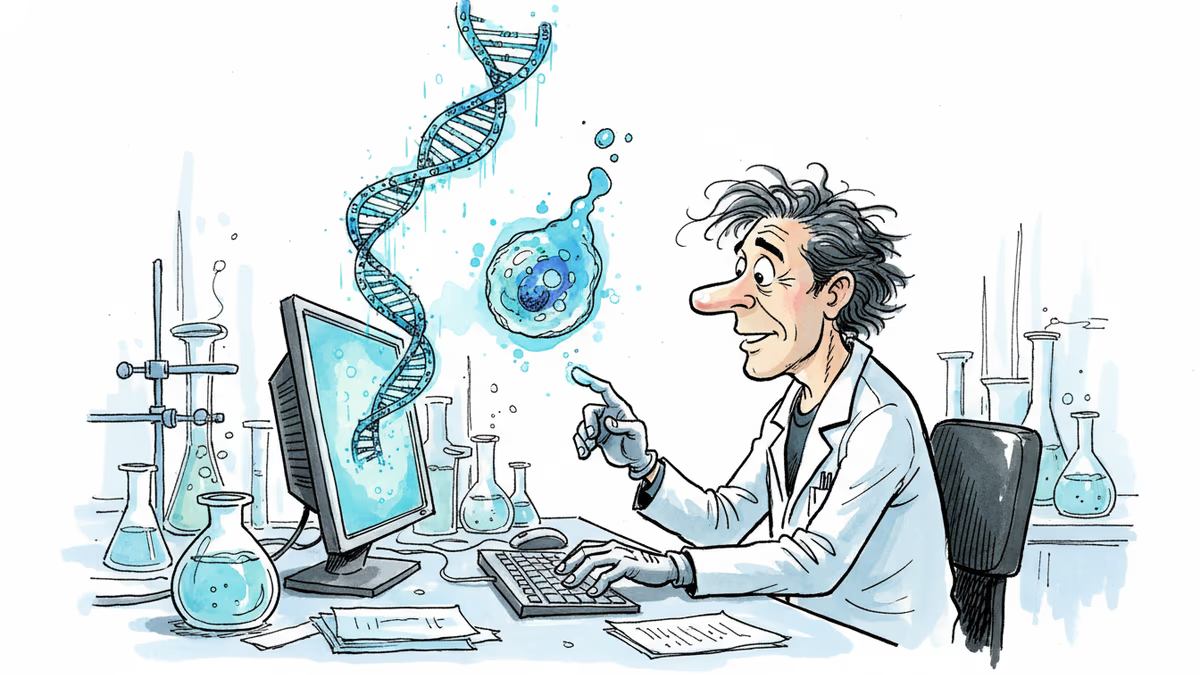
Writing Life: What Synthetic Biology Has—and Hasn't—Delivered
J. Craig Venter's death prompts a clear-eyed look at synthetic biology's 15 years of promise, progress, and stubborn limits—and the questions science still can't answer.
For most of human history, life was something you observed. In 2010, a team of scientists decided it was something you could write.
When J. Craig Venter died on April 29, 2026, the obituaries rightly noted his role in sequencing the first draft of the human genome. But the achievement that may prove more consequential came a decade later: his team built a bacterial genome on a computer, synthesized it in a lab, and used it to take control of a living cell. It wasn't life created from nothing. It was, however, the first time the instruction set for a living organism had been authored by human hands.
Fifteen years on, it's worth asking what that moment actually set in motion—and where the field stands now that its most prominent pioneer is gone.
From Reading to Rewriting
The story of modern biology is, in large part, a story of decoding. The discovery of DNA's double-helix structure in 1953 established how genetic information is stored. The Human Genome Project—which Venter helped accelerate through his private-sector sequencing effort—produced the first complete map of human genes by the early 2000s.
But Venter and others kept pushing at a different question: if DNA could be read like code, could it also be written? That question is the founding premise of synthetic biology. Rather than tweaking individual genes, researchers began asking whether entire genomes could be constructed from scratch and inserted into cells to direct their behavior.
The 2010 synthetic cell experiment answered yes—at least in principle. The genome was designed on a computer, assembled chemically in a lab, and transplanted into a bacterial cell that then functioned according to its new synthetic instructions. The host cell itself wasn't built from nonliving components, but the software running it was entirely human-made. The implication was hard to overstate: life might not only be understood but designed.
What the Field Has Actually Delivered

In the years since, synthetic biology has produced genuine, if uneven, results. Researchers have engineered microbes to manufacture artemisinin—a critical antimalarial drug—far more efficiently than traditional extraction allows. Work is underway on microbes that can detect or break down environmental pollutants, offering potential tools for cleaning contaminated sites. Sustainable biofuels derived from engineered organisms have attracted significant investment as an alternative to fossil fuels.
The U.S. Government Accountability Office has formally recognized the field's potential across medicine, energy, and environmental science. Venture capital followed the scientific excitement. For a period, the analogy that drove the field—biology as software, organisms as programs—seemed not just poetic but actionable.
The reality has been more complicated. Living systems turned out to be far less modular than early synthetic biology assumed. Gene interactions are difficult to predict; results that hold in controlled lab conditions frequently fail to scale. The biofuels sector has been the most visible example: translating laboratory successes into industrial production has proved stubbornly hard, and several high-profile companies backed by that early optimism have struggled or folded.
The most fundamental limit remains intact: scientists still cannot construct a fully living organism from nonliving components alone. Even Venter's landmark synthetic cell depended on an existing biological chassis to function. Creating life entirely from scratch—the implicit endpoint of the field's most ambitious vision—remains out of reach.
The Dual-Use Problem Grows Sharper
As the tools of synthetic biology become more accessible, a different kind of concern has moved to the foreground. The same capabilities that allow researchers to design beneficial organisms could, in principle, be used to engineer harmful ones. DNA synthesis technology has become cheaper and more widely available, lowering the barriers not just for legitimate researchers but for potential bad actors.
The field is widely described as dual-use: advances in gene editing, genome synthesis, and bioengineering carry both medical promise and biosecurity risk. Governance frameworks—national and international—have struggled to keep pace. The challenge isn't only deliberate misuse; engineered organisms released into ecosystems could cause unintended genetic contamination or disrupt biodiversity in ways that are difficult to reverse.
These concerns are likely to intensify as artificial intelligence accelerates the design of new biological systems. AI tools can already suggest novel protein structures and genetic sequences far faster than human researchers working alone. The combination of AI-assisted design and increasingly accessible synthesis technology means the gap between what's scientifically possible and what's legally or ethically governed is widening.
Different stakeholders read this landscape differently. Pharmaceutical and biotech companies see a platform for cheaper, faster drug development. Environmental groups warn of ecosystem risks from organisms that don't stay where they're put. Defense and intelligence agencies treat engineered pathogens as a growing threat category. And some philosophical and religious traditions question whether humans should be in the business of authoring life at all—a concern that tends to get less airtime in scientific literature than it does in the wider culture.
This content is AI-generated based on source articles. While we strive for accuracy, errors may occur. We recommend verifying with the original source.
Related Articles
Trump's NIH pushes to end primate research at major university centers, sparking debate over animal testing vs. cutting-edge alternatives in medical research.
As surrogacy becomes more accessible, we're forced to confront uncomfortable questions about bodily autonomy, economic inequality, and what we owe each other in the pursuit of parenthood.
Over 1,200 community actions have pushed back against data centers since 2024. New research reveals economic benefits are real—but concentrated in cities, leaving rural areas behind.
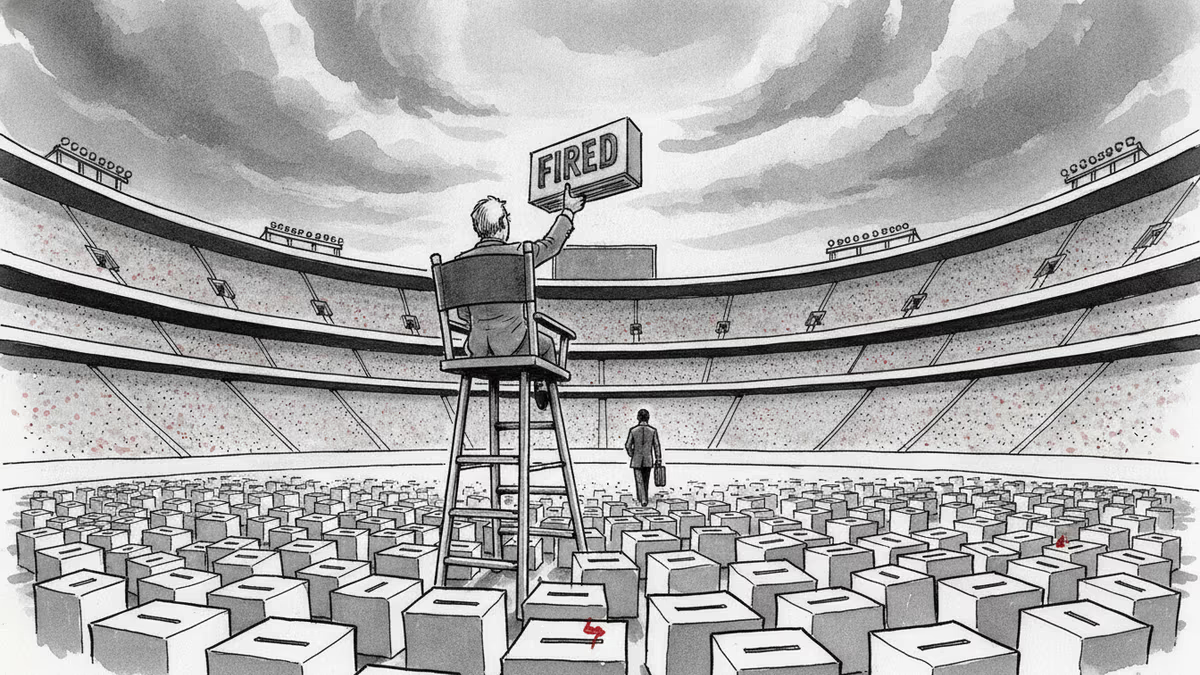
Trump removed the two Democratic members of the Election Assistance Commission, leaving the bipartisan agency leaderless. A Supreme Court ruling made it legal. Here's why a non-crisis can still be a warning sign.
Trump's NIH pushes to end primate research at major university centers, sparking debate over animal testing vs. cutting-edge alternatives in medical research.
As surrogacy becomes more accessible, we're forced to confront uncomfortable questions about bodily autonomy, economic inequality, and what we owe each other in the pursuit of parenthood.
Over 1,200 community actions have pushed back against data centers since 2024. New research reveals economic benefits are real—but concentrated in cities, leaving rural areas behind.
Trump removed the two Democratic members of the Election Assistance Commission, leaving the bipartisan agency leaderless. A Supreme Court ruling made it legal. Here's why a non-crisis can still be a warning sign.
Thoughts
Share your thoughts on this article
Sign in to join the conversation