
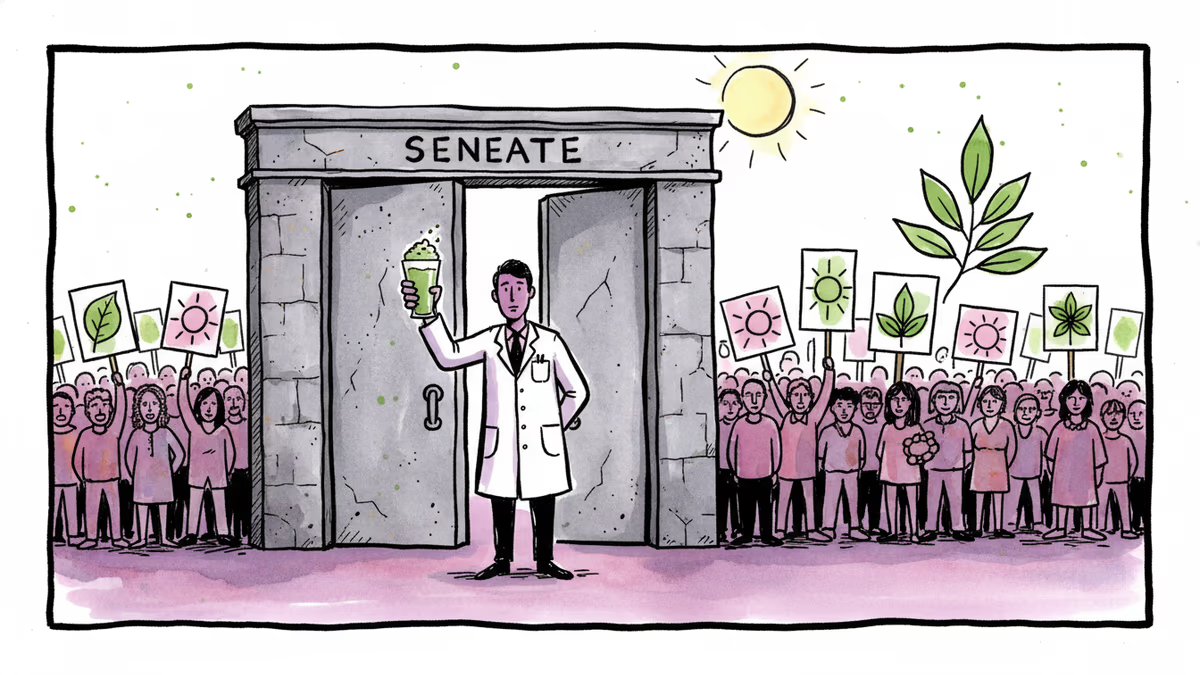
The Wellness Candidate Who Couldn't Get Confirmed
Trump withdrew Casey Means's surgeon general nomination, signaling the limits of the MAHA movement. What happens when wellness culture tries to become public health policy?
The United States almost got a surgeon general without a medical license.
On April 30, President Trump posted a brief announcement on Truth Social: he was pulling the nomination of Casey Means as the nation's top doctor. Means dropped out of her surgical residency in 2018 and reinvented herself as a wellness influencer. Her book, Good Energy, became something close to a manifesto for Robert F. Kennedy Jr.'s Make America Healthy Again movement — a sweeping critique of processed food, pharmaceutical incentives, and what she calls a broken medical establishment. One prominent MAHA activist told a reporter that failing to confirm Means would "ruin the soul of MAHA."
It was ruined, at least for now.
What Actually Blocked Her
Means's nomination had been stalled in the Senate since February. Three Republican senators — Bill Cassidy, Lisa Murkowski, and Susan Collins — made clear they had serious reservations. The White House initially tried to push through, inviting Means to a roundtable with fellow MAHA influencers just weeks ago. But by the time Trump posted his withdrawal, Means herself told reporters it had become obvious over the past week that the votes simply weren't there.
The senators' reluctance wasn't hard to understand. Means has described Americans' chronic health problems as a "spiritual crisis." She's spoken openly about using psychedelics. She's argued that pesticides and hormonal birth control reflect a "disrespect of life" — though she later clarified she meant specific cases with elevated medical risk. During a 2024 appearance on Tucker Carlson's podcast, she questioned the universal newborn hepatitis-B vaccine dose. Her close association with Kennedy, a longtime vaccine skeptic, added another layer of concern.
At her Senate confirmation hearing, Means tried to walk a careful line, telling Cassidy she believes vaccines are "a key part of any infectious-disease public-health strategy." But that carefully worded endorsement wasn't enough. She told reporters she believes concerns about the anti-vaccine wing of MAHA ultimately sank her. Trump, for his part, blamed Cassidy directly on Truth Social, accusing him of playing "political games." Cassidy's office responded simply: she "did not have the votes on committee or on the floor."
The Replacement, and What She Reveals

Trump's new pick is Nicole Saphier, a radiologist at Memorial Sloan Kettering and a Fox News contributor. The contrast is instructive.
Saphier isn't a conventional public-health nominee by any measure. She published a book in 2021 arguing the U.S. overreacted to COVID-19 for political reasons. She's endorsed Kennedy's reworked food pyramid and praised whole milk, positions that nutrition experts have received with skepticism. But she's vaccinated patients, advocates for standard cancer treatments, has spoken in favor of measles and polio vaccines, and publicly questioned Defense Secretary Pete Hegseth's decision to repeal the military's flu-vaccine mandate. Compared to the loudest voices in MAHA, she's practically an institutionalist.
The choice of Saphier tells you something about where the White House actually wants to land: close enough to Kennedy's brand to keep MAHA activists engaged, but far enough from the fringe to survive a Senate vote.
When Wellness Culture Meets Institutional Power
Means's defeat is worth examining beyond the politics of one nomination.
The wellness movement that produced her has spent the last decade building a remarkably effective critique of American medicine. U.S. chronic disease rates are among the highest in the developed world. Healthcare spending as a share of GDP is unmatched globally. Trust in pharmaceutical companies and federal health agencies has eroded sharply since the pandemic. Means didn't invent these grievances — she packaged them for an audience that already felt them.
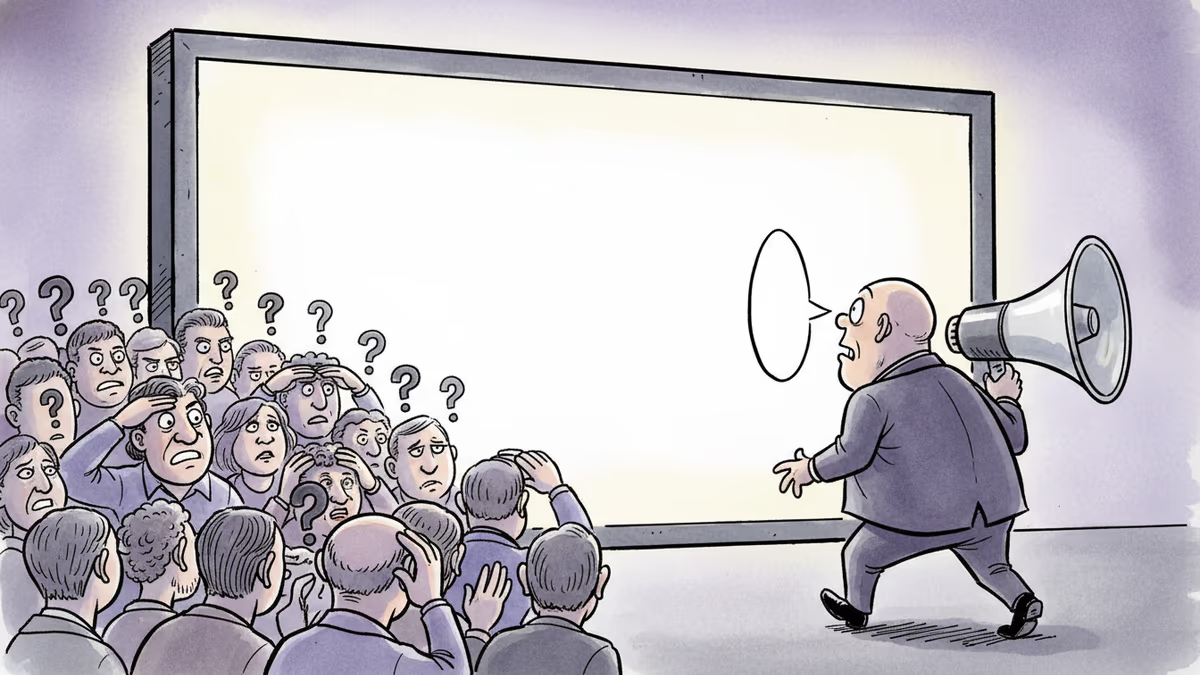
But there's a meaningful difference between the language of wellness culture and the language of public health policy. Wellness influencers speak to individuals: optimize your biology, question what you've been told, take back control of your body. It's persuasive precisely because it's personal. Public health policy, by contrast, operates at the population level — where individual choices interact with herd immunity, food supply regulation, and liability frameworks. The Senate, whatever its other flaws, was essentially asking: can this person translate between those two registers? The answer, apparently, was no.
Means herself rejected that framing, describing her defeat as a win for "the status quo." That's a coherent position. But it sidesteps the harder question: which parts of the status quo deserve challenging, and which parts exist because dismantling them would cause measurable harm?
MAHA's broader momentum has visibly slowed. A judge issued a preliminary ruling last month against several of Kennedy's most aggressive anti-vaccine moves at HHS. The White House has reportedly asked Kennedy to stop discussing vaccines publicly ahead of the midterms. An executive order signed in February could extend liability protection to glyphosate manufacturers — the opposite of what MAHA activists wanted. The CDC has a new director nominee with conventional public-health credentials.
At the end of his 2024 campaign, Trump promised to let Kennedy "go wild on health." The last few months suggest the administration has decided that wild has limits.
This content is AI-generated based on source articles. While we strive for accuracy, errors may occur. We recommend verifying with the original source.
Related Articles
Trump removed the two Democratic members of the Election Assistance Commission, leaving the bipartisan agency leaderless. A Supreme Court ruling made it legal. Here's why a non-crisis can still be a warning sign.
Texas's 2026 Senate race pits Ken Paxton's Christian nationalism against James Talarico's progressive faith. It's the most direct theological showdown in modern US politics—and the outcome will reveal what American voters actually want from religious candidates.
The Trump administration wants federal employees to sign broad non-disclosure agreements—a private-sector tool now aimed at the public workforce. What happens when government runs like a corporation?
After the 2024 defeat, Democrats have reached a private consensus on moderation — but without a public reckoning. Can a 'vibe shift' actually rebuild a party brand?
Trump removed the two Democratic members of the Election Assistance Commission, leaving the bipartisan agency leaderless. A Supreme Court ruling made it legal. Here's why a non-crisis can still be a warning sign.
Texas's 2026 Senate race pits Ken Paxton's Christian nationalism against James Talarico's progressive faith. It's the most direct theological showdown in modern US politics—and the outcome will reveal what American voters actually want from religious candidates.
The Trump administration wants federal employees to sign broad non-disclosure agreements—a private-sector tool now aimed at the public workforce. What happens when government runs like a corporation?
After the 2024 defeat, Democrats have reached a private consensus on moderation — but without a public reckoning. Can a 'vibe shift' actually rebuild a party brand?
Thoughts
Share your thoughts on this article
Sign in to join the conversation