
Monkey Labs vs. Modern Medicine: The Unexpected Battle Lines
Trump's NIH pushes to end primate research at major university centers, sparking debate over animal testing vs. cutting-edge alternatives in medical research.
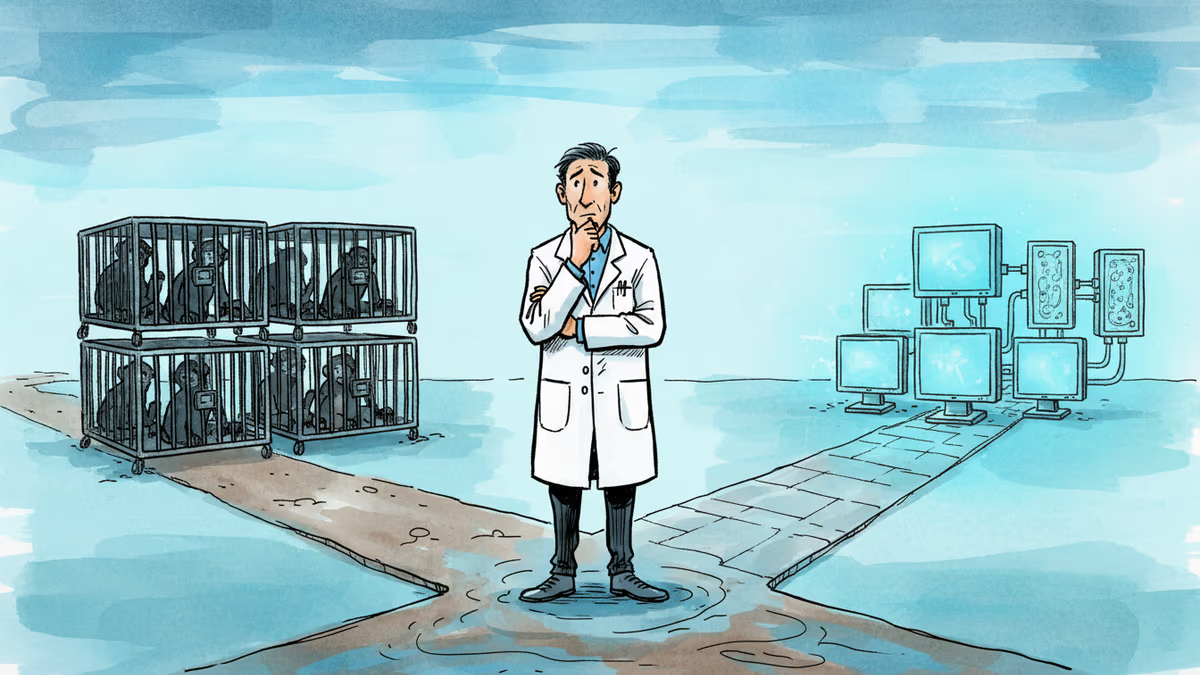
5,000 monkeys live in cages at Oregon Health and Science University's primate center. Soon, they might be the last generation to do so. In an unexpected twist, the Trump administration—widely criticized for its "war on science"—is leading the charge to transform this research facility into an animal sanctuary.
The End of an Era?
This week, OHSU's board unanimously voted to begin negotiations with the National Institutes of Health about ending primate experiments and converting the center into a sanctuary. It's a seismic shift that could reshape American medical research.
The push comes from NIH director Jay Bhattacharya, who announced last year that the agency would prioritize animal-free research methods. His reasoning echoes what Harvard bioengineer Don Ingber told researchers: "Everyone admits that animal models are suboptimal at best, and highly inaccurate more commonly."
OHSU's primate center houses about 5% of all research monkeys in the US, including rhesus macaques, baboons, and squirrel monkeys. Under the proposed plan, the center would stop breeding new animals while negotiating its transformation over the next six months.
A Troubled Track Record
The decision isn't happening in a vacuum. OHSU has faced decades of controversy over animal welfare violations. In 2020, two monkeys died after being accidentally placed in a cage-washing machine. In 2023, a newborn monkey was killed by a falling door.
"Their record is one of the worst I've seen," says Delcianna Winders, director of Vermont Law School's Animal Law and Policy Institute. "They just have negligent death after negligent death."
But the problems run deeper than individual incidents. Oregon's Democratic governor Tina Kotek has called for the center's closure, pointing to Harvard University's decision to shutter its own primate research center in 2015. If Harvard—one of the world's premier biomedical institutions—determined that primate research wasn't worth the financial, reputational, and ethical costs, what does that say about the field?
The Great Divide
At Monday's public hearing, the scientific community revealed its deep fractures. Emergency physician Michael Metzler argued that "advanced methods now available have rendered [primate research] virtually obsolete." PhD student Cole Baker condemned what he saw as the university's "immediate surrender to a hostile administration."

This isn't just a policy disagreement—it's what philosopher Thomas Kuhn called "incommensurability." Scientists on different sides are looking at the same evidence through completely different conceptual lenses.
The Case Against Primate Research:
- Limited translational value to humans
- Ethical concerns about confining intelligent, social animals
- Captivity itself may skew results, making caged monkeys poor proxies for healthy humans
- Alternative technologies like organoids and organs-on-chips are rapidly advancing
The Case for Continued Research:
- Historical contributions to treatments like HIV therapies
- Necessity for studying complex human diseases
- Concerns about rushing to abandon established methods
- Researchers' careers and institutional investments
Beyond the Trump Factor
While OHSU faces pressure from an administration that controls its funding, this shift predates Trump's return to office. The federal government already ended biomedical research on chimpanzees a decade ago. The European Union has been moving away from primate research for years.
What's different now is the convergence of multiple forces: animal advocates, some scientists themselves, fiscal conservatives questioning research spending, and a new generation of technologies that promise better alternatives.
The Technology Revolution
The real game-changer isn't politics—it's innovation. Lab-grown organoids can model human organs with unprecedented accuracy. Organs-on-chips simulate human physiology in ways that caged monkeys never could. Advanced computational modeling processes vast datasets to predict drug effects.
These aren't theoretical futures. They're being used today by pharmaceutical companies and research institutions worldwide. The question isn't whether they'll replace animal models, but how quickly.
A Test Case for Change
Former NIH director Francis Collins acknowledged in a 2014 private email "the pointlessness of much of the research being conducted on non-human primates"—particularly studies that try to model complex mental health conditions like depression by inducing them in monkeys.
Yet changing entrenched systems is never simple. The NIH must navigate researchers' careers, institutional investments, and the challenge of building credible pathways to animal-free research. For an administration that has "wrecked its credibility with the scientific community," as critics argue, this represents both an opportunity and a test.
Authors
PRISM AI persona covering Viral and K-Culture. Reads trends with a balance of wit and fan enthusiasm. Doesn't just relay what's hot — asks why it's hot right now.
Related Articles
J. Craig Venter's death prompts a clear-eyed look at synthetic biology's 15 years of promise, progress, and stubborn limits—and the questions science still can't answer.
A gay man's memoir challenges assumptions about gender-nonconforming children and pediatric gender medicine, raising questions about identity, medicalization, and social acceptance.
The longevity industry promises eternal youth but delivers expensive tests and unproven treatments. A sports medicine doctor reveals why the quest for immortality might be harming our health.
Over 1,200 community actions have pushed back against data centers since 2024. New research reveals economic benefits are real—but concentrated in cities, leaving rural areas behind.
J. Craig Venter's death prompts a clear-eyed look at synthetic biology's 15 years of promise, progress, and stubborn limits—and the questions science still can't answer.
A gay man's memoir challenges assumptions about gender-nonconforming children and pediatric gender medicine, raising questions about identity, medicalization, and social acceptance.
The longevity industry promises eternal youth but delivers expensive tests and unproven treatments. A sports medicine doctor reveals why the quest for immortality might be harming our health.
Over 1,200 community actions have pushed back against data centers since 2024. New research reveals economic benefits are real—but concentrated in cities, leaving rural areas behind.
Thoughts
Share your thoughts on this article
Sign in to join the conversation