
Switch 2's Storage Dilemma: When Faster Means Pricier
Nintendo Switch 2 requires expensive microSD Express cards instead of regular microSD. 4.4x faster speeds come with 2x higher prices - what this means for gamers and the industry.
$200 for 1TB? The Hidden Cost of Nintendo's Next Console
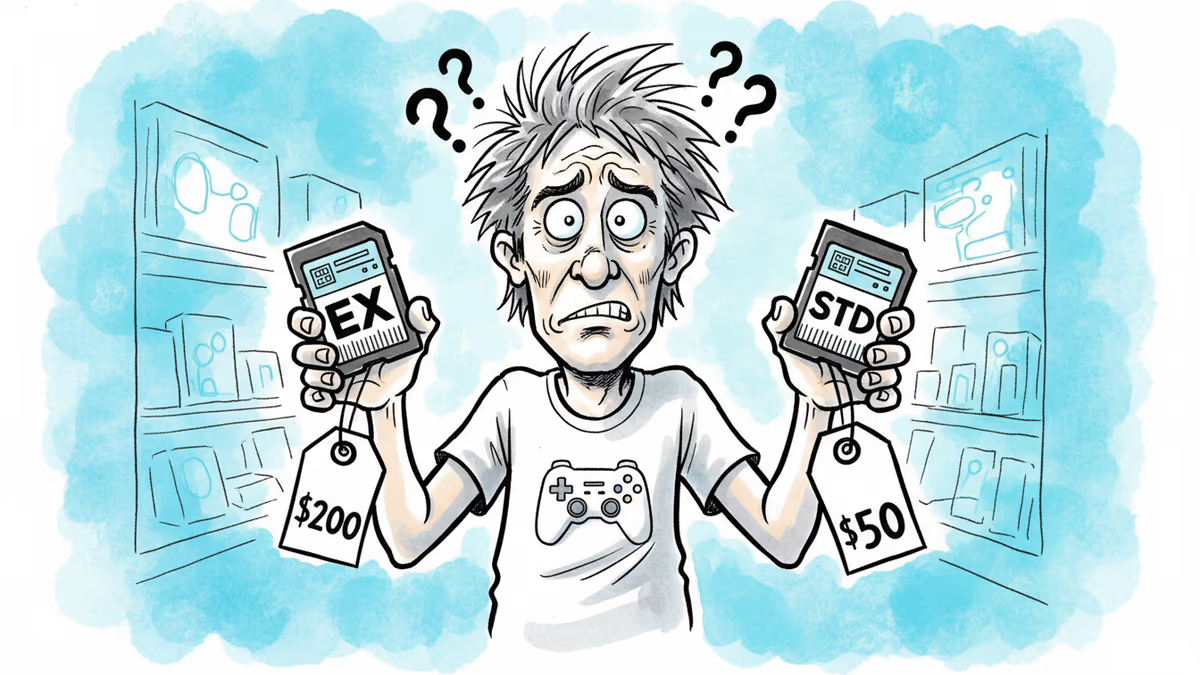
Your old microSD cards won't work with the Nintendo Switch 2. That innocuous-looking "EX" label etched on the new microSD Express cards represents more than just a 4.4x speed boost – it's a gateway to significantly higher storage costs.
While the Switch 2 comes with 256GB of built-in storage, modern games with detailed textures and expansive worlds will quickly fill that space. The cheapest 1TB microSD Express card costs nearly $200, with 512GB models ranging from $75 to $100. Compare that to regular microSD cards, where 1TB can be found for under $80.
The Performance Paradox: Better Gaming, Bigger Bills
The speed increase isn't just marketing fluff. Switch 2 games demand faster data transfer to handle enhanced graphics and larger game worlds without stuttering. Nintendo's choice of microSD Express ensures smooth gameplay, but creates a new barrier to entry.
Interestingly, all microSD Express cards perform identically regardless of brand. Samsung, SanDisk, Lexar, and even Walmart's budget Onn brand deliver the same speeds. The recommendation? Buy the cheapest option from a trusted retailer with good warranty support.

Current best deals hover around $35 for 256GB and $75 for 512GB during sales, though regular pricing runs significantly higher.
Gaming's New Economics: Premium Experience, Premium Price
This shift reflects a broader trend in gaming hardware. As consoles become more powerful, the ecosystem costs rise beyond the initial purchase price. Game developers can now design with larger file sizes and faster loading in mind, but consumers face a more expensive entry point for the "complete" experience.
The timing is particularly challenging. With inflation affecting household budgets, adding $75-200 for adequate storage on top of the console price creates a steeper adoption curve. This could slow initial sales or push some consumers toward physical game cartridges – ironically making an "old" technology more appealing.
Market Response: Adaptation or Resistance?
Retailers are already adjusting. GameStop offers microSD Express cards up to 1TB, while Walmart's aggressive pricing on its Onn brand suggests a race to make the technology more accessible.
The real test comes when casual gamers – Nintendo's core audience – encounter this requirement. Will they absorb the additional cost, or will Nintendo face pressure to bundle larger storage or subsidize card prices?
Authors
Related Articles
Pokémon Champions launched on Switch with bugs breaking core battle mechanics. But the deeper issue isn't the bugs — it's whether a game trying to please all players can satisfy any of them.

Xreal and Viture's latest AR glasses all do a few things well and a few things poorly. Here's what the best pair would look like — and why none of them are there yet.
Nine months after a record-breaking launch, Nintendo is cutting Switch 2 production from 6 million to 4 million units per quarter. What went wrong, and what does it signal for the console market?

Generative AI tools dominated GDC 2026 — but most developers aren't shipping them in real games. What's holding the industry back, and what does that gap reveal?
Pokémon Champions launched on Switch with bugs breaking core battle mechanics. But the deeper issue isn't the bugs — it's whether a game trying to please all players can satisfy any of them.
Xreal and Viture's latest AR glasses all do a few things well and a few things poorly. Here's what the best pair would look like — and why none of them are there yet.
Nine months after a record-breaking launch, Nintendo is cutting Switch 2 production from 6 million to 4 million units per quarter. What went wrong, and what does it signal for the console market?
Generative AI tools dominated GDC 2026 — but most developers aren't shipping them in real games. What's holding the industry back, and what does that gap reveal?
Thoughts
Share your thoughts on this article
Sign in to join the conversation