
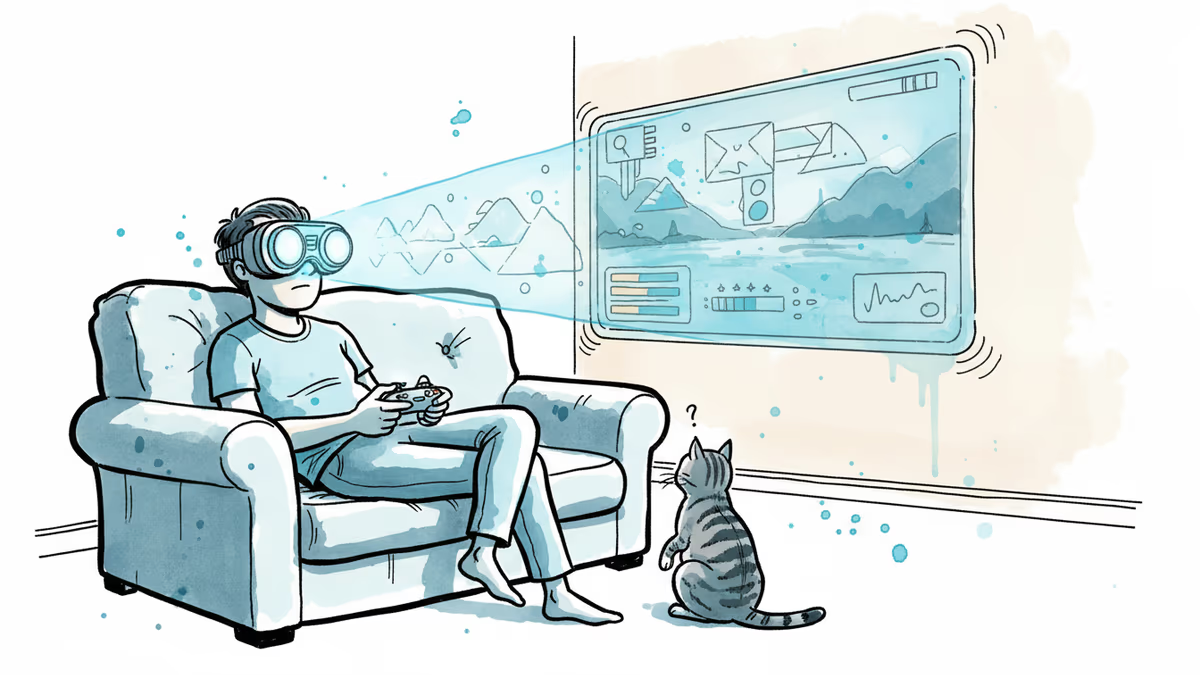
No Perfect AR Glasses Yet — But We're Getting Closer
Xreal and Viture's latest AR glasses all do a few things well and a few things poorly. Here's what the best pair would look like — and why none of them are there yet.
You're lying on your couch. To everyone else in the room, you're just staring at a wall. But through a pair of glasses, you're looking at what feels like a 170-inch screen floating in mid-air, running your Steam Deck.
That's the pitch for AR glasses as a gaming peripheral — and in 2026, it's finally close to working. The operative word being close.
After months of nightly testing with three of the most popular AR glasses on the market — Xreal's$4491S, its $649One Pro, and Viture's$549Beast — the conclusion is both simple and frustrating: there is no best pair. Each one wins in a different category and stumbles in another. The perfect AR glasses for gaming would need to be assembled from parts that don't yet exist in a single device.
What's Actually New: 3DoF Changes Everything (Almost)
AR glasses as portable displays aren't new. What's new is 3DoF — three degrees of freedom — the ability to anchor your virtual screen in space so it doesn't wobble every time you move your head. Earlier generations of AR glasses were essentially strapped screens: wherever your head went, the display followed. The result was nauseating for anything longer than a short session.
With 3DoF, you can look away, shift in your seat, or crane your neck — and the screen stays put, floating in the same spot in the room. It's a small change in description and a large change in usability.
But here's the catch: not all 3DoF implementations are equal. Xreal's version actually works. When you anchor the screen, it stays anchored. Viture's Beast technically offers the feature, but the screen slowly drifts out of view during use. For a feature that's arguably the main reason to buy these glasses in 2026, that's not a minor bug — it's a dealbreaker.
A Tale of Three Trade-offs

Comfort and audio go to Xreal. The 1S weighs just 85 grams versus the Beast's 96 grams — an 11-gram gap that becomes meaningful after a long gaming session. The temple arms are thinner and better balanced, reducing ear strain. Audio, tuned by Bose, delivers real low-end punch that makes games and music genuinely enjoyable at low volumes. Viture'sHarman-tuned audio leans mid and high, sounding comparatively thin.
Picture quality goes to Viture. All three use Sony micro-OLED panels, but the Beast's optics do a better job of cutting reflections and preserving contrast across environments. The blacks are deep, the highlights pop, and it holds up in bright rooms where the Xreal 1S visibly struggles — its OLEDs wash out in ambient light, making images look closer to LCD quality. The One Pro matches the Beast in picture quality but typically costs $100 more.
Build quality and polish go to Xreal. The hinges on Xreal's glasses snap firmly into place. The Beast's temple arms swing open loosely and feel cheap by comparison. Connection speed to devices is also faster on Xreal by a few seconds — a small thing that accumulates into a better overall experience.
The Nintendo Problem Nobody Solved
If you own a Nintendo Switch 2, neither brand has a clean answer for you. Nintendo's hardware design means no AR glasses can connect via a single USB-C cable — a dock is required.
Xreal announced a dedicated Neo charging dock at CES 2026, then quietly canceled it due to reliability issues. Switch 2 owners with Xreal glasses are currently left hunting for third-party solutions. Viture, meanwhile, sells a $130 Pro Mobile Dock that works seamlessly with the Switch 2 and doubles as a 13,000mAh battery pack. It also has a full HDMI port for console passthrough. It's not cheap, but it's a complete solution — which Xreal currently can't offer.
Who Should Actually Buy These?
At $449–$649 plus potential accessories, these aren't impulse purchases. The honest use case is narrower than the marketing suggests.
Frequent travelers who want a private, large-screen experience on planes or in hotel rooms will get real value. So will people in small apartments who want a cinematic setup without a TV. For everyone else — especially those who already own a large display at home — the value proposition thins considerably.
The broader question is whether this category is in a transitional phase or a permanent niche. AR glasses as gaming peripherals sit in an awkward middle ground: too specialized for mainstream adoption, but too promising for enthusiasts to ignore. The $400-plus price point hasn't moved much in two years, and neither has the fundamental limitation — no single pair does everything well.
Authors
Related Articles

Xreal's Project Aura debuted at Google I/O with OLED displays, hand tracking, and an IPO on the horizon. The industry has burned billions for a decade. So why does it feel like something has actually shifted?
Pokémon Champions launched on Switch with bugs breaking core battle mechanics. But the deeper issue isn't the bugs — it's whether a game trying to please all players can satisfy any of them.
Nine months after a record-breaking launch, Nintendo is cutting Switch 2 production from 6 million to 4 million units per quarter. What went wrong, and what does it signal for the console market?

Generative AI tools dominated GDC 2026 — but most developers aren't shipping them in real games. What's holding the industry back, and what does that gap reveal?
Xreal's Project Aura debuted at Google I/O with OLED displays, hand tracking, and an IPO on the horizon. The industry has burned billions for a decade. So why does it feel like something has actually shifted?
Pokémon Champions launched on Switch with bugs breaking core battle mechanics. But the deeper issue isn't the bugs — it's whether a game trying to please all players can satisfy any of them.
Nine months after a record-breaking launch, Nintendo is cutting Switch 2 production from 6 million to 4 million units per quarter. What went wrong, and what does it signal for the console market?
Generative AI tools dominated GDC 2026 — but most developers aren't shipping them in real games. What's holding the industry back, and what does that gap reveal?
Thoughts
Share your thoughts on this article
Sign in to join the conversation