
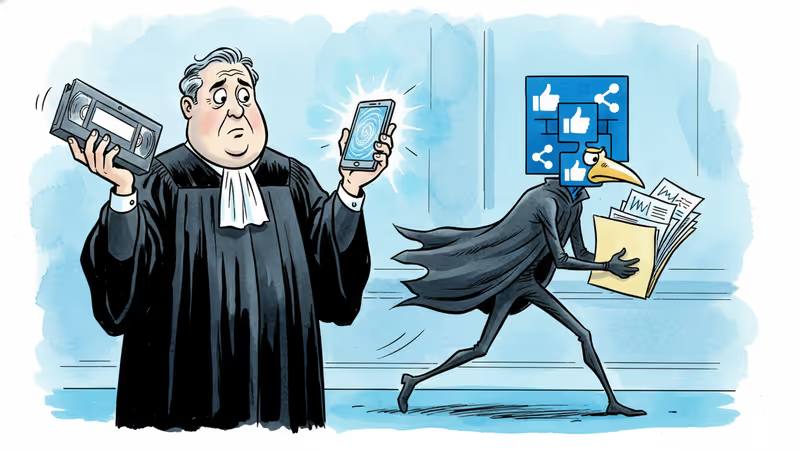
When Your Netflix History Becomes Facebook's Gold Mine
Supreme Court to decide if streaming platforms can share viewing data without consent. A 1988 video privacy law meets the digital age reality.
Your late-night true crime binge. That guilty-pleasure reality show. The documentary you watched at 3 AM. What if all of it was secretly packaged and sold to the highest bidder?
The Supreme Court is about to answer that question. In Michael Salazar v. Paramount Global, the justices will determine whether a 1988 video privacy law can protect modern streaming users from having their viewing habits monetized without consent.
The Facebook Pixel That Started It All
Salazar's story began innocuously enough. In 2022, he signed up for a newsletter on 247Sports.com, a Paramount-owned sports site, providing his email address. Later, while logged into Facebook, he watched videos on the same site.
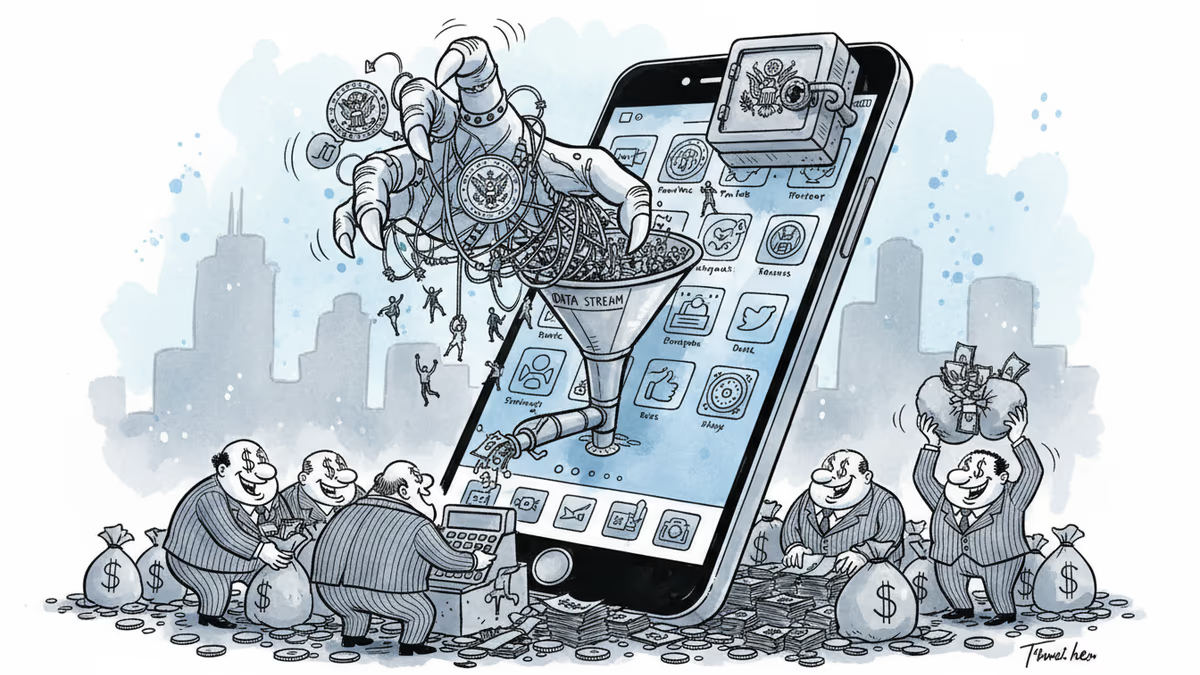
Unbeknownst to Salazar, Paramount had embedded Facebook Pixel tracking code on its website. This invisible digital spy automatically transmitted his Facebook ID and viewing history to Facebook's servers. Both companies then used this data to create targeted advertisements, boosting their revenue streams while Salazar remained completely unaware of the transaction.
The case hinges on a deceptively simple question: Does the 1988 Video Privacy Protection Act (VPPA) protect users who don't directly pay for content?
When Blockbuster Law Meets Netflix Reality
The VPPA emerged from a uniquely American scandal. In 1987, a newspaper published Supreme Court nominee Robert Bork's video rental history from his local Blockbuster, revealing his taste for obscure foreign films and mainstream Hollywood fare. The public outcry led Congress to pass strict protections for video rental records.
But that was the era of VHS tapes and membership cards. Today's streaming landscape operates on fundamentally different economics. Platforms like YouTube, Hulu, and Paramount+ offer free content supported by advertising revenue. Users pay with attention and data rather than dollars.

The legal question isn't just technical—it's existential for the modern internet economy.
The $50 Billion Question
If the Supreme Court rules that free users deserve the same privacy protections as paying subscribers, the ripple effects will reshape digital advertising. The streaming industry generated over $50 billion in ad revenue last year, much of it powered by detailed viewer data.
Netflix, Disney+, and Amazon Prime have all introduced ad-supported tiers, betting that users will trade privacy for lower subscription costs. A broad VPPA interpretation could force these platforms to obtain explicit consent before sharing any viewing data—potentially crippling their advertising effectiveness.
The stakes extend beyond streaming. Social media platforms, news websites, and e-commerce sites all use similar tracking technologies. If watching a free video triggers VPPA protection, where does that leave the rest of the data economy?
The Privacy Paradox Deepens
Consumers send mixed signals about privacy. They demand free content while simultaneously expressing outrage about data collection. They use ad blockers but expect personalized recommendations. They share intimate details on social media but bristle when companies use that information commercially.
Salazar's case crystallizes this tension. He benefited from free sports content and likely saw relevant advertisements. Yet he's seeking damages for the very data sharing that made his free experience possible.
The Supreme Court must decide whether 1988 privacy principles can govern 2024 digital realities—or whether Congress needs to write new rules for the streaming age.
Authors
Related Articles
From a niche experiment in 2018 to a mainstream disruption in 2026, AI-generated music is forcing the industry to rethink creativity, copyright, and compensation.
Tinder now rewards users who scan their irises at a World orb with free in-app boosts. As AI agents flood dating apps, 'being human' is becoming a verified status — and a business model.
Wisconsin Governor Tony Evers vetoed an age verification bill for adult sites, citing privacy concerns. With 25+ states going the other way, the debate cuts to the heart of online freedom vs. child protection.
CBP admits buying location data from ad industry while Meta contractors watch users in bathrooms through smart glasses. The digital privacy boundary is crumbling.
From a niche experiment in 2018 to a mainstream disruption in 2026, AI-generated music is forcing the industry to rethink creativity, copyright, and compensation.
Tinder now rewards users who scan their irises at a World orb with free in-app boosts. As AI agents flood dating apps, 'being human' is becoming a verified status — and a business model.
Wisconsin Governor Tony Evers vetoed an age verification bill for adult sites, citing privacy concerns. With 25+ states going the other way, the debate cuts to the heart of online freedom vs. child protection.
CBP admits buying location data from ad industry while Meta contractors watch users in bathrooms through smart glasses. The digital privacy boundary is crumbling.
Thoughts
Share your thoughts on this article
Sign in to join the conversation