
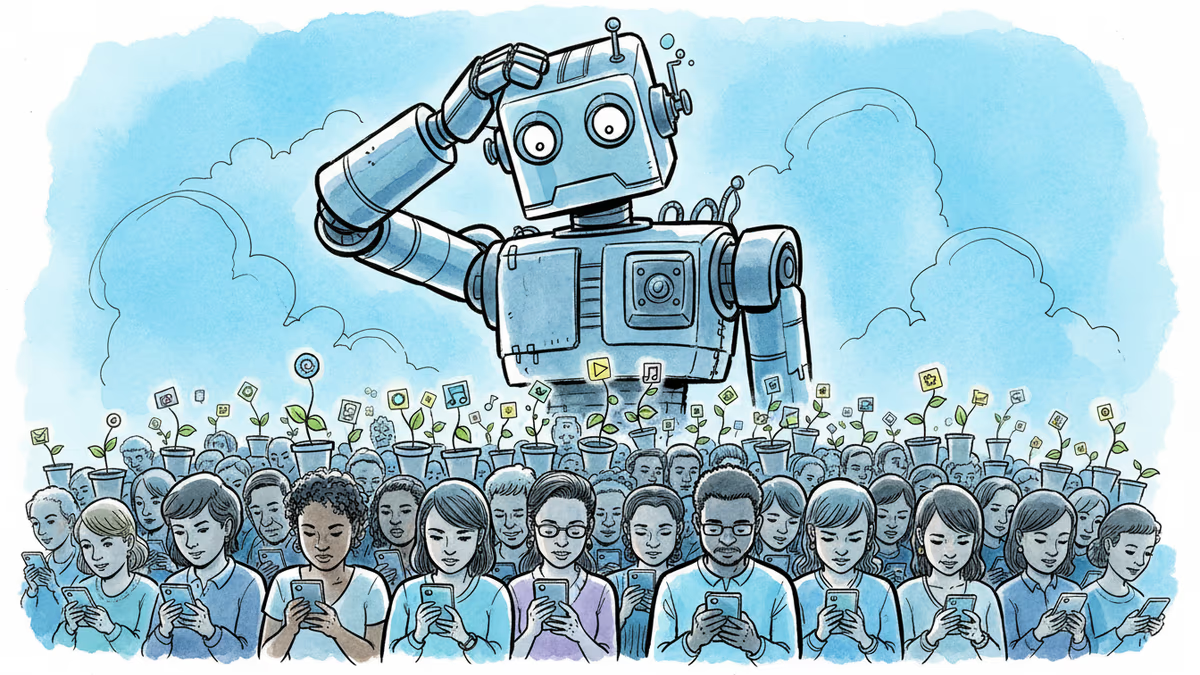
AI Was Supposed to Kill Apps. It's Doing the Opposite.
New data shows global app releases surged 60% year-over-year in Q1 2026. The theory that AI chatbots would replace apps may have it completely backwards.
Two years ago, the consensus was clear: AI would make apps obsolete. Why download a dozen apps when one chatbot handles everything? It was a tidy theory. The Q1 2026 numbers just blew it apart.
The Data Nobody Predicted
According to Appfigures, a market intelligence firm tracking app store activity, new app releases across the Apple App Store and Google Play surged 60% year-over-year in the first quarter of 2026. On iOS alone, that number climbs to 80%. April is looking even sharper: up 104% across both stores, 89% on iOS. That's not a blip — it's effectively a doubling in twelve months.
Apple's SVP of Worldwide Marketing, Greg Joswiak, put it plainly in a recent interview: rumors of the App Store's death in the AI age "may have been greatly exaggerated." The Mark Twain reference was deliberate. The data backs him up.
What's changing isn't just volume — it's category mix. Mobile games still dominate new releases, as they have for years. But for the first time, productivity apps have broken into the top five. Utilities jumped to the number two slot. Lifestyle apps moved from fifth to third. Health and fitness rounded out the top five. The App Store is quietly shifting from entertainment platform to utility infrastructure.
AI Didn't Kill the App. It Became the Developer.
The leading hypothesis for the surge is both simple and counterintuitive: AI coding tools like Claude Code and Replit have lowered the barrier to app creation so dramatically that a new class of builder has entered the market. People with ideas but no engineering background — designers, small business owners, educators, hobbyists — can now describe what they want in plain language and ship something real.
"Vibe coding" — the practice of prompting an AI to generate functional code from a conversational description — has moved from novelty to workflow in under two years. The result appears to be an app gold rush led not by professional developers, but by first-timers.

For app developers reading this, the implications cut both ways. The market for your skills isn't shrinking — but the definition of "developer" is expanding fast. The question isn't whether AI can replace you; it's whether the tools you use are evolving as quickly as the people entering your space.
The Quality Problem Nobody Wants to Talk About
More apps mean more problems. The same week this data surfaced, Apple pulled the rewards app Freecash from the App Store for rule violations — after letting it sit in the top five charts for months. A separate incident was worse: a malicious clone of Ledger Live, a legitimate cryptocurrency wallet app, slipped through App Store review and drained $9.5 million in crypto from victims' accounts before being caught.
Apple isn't defenseless. Its own 2024 analysis reported removing or rejecting more than 17,000 apps for bait-and-switch violations, rejecting over 320,000 submissions for spam or copying, and blocking more than 37,000 potentially fraudulent apps. That's a significant operation. But the high-profile failures suggest the review process is being outpaced.
Apple commentator John Gruber has argued for years that the App Store needs a dedicated "bunco squad" — a team specifically watching for scammy or fraudulent apps that are gaining traction or revenue. If AI-assisted vibe coding is behind the current surge, that argument just got considerably stronger. Volume is the enemy of vigilance.
The Bigger Bet Being Challenged
The "apps are dying" thesis wasn't fringe thinking. Nothing CEO Carl Pei has been building toward a smartphone redesigned for the AI era, one where the app grid gives way to conversational interfaces. The New York Times reported last year on smart glasses, ambient computing, and AI-enabled smartwatches as potential successors to the smartphone paradigm. OpenAI is reportedly developing AI hardware with legendary designer Jony Ive.
None of that is wrong, exactly. These platforms may yet reshape how we interact with software. But the current data suggests something the disruption narrative tends to skip: even if the container changes, the demand for small, task-specific software units doesn't disappear. It multiplies.
For investors in the mobile and developer tools space, that's a meaningful signal. The picks-and-shovels play — infrastructure for AI-assisted development, app store optimization tools, quality assurance platforms — may be more durable than the "apps are over" consensus implied.
Authors
Related Articles
A surprise leak of Anthropic's Claude Code source code revealed 'Kairos'—a dormant background AI agent designed to act before you even ask. Here's what it means.
A routine update to Claude Code leaked over 512,000 lines of TypeScript source code, exposing internal AI instructions, unreleased features, and memory architecture. What does this mean for AI transparency?
A federal judge dismissed Musi's lawsuit against Apple with prejudice after the free music app was pulled from the App Store. What does it mean for developers, users, and platform power?
Apple quietly blocks all ByteDance apps for US-based iPhones, even with Chinese App Store accounts. This goes beyond TikTok—it's about platform power in geopolitical conflicts.
A surprise leak of Anthropic's Claude Code source code revealed 'Kairos'—a dormant background AI agent designed to act before you even ask. Here's what it means.
A routine update to Claude Code leaked over 512,000 lines of TypeScript source code, exposing internal AI instructions, unreleased features, and memory architecture. What does this mean for AI transparency?
A federal judge dismissed Musi's lawsuit against Apple with prejudice after the free music app was pulled from the App Store. What does it mean for developers, users, and platform power?
Apple quietly blocks all ByteDance apps for US-based iPhones, even with Chinese App Store accounts. This goes beyond TikTok—it's about platform power in geopolitical conflicts.
Thoughts
Share your thoughts on this article
Sign in to join the conversation