
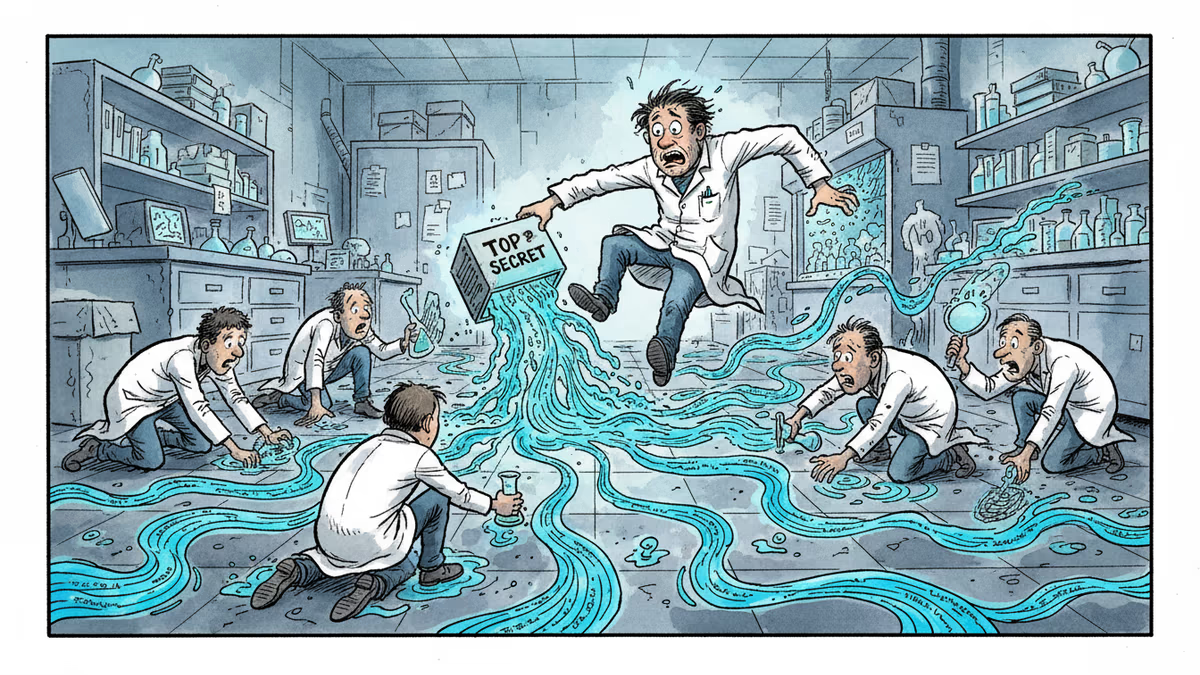
Anthropic Accidentally Open-Sourced Its Secrets
A routine update to Claude Code leaked over 512,000 lines of TypeScript source code, exposing internal AI instructions, unreleased features, and memory architecture. What does this mean for AI transparency?
Half a million lines of code. One forgotten config file. The curtain just dropped on Anthropic's most closely guarded product.
When Anthropic pushed version 2.1.88 of Claude Code — its AI-powered coding assistant — someone left the source map files in the deployment package. Source maps are developer debugging tools that link compiled, minified code back to its original readable form. In this case, that meant Anthropic's entire TypeScript codebase for Claude Code shipped directly to users' machines, fully readable.
A user on X spotted it first. Within hours, the developer community was digging in.
What Was Inside
The leaked package reportedly contains more than 512,000 lines of code — not a config file or two, but the architectural blueprint of one of the most talked-about AI coding tools on the market. Ars Technica and VentureBeat reported on the find, and developers who've analyzed the code claim to have surfaced three particularly sensitive categories of information.
First: Anthropic's internal instructions to the AI. The system prompts that shape how Claude Code behaves — what it prioritizes, what it avoids, how it frames its responses — are among the most proprietary assets an AI company holds. These are now, at least partially, in the wild.
Second: unreleased features. Code doesn't lie. Traces of functionality not yet announced to the public were reportedly visible throughout the codebase. For competitors, this is the equivalent of reading a rival's product roadmap before the board meeting.
Third: the memory architecture. How Claude Code stores and retrieves context across a session is a core differentiator in the AI coding tool market. That design philosophy is now exposed.

How Does This Even Happen?
Source map leaks aren't exotic hacks. They're mundane build pipeline mistakes — the kind that happen when a developer flag gets set wrong, an automation script skips a step, or a checklist item gets missed in a fast-moving release cycle. The irony is that source maps exist to help developers catch errors. This time, the error was including them at all.
What makes this notable isn't the technical failure. It's who it happened to. Anthropic positions itself as one of the most safety-conscious, process-rigorous AI labs in the world. If this kind of oversight happens there, it's a reminder that operational security and research excellence don't always move in lockstep.
Three Ways to Read This
For developers using Claude Code, the reaction is genuinely mixed. On one hand, there's the appeal of finally seeing inside the black box — understanding how the tool actually works, not just what it claims to do. On the other hand, it raises a legitimate question: if Anthropic shipped 512,000 lines of internal code without noticing, what else is leaving your machine without your knowledge?
For competitors — GitHub Copilot, Cursor, Devin, and a growing field of AI coding assistants — this is an unearned intelligence windfall. Whether they can legally act on what's now public is a separate legal question, but the information is out there. The competitive moat just got a little shallower.
For regulators, the timing is pointed. The EU's AI Act is actively wrestling with questions of AI system transparency — how much should companies be required to disclose about their models' internal instructions and behavior? Anthropic just provided an accidental case study in what happens when that information surfaces without consent. It didn't collapse the company. It didn't break the product. But it did change the conversation.
The Bigger Pattern
This isn't the first time proprietary AI internals have leaked — and it won't be the last. As AI tools become more deeply embedded in professional workflows, the gap between what these systems say they do and what they actually do becomes more consequential. System prompts, memory architectures, and behavioral guidelines are the hidden layer that shapes every output a developer receives.
The AI industry has largely operated on a "trust us" basis when it comes to these internals. Users accept that the black box works as advertised. Anthropic's mistake didn't cause harm — but it did briefly remove the box.
Authors
Related Articles
Anthropic shipped Claude Sonnet 5, its mid-tier agent model, on June 30. Behind the 'Opus-class power, budget price' headline sits a tokenizer catch and a three-horse race that's only half real. Here's what developers should actually run the numbers on.
A small but growing group of developers has gone all-in on AI coding agents like Claude Code and OpenClaw. History suggests the rest of us won't be far behind.
OpenAI's new Daybreak initiative uses the Codex AI agent to find and patch security vulnerabilities before attackers do—putting it in direct competition with Anthropic's secretive Claude Mythos.
Anthropic is closing what may be its final private fundraise at a $900B valuation, surpassing OpenAI. Investors have 48 hours to commit to the ~$50B round.
Anthropic shipped Claude Sonnet 5, its mid-tier agent model, on June 30. Behind the 'Opus-class power, budget price' headline sits a tokenizer catch and a three-horse race that's only half real. Here's what developers should actually run the numbers on.
A small but growing group of developers has gone all-in on AI coding agents like Claude Code and OpenClaw. History suggests the rest of us won't be far behind.
OpenAI's new Daybreak initiative uses the Codex AI agent to find and patch security vulnerabilities before attackers do—putting it in direct competition with Anthropic's secretive Claude Mythos.
Anthropic is closing what may be its final private fundraise at a $900B valuation, surpassing OpenAI. Investors have 48 hours to commit to the ~$50B round.
Thoughts
Share your thoughts on this article
Sign in to join the conversation