
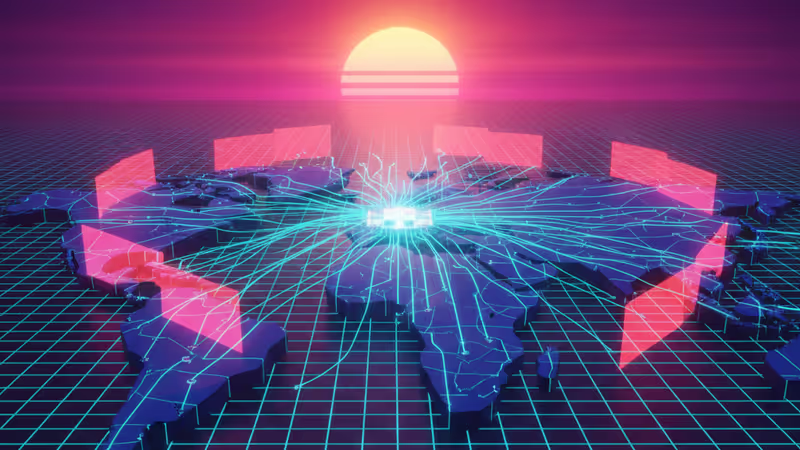
2025 in Tech: How Trump's Tariffs and an AI Bubble Scare Redrew the Map
A review of the tech industry in 2025. An analysis of how Donald Trump's tariffs and the AI investment bubble scare reshaped global supply chains and markets.
The tech world in 2025 was caught between two massive storms. One was a geopolitical tempest from Washington, D.C., and the other was an artificial intelligence (AI) gold rush that started to look like a bubble. According to reporting from Nikkei Asia, the year was defined by uncertainty as markets wrestled with the return of Donald Trump to the White House and the "DeepSeek shock" from China that briefly rattled the foundations of the entire AI investment boom.
The Trump Shockwave Reshapes Supply Chains
One of the year's biggest questions was how the tech supply chain would respond to Trump's "reciprocal" tariffs. These policies threatened to impose punishingly high rates on production hubs like Thailand and Vietnam, upending the "out-of-China" plans for giants like Apple and Nvidia. Yet, a surprising outcome emerged from the chaos: the development of a U.S. supply ecosystem for servers. While a "Made in America" iPhone remains a distant dream, this shift signaled a tangible move toward onshoring in critical sectors.
The AI Gold Rush and Its Bubble Fears

The other dominant question was whether we're in an AI investment bubble, and if so, when it might burst. The "DeepSeek shock" in January gave investors a genuine scare. This feverish environment fueled a global data center construction race, with places like Johor, Malaysia, becoming an epicenter of the boom. However, it also created bottlenecks, as seen in Japan, where construction delays hampered new projects. The boom also created lucrative niches, helping Thailand secure a key role in printed circuit boards (PCBs).
China's Accelerating Tech Challenge
2025 also saw China's technological ambitions gain significant ground. The industry braced for a 'China shock' in mature chips, while Chinese firm SiCarrier emerged as a serious challenger to semiconductor equipment titan ASML. Furthermore, Beijing's latest curbs on rare-earth exports served as a stark reminder that the tech rivalry extends beyond chips to crucial raw materials. These moves reflect the complex geopolitical landscape faced by global players in sectors from electric vehicles, where BYD's price cuts made waves, to autonomous driving.
Authors
Related Articles

Taiwan's Thunder Tiger became the first Asian firm to win US military drone clearance with a China-free supply chain. As Trump meets Xi, the drone arithmetic reshapes defense strategy.
Apple quietly removed the entry-level $599 Mac Mini, raising the starting price to $799 — just one day after Tim Cook warned of chip supply constraints on the earnings call.
As the Strait of Hormuz closure traps 1,900 vessels, abandoned seafarers reveal a structural flaw at the heart of global trade—no single authority is responsible when things go wrong.
Sony halted orders for most of its CFexpress and SD card lineup on March 27, 2026 — the same day it raised PS5 prices. What does this mean for photographers, consumers, and Sony's broader strategy?
Taiwan's Thunder Tiger became the first Asian firm to win US military drone clearance with a China-free supply chain. As Trump meets Xi, the drone arithmetic reshapes defense strategy.
Apple quietly removed the entry-level $599 Mac Mini, raising the starting price to $799 — just one day after Tim Cook warned of chip supply constraints on the earnings call.
As the Strait of Hormuz closure traps 1,900 vessels, abandoned seafarers reveal a structural flaw at the heart of global trade—no single authority is responsible when things go wrong.
Sony halted orders for most of its CFexpress and SD card lineup on March 27, 2026 — the same day it raised PS5 prices. What does this mean for photographers, consumers, and Sony's broader strategy?
Thoughts
Share your thoughts on this article
Sign in to join the conversation