
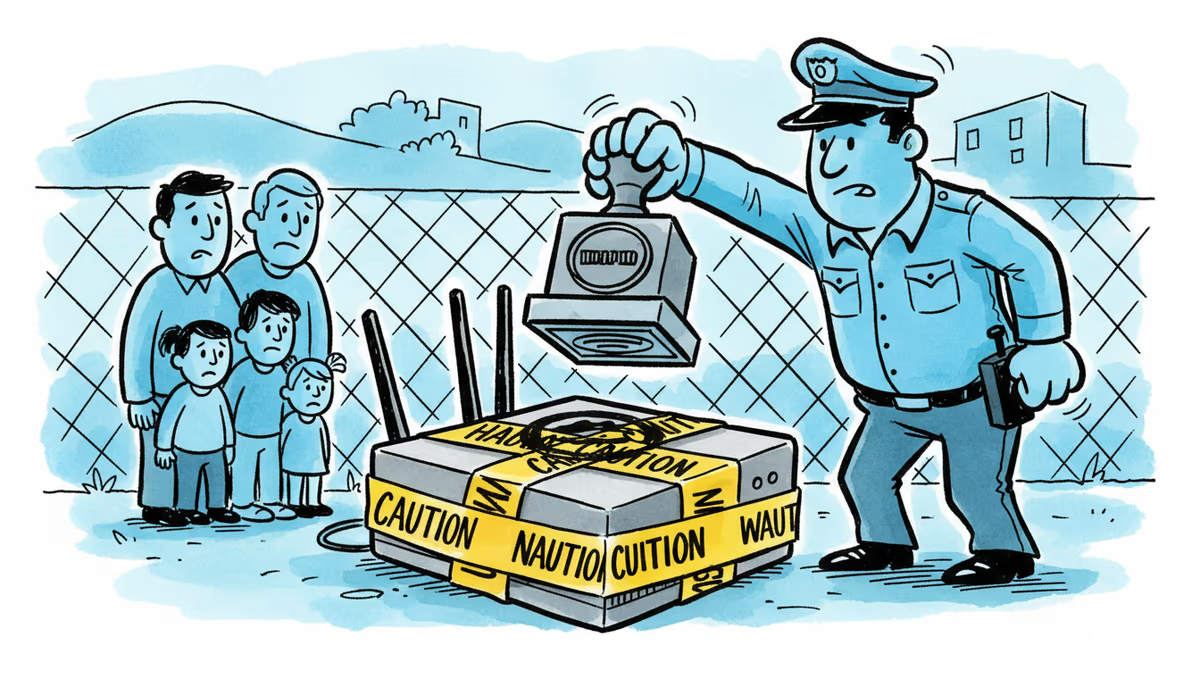
Your Router Has a Nationality Problem Now
The FCC has banned new imports of foreign-made consumer networking gear, citing national security. After drones, routers are next. What this means for prices, competition, and the future of connected homes.
Flip your home router over. Where was it made?
Chances are, the answer just became a federal matter.
The Federal Communications Commission has banned all new imports of foreign-made consumer networking equipment—Wi-Fi routers, wired routers, the devices that sit between your household and the internet—unless manufacturers obtain an explicit exemption. The stated reason: "an unacceptable risk to the national security of the United States and to the safety and security of U.S. persons."
This isn't the first move of its kind. In December, the FCC issued an identical ban on foreign-made drones. The perimeter is expanding.
What the Ban Actually Does
The mechanics matter here. Devices that already hold FCC radio authorization can continue to be imported and sold. Your current router is fine. But any foreign-made networking product that hasn't already cleared the FCC's authorization process is now locked out of the U.S. market—unless its maker applies for and receives a specific exemption.
In practice, this is a hard stop on new market entry. And while the rule doesn't name a country, the target isn't difficult to identify. TP-Link alone has dominated Amazon's router bestseller lists for years. Huawei and ZTE equipment was already banned from U.S. telecom infrastructure. This rule extends that logic down to the consumer shelf.
Why This, Why Now
The FCC's decision didn't emerge in a vacuum. It's the latest step in a years-long effort to strip Chinese hardware from U.S. communications infrastructure—a process that began with carrier-grade equipment and has steadily moved toward consumer devices.

The urgency has a name: Salt Typhoon. In 2024, U.S. officials confirmed that Chinese state-linked hackers had breached the networks of major American telecom carriers, accessing call records and, in some cases, live communications of government officials and political figures for months. Routers are the chokepoint. Every packet of data in your home passes through one. A compromised router is a window into everything.
The FCC's logic: don't wait for the breach. Block the hardware at the border.
Who Wins, Who Loses
For consumers, the most immediate effect is likely to be price. A significant portion of routers sold under $50 in the U.S. are foreign-made. If exemptions are hard to obtain, that low-cost tier shrinks. American and European brands—Netgear, Eero (owned by Amazon), Cisco—stand to benefit from reduced competition. Whether that benefit gets passed to consumers or absorbed as margin is a different question.
For foreign manufacturers, the stakes go beyond lost sales. TP-Link has reportedly been exploring moving its headquarters to the U.S. as a potential workaround. The calculus is stark: reincorporate, or lose access to the world's largest consumer market. It's a form of regulatory pressure that doesn't require tariffs.
For U.S. allies and trading partners, this rule raises a quiet but significant question. The ban applies to all foreign-made devices, not just Chinese ones. A router made in Taiwan, South Korea, or Germany technically falls under the same restriction. The exemption process will determine how broadly this is enforced in practice—but the framework is now in place.
The Security Argument Has Holes
Not everyone is convinced the approach is sound. Some cybersecurity researchers argue that router vulnerabilities are primarily a software problem, not a hardware nationality problem. Firmware that isn't updated, default passwords that never get changed, poorly audited code—these are the real attack surfaces, and they exist in American-made devices too.
There's also a structural irony: many routers branded as American or European are manufactured in the same Chinese factories as their competitors. The FCC's rule targets the country of the authorizing company, not necessarily the country where the chips were fabbed or the board was assembled. Whether that distinction holds up as a security measure is genuinely debatable.
Economists have noted that the rule functions, whatever its intent, as industrial policy. It walls off a market segment for domestic producers without requiring them to compete on price or performance. That may or may not be a bad thing—but it's worth naming.
Authors
Related Articles
China is restricting AI researchers and startup founders from traveling abroad as the U.S.-China AI performance gap narrows to just 2.7%. What Beijing's talent lockdown means for the global AI race.
A critical vulnerability in Starlette—downloaded 325 million times per week—puts millions of AI agent servers at risk, exposing stored credentials for email, databases, and third-party services.
GitHub confirmed hackers stole data from 3,800 internal repositories via a poisoned VS Code extension. Here's why developer tools are now the most dangerous attack surface in tech.
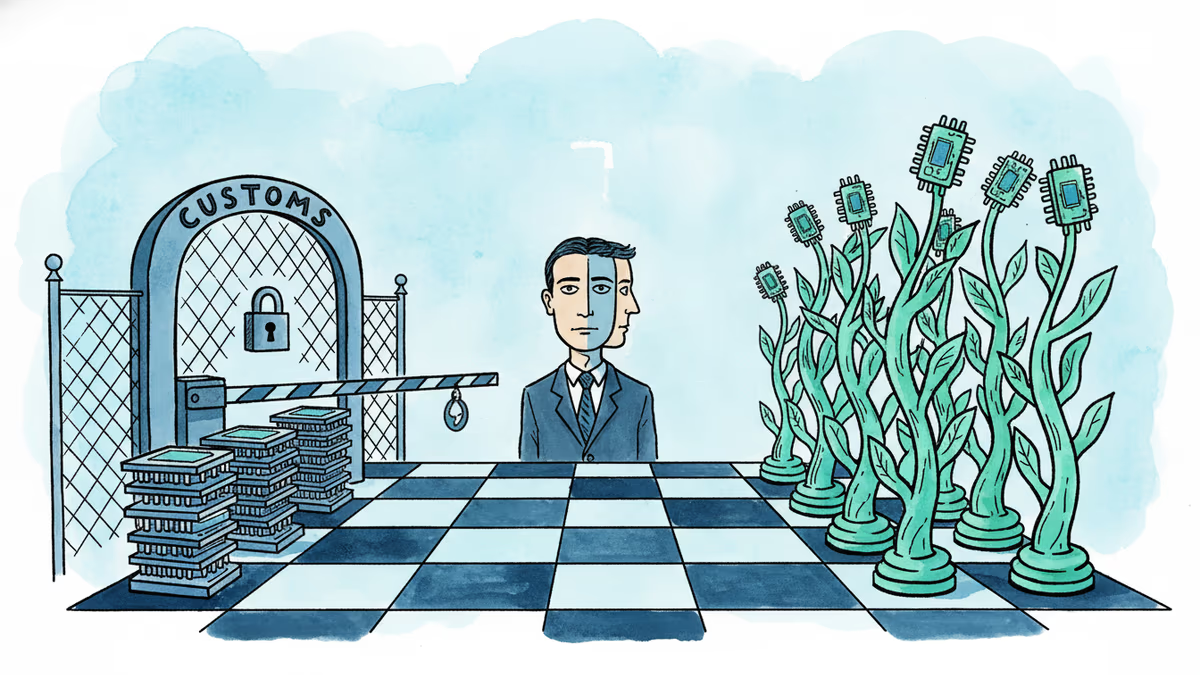
Beijing added an Nvidia gaming chip to its customs ban list the same week Jensen Huang visited China with Trump. Here's what it means for the chip war—and who actually wins.
China is restricting AI researchers and startup founders from traveling abroad as the U.S.-China AI performance gap narrows to just 2.7%. What Beijing's talent lockdown means for the global AI race.
A critical vulnerability in Starlette—downloaded 325 million times per week—puts millions of AI agent servers at risk, exposing stored credentials for email, databases, and third-party services.
GitHub confirmed hackers stole data from 3,800 internal repositories via a poisoned VS Code extension. Here's why developer tools are now the most dangerous attack surface in tech.
Beijing added an Nvidia gaming chip to its customs ban list the same week Jensen Huang visited China with Trump. Here's what it means for the chip war—and who actually wins.
Thoughts
Share your thoughts on this article
Sign in to join the conversation