
The $325 Million Supercomputer That Had to Die at Age 7
Why Sierra, once the world's second-fastest supercomputer, was decommissioned despite working perfectly. A look at the brutal economics of cutting-edge technology.
When the Government Decides Your $325 Million Computer Must Die
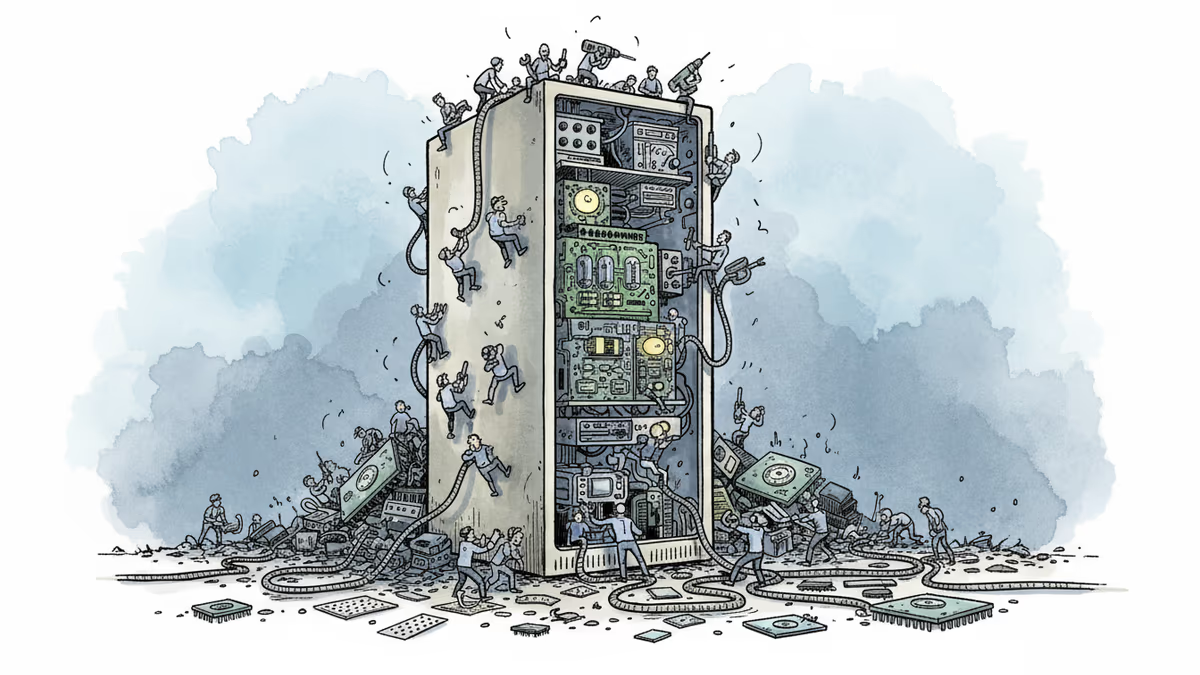
Sierra was still working perfectly when they killed her. The supercomputer that once ranked as the world's second-fastest had just finished her final jobs in October, processing nuclear weapons simulations with the same precision she'd maintained for seven years. But in the brutal economics of high-performance computing, being functional isn't enough to survive.
At Lawrence Livermore National Laboratory in California, Sierra occupied 7,000 square feet and consumed 11 megawatts of power—enough to run a small city. Her 240 racks housed thousands of IBM Power9 CPUs and Nvidia Volta V100 GPUs, capable of 94.64 petaflops at peak performance. Yet none of that mattered when El Capitan, her 19 times faster successor, came online.
Why execute a machine that cost hundreds of millions and still functioned flawlessly?
The Bathtub Curve: Why Even Supercomputers Age Like Humans
Every piece of technology follows what IT experts call the "bathtub curve"—high failure rates at birth due to manufacturing defects, a stable middle period, then rising failures as components wear out. Sierra hadn't reached the final steep decline, but she was approaching it.
"As you age—just like humans—you are likely to get more disease," explains Devesh Tiwari, who researches high-performance computing at Northeastern University. "You are likely to fail more, so you need more caring and feeding."
The writing was on the wall: IBM no longer produces Sierra's components or supports her version of Red Hat Enterprise Linux. Replacement parts were becoming impossible to source. The machine that once represented the cutting edge was becoming a maintenance nightmare.
"If they had infinite resources, they would run infinite supercomputers," says Ann Dunkin, former chief information officer of the US Department of Energy. "But it's really about resources."
When Your Replacement is 19 Times Better

El Capitan delivered the final blow. While Sierra could hit 94.64 petaflops, her successor clocks 1.809 exaflops—a performance leap that made Sierra's capabilities look quaint overnight. El Capitan's 36-megawatt power consumption could run 36,000 homes, but the performance per watt equation had shifted dramatically.
"Sierra's juice was no longer worth the squeeze," admits Rob Neely, the lab's associate director for weapons simulation and computing.
This isn't just about raw speed. El Capitan uses AMD Instinct MI300A APUs with shared memory across CPUs and GPUs—an architecture that makes Sierra's design look like ancient history. In supercomputing, yesterday's marvel becomes today's inefficiency with ruthless speed.
The Art of Killing a Computer Full of State Secrets
Sierra couldn't just be unplugged and hauled away. Loaded with classified nuclear weapons data, she required what amounts to a high-tech cremation. The decommissioning process reads like a forensic procedure:
First, users received email warnings to save their work. Then a "do not resuscitate" order—no new parts. The actual shutdown happened in phases, starting with compute nodes and ending with management systems.
But the real destruction began after Sierra went dark. Staff wearing gloves methodically removed lithium-ion batteries for specialty recycling. System boards, processors, and skeletal racks went to industrial shredders. Flash memory components—which can store data even without power—were ground into fine powder.
Magnetic drives faced a special government-approved "degausser"—a permanent magnet so powerful it can wipe nearby credit cards and interfere with medical devices. The entire process takes months and costs millions more.
The Loneliness of Obsolete Machines
Most supercomputers don't get dignified retirements. Museums rarely want them—they're too big, too power-hungry, and too specialized. When New Mexico tried to sell its Encanto supercomputer in 2013, they ended up breaking it down for parts. Argonne National Lab couldn't find takers for most of its once-mighty Intrepid system.
Some facilities hold retirement ceremonies. In 2006, Livermore threw a party for the ASCI White system, complete with countdown and cake. But sentiment doesn't change economics. Sierra's farewell was clinical: scripts shut her down digitally, power switches flipped off physically, cooling water drained and tested for environmental safety.
The earthquake-proof base and cooling infrastructure remain, waiting for the next generation. Even in death, Sierra serves—as foundation for whatever comes next.
Authors
Related Articles
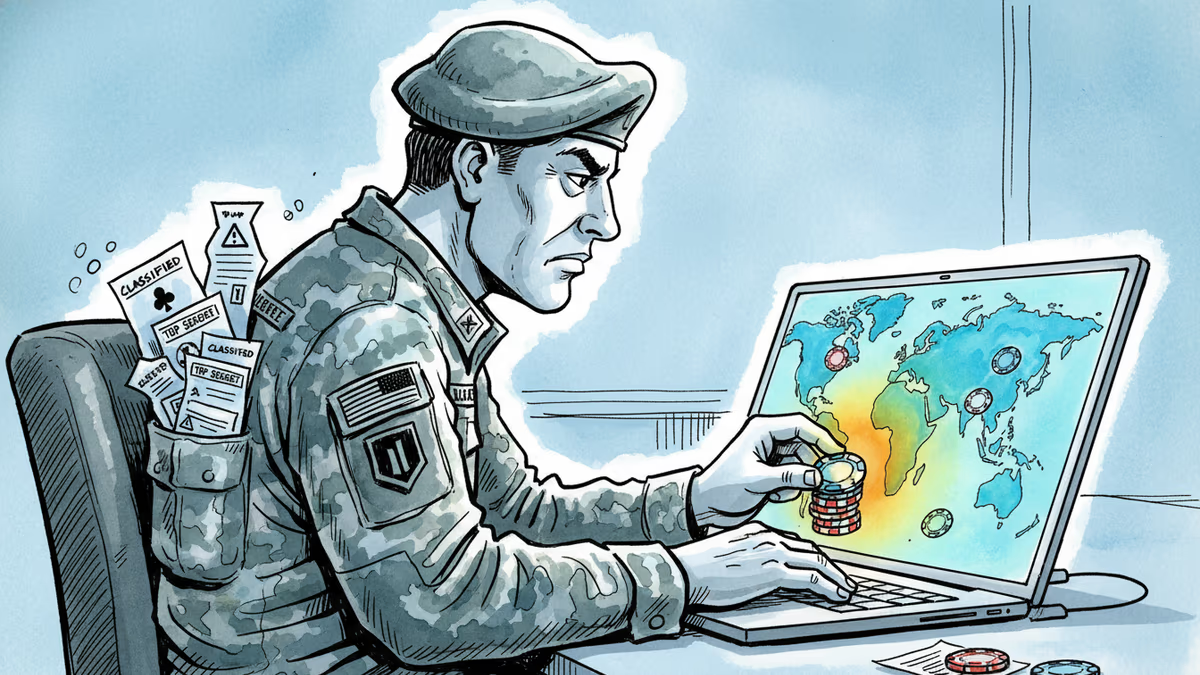
A US special forces soldier involved in the operation that captured Venezuela's Maduro allegedly used classified intel to bet on Polymarket, pocketing over $400,000. The case exposes a gaping hole in how prediction markets are regulated.
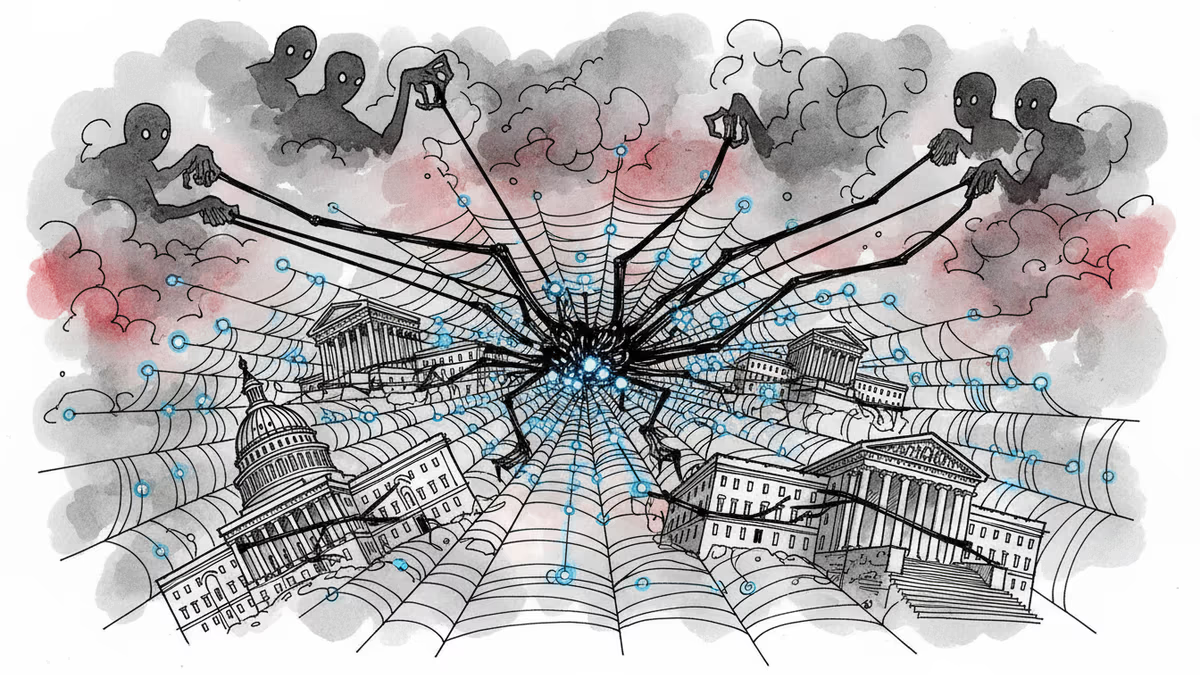
FBI's wiretapping and surveillance systems have been hacked. We analyze the strategic pattern behind China's cascade of cyberattacks and what it means for national security.
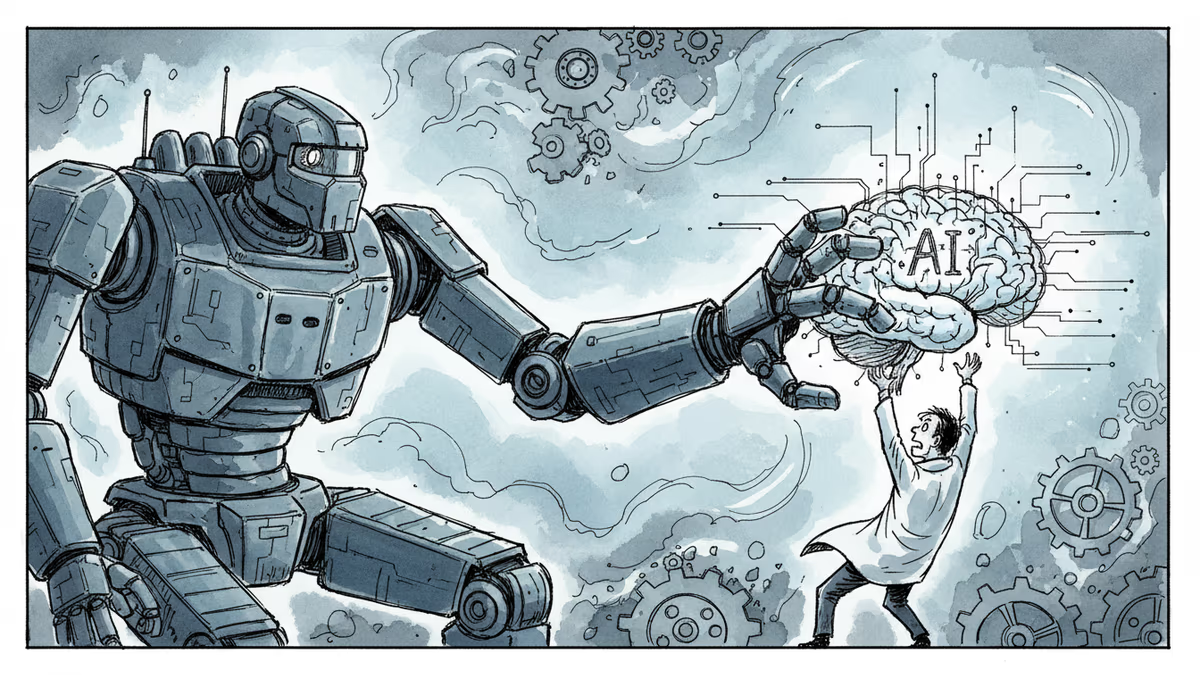
Trump's explosive reaction to Anthropic's military contract refusal reveals the growing tension between AI ethics and national security demands.

From Australia to Germany, nations are pouring billions into domestic launch capabilities. Is the US-China space duopoly finally facing real competition?
A US special forces soldier involved in the operation that captured Venezuela's Maduro allegedly used classified intel to bet on Polymarket, pocketing over $400,000. The case exposes a gaping hole in how prediction markets are regulated.
FBI's wiretapping and surveillance systems have been hacked. We analyze the strategic pattern behind China's cascade of cyberattacks and what it means for national security.
Trump's explosive reaction to Anthropic's military contract refusal reveals the growing tension between AI ethics and national security demands.
From Australia to Germany, nations are pouring billions into domestic launch capabilities. Is the US-China space duopoly finally facing real competition?
Thoughts
Share your thoughts on this article
Sign in to join the conversation