
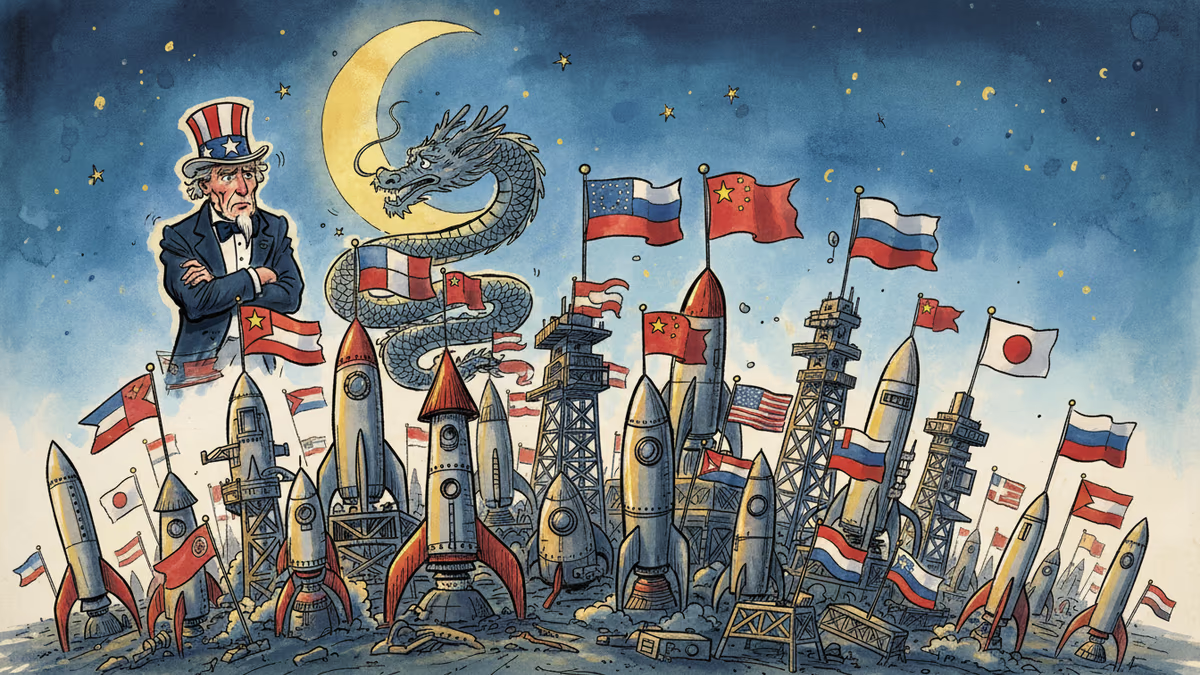
The Space Sovereignty Gold Rush Has Begun
From Australia to Germany, nations are pouring billions into domestic launch capabilities. Is the US-China space duopoly finally facing real competition?
$40 Billion Is Moving Fast
Australia just committed $3 billion to homegrown space startups last month. Canada followed with $2.5 billion. Germany pledged $2 billion. Spain added $1.5 billion to the pot. What do these nations have in common? They've all been dependent on foreign rockets to launch their own satellites.
Until now, space launch has been essentially a two-horse race. SpaceX and China's Long March series control 80% of the global launch market. Everyone else has had to pick a side when they need to get their satellites up.
But something's shifting. Since Ukraine, "space sovereignty" has become the buzzword in government corridors from Canberra to Berlin.
Security vs. Economics: The New Math
"Launch your satellites on your own rockets" sounds logical, but the economics are brutal. SpaceX charges roughly $2,700 per kilogram to orbit. Emerging national champions demand $5,000-8,000. That's 2-3x more expensive.
So why are governments writing these massive checks? The answer crystallized in February 2022. When Russia invaded Ukraine, Europe's satellite launch schedule froze for six months. They'd been relying on Russian Soyuz rockets. Oops.
China presents a similar dilemma. As Taiwan Strait tensions escalate, the question becomes: "Would you trust your military satellites to Chinese rockets?"
Australia's Space Agency head Enea Pentassini puts it bluntly: "Without satellites, there's no GPS, no weather forecasts, no financial transactions. Depending on foreign powers for this is a national security blind spot."

The Alliance Advantage
What's interesting is which countries are making these bets. Australia, Canada, Germany, Spain – all longtime US allies who've watched the space duopoly with growing unease. They're not trying to compete with SpaceX on pure economics. They're building what defense analysts call "redundant capability."
The strategy is clever. Pool resources among allied nations, share launch schedules, and create a "third option" that's neither American nor Chinese. Germany's Rocket Factory Augsburg is already talking to Canadian satellite operators. Australia's Gilmour Space has inked preliminary deals with European customers.
It's not about replacing SpaceX – it's about having alternatives when geopolitics gets messy.
The Frequency Problem
But here's the catch: space launch is all about scale. You need to launch 100+ times per year to drive costs down significantly. SpaceX manages roughly 90 launches annually. These emerging national programs? Maybe 10-15 combined.
That frequency gap matters. Satellite operators don't just want cheaper launches – they want available launches. If your satellite is ready to fly, you can't wait six months for the next national rocket. You'll book with whoever's launching next week.
This is where the sovereignty argument gets tested. Are governments willing to subsidize higher costs and longer wait times for the sake of independence?
The Decoupling Accelerates
The geopolitical pressure is only intensifying. The US is considering restrictions on American companies using Chinese launch services. China's already limiting access to its Long March rockets for Western customers. The "friends only" space economy is becoming reality.
Rocket Lab, the US-New Zealand company, is betting big on this trend. CEO Peter Beck recently said: "In five years, you'll see distinct space blocs – democratic allies launching together, authoritarian states doing their own thing."
That's a dramatic shift from the international cooperation that defined early space exploration. But it's the logical endpoint when satellites become critical infrastructure and launch capability becomes a weapon of statecraft.
Authors
Related Articles

A US special forces soldier involved in the operation that captured Venezuela's Maduro allegedly used classified intel to bet on Polymarket, pocketing over $400,000. The case exposes a gaping hole in how prediction markets are regulated.
FBI's wiretapping and surveillance systems have been hacked. We analyze the strategic pattern behind China's cascade of cyberattacks and what it means for national security.

SpaceX pivots from Mars to Moon as both private and public space leaders shift focus to lunar surface operations. What's driving this sudden change in space priorities?
Congress considers limiting NASA's launch funding to prevent any single provider from receiving more than 50% of contracts, potentially reshaping the space industry
A US special forces soldier involved in the operation that captured Venezuela's Maduro allegedly used classified intel to bet on Polymarket, pocketing over $400,000. The case exposes a gaping hole in how prediction markets are regulated.
FBI's wiretapping and surveillance systems have been hacked. We analyze the strategic pattern behind China's cascade of cyberattacks and what it means for national security.
SpaceX pivots from Mars to Moon as both private and public space leaders shift focus to lunar surface operations. What's driving this sudden change in space priorities?
Congress considers limiting NASA's launch funding to prevent any single provider from receiving more than 50% of contracts, potentially reshaping the space industry
Thoughts
Share your thoughts on this article
Sign in to join the conversation