
When Rockets Fail Forward
ULA's Vulcan rocket suffered another booster malfunction but still completed its mission, highlighting the space industry's approach to reliability through redundancy.
Lightning Strikes Twice
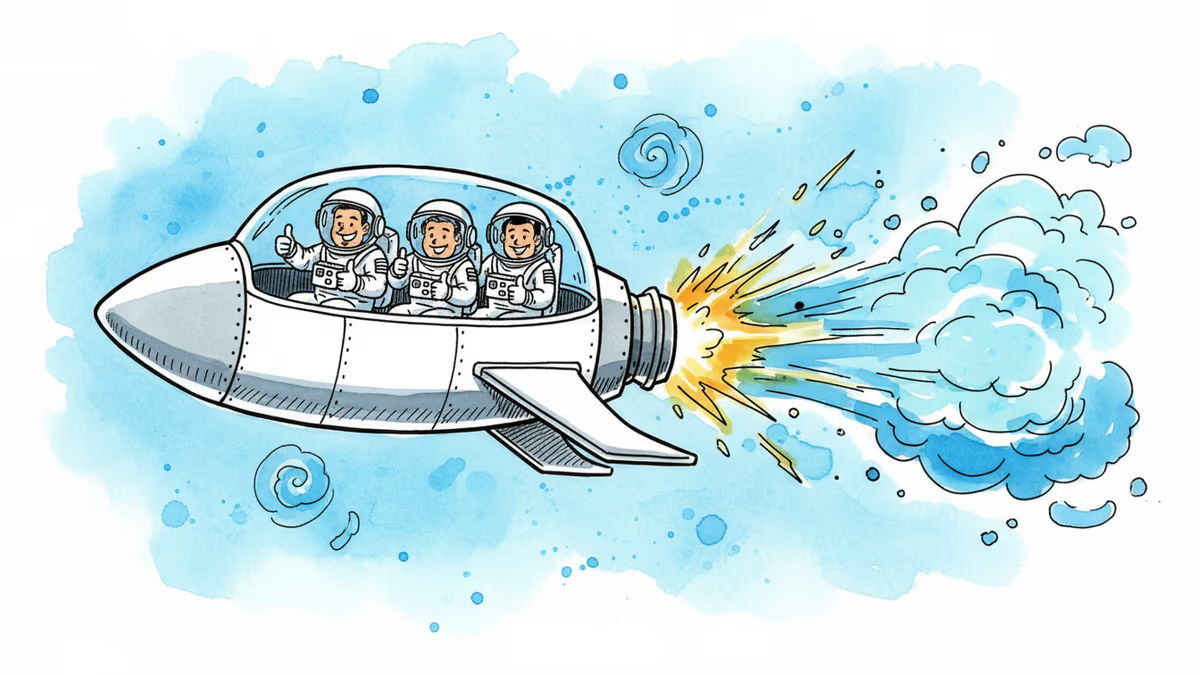
Sparks showered from a United Launch Alliance Vulcan rocket's booster just moments after Thursday's pre-dawn liftoff from Florida. The rocket twisted, recovered, and delivered its military satellite payload to orbit anyway.
It was eerily familiar. Sixteen months ago, another Vulcan rocket lost an entire booster nozzle shortly after launch but still completed its mission. Now it's happened again—different failure mode, same outcome.
Boeing and Lockheed Martin's joint venture has launched an investigation. Close-up footage shows a fiery plume erupting from the throat area of one of four solid rocket boosters, right where the propellant casing meets the bell-shaped nozzle.
The Art of Graceful Degradation
Why can Vulcan keep flying with a malfunctioning booster? The answer lies in redundancy—the space industry's insurance policy against Murphy's Law.
Vulcan's design philosophy mirrors that of modern aircraft: multiple systems that can compensate when others fail. With two main engines and up to six solid boosters, losing one booster still leaves plenty of thrust margin.
SpaceX pioneered this approach with Falcon 9's nine-engine design. The rocket has successfully completed missions despite engine failures in 2012 and 2016. "Failure is not an option" has evolved into "failure is manageable."
When Patterns Become Problems

But repeated failures in the same component tell a different story. Aerospace engineers are raising eyebrows at Vulcan's solid booster issues—not because they caused mission failures, but because they suggest systematic problems.
Solid rocket motors are essentially controlled explosives. Once lit, they can't be shut off. The throat section endures extreme temperatures and pressures, making the propellant casing-to-nozzle joint a critical failure point. Two consecutive issues in this area hint at potential design, manufacturing, or quality control problems.
ULA maintains the rocket performed "as designed," emphasizing that completing missions despite component failures proves the redundancy concept works. Critics argue that's missing the point—redundancy shouldn't be regularly tested in flight.
Market Implications
SpaceX is watching quietly. Vulcan competes directly with Falcon Heavy for lucrative military launch contracts. Recurring booster problems could shift customer confidence, especially when SpaceX touts its 99% success rate.
European competitor Arianespace and emerging players like Blue Origin also stand to benefit. In the launch industry, reliability often trumps cost—customers need their $500 million satellites to reach orbit, not become expensive fireworks.
The Pentagon, Vulcan's primary customer, faces a dilemma. National security launches require assured access to space, but the military has been pushing for competition to break ULA's historical monopoly. Vulcan's issues complicate that strategy.
The Reliability Paradox
Vulcan's troubles highlight a fundamental tension in aerospace engineering. Traditional approaches prioritize preventing failures through exhaustive testing and conservative designs. Modern approaches accept that failures will occur and design systems to handle them gracefully.
Tesla applies similar thinking to autonomous driving—instead of trying to eliminate all edge cases, the system learns to handle unexpected situations. But rockets carrying billion-dollar payloads operate in a less forgiving environment than highways.
The question isn't whether redundancy works—Vulcan's mission successes prove it does. The question is whether customers will accept a rocket that regularly needs its backup systems.
Authors
Related Articles
The US Space Force has transferred yet another GPS satellite launch from ULA to SpaceX — the fourth such move in just over a year. What this pattern reveals about the future of military space launches.

SpaceX pivots from Mars to Moon as both private and public space leaders shift focus to lunar surface operations. What's driving this sudden change in space priorities?

Congress considers limiting NASA's launch funding to prevent any single provider from receiving more than 50% of contracts, potentially reshaping the space industry

From Australia to Germany, nations are pouring billions into domestic launch capabilities. Is the US-China space duopoly finally facing real competition?
The US Space Force has transferred yet another GPS satellite launch from ULA to SpaceX — the fourth such move in just over a year. What this pattern reveals about the future of military space launches.
SpaceX pivots from Mars to Moon as both private and public space leaders shift focus to lunar surface operations. What's driving this sudden change in space priorities?
Congress considers limiting NASA's launch funding to prevent any single provider from receiving more than 50% of contracts, potentially reshaping the space industry
From Australia to Germany, nations are pouring billions into domestic launch capabilities. Is the US-China space duopoly finally facing real competition?
Thoughts
Share your thoughts on this article
Sign in to join the conversation