
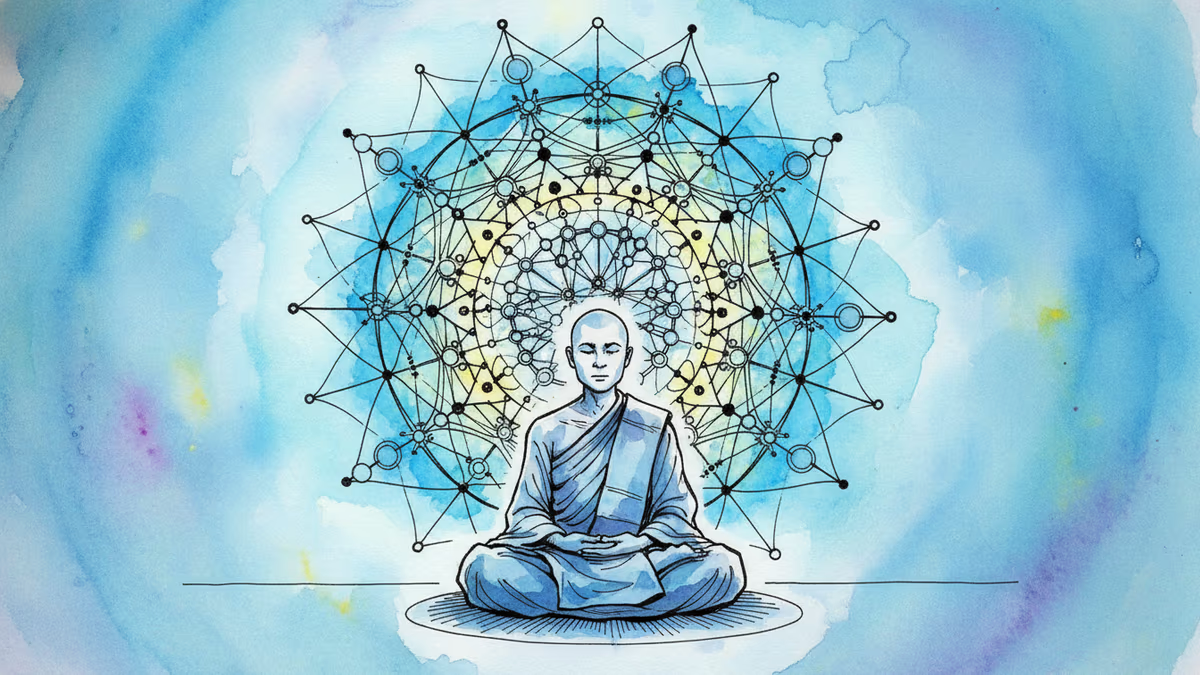
Your Meditating Brain Isn't Resting—It's Working Overtime
A groundbreaking study of Buddhist monks reveals meditation dramatically increases brain complexity rather than calming it down, challenging everything we thought we knew about this ancient practice.
12 Buddhist monks walked into a lab in Italy. It sounds like the setup to a joke, but the punchline rewrites everything we thought we knew about meditation.
Researchers from the University of Montreal and Italy's National Research Council brought these practitioners of the Thai Forest Tradition from their monastery outside Rome into a high-tech laboratory. Using magnetoencephalography (MEG)—technology that captures the brain's electrical signals with extraordinary precision—they monitored what actually happens in the meditating mind.
The results? Your brain during meditation isn't taking a break. It's working harder than ever.
Two Paths, One Surprising Truth
The study focused on two classical meditation techniques that couldn't be more different. Samatha meditation narrows attention like "focusing a flashlight beam," as lead researcher Karim Jerbi puts it—practitioners concentrate on steady breathing to achieve deep calm. Vipassana does the opposite, "widening the beam" to observe thoughts, emotions, and sensations as they arise without judgment.
Yet both practices produced the same startling result: dramatically increased brain signal complexity compared to rest states. The meditating brain doesn't quiet down—it enters what researchers describe as "a dynamic state rich with information."
This challenges the Western conception of meditation as mental downtime. Instead, it's more like switching your brain from energy-saving mode to high-performance computing.
The Sweet Spot Between Order and Chaos
The most fascinating discovery involved something called "criticality"—a concept borrowed from physics describing systems that operate most efficiently at the border between order and chaos. Think of it as your brain's Goldilocks zone: not too rigid, not too chaotic, but just right for optimal function.
"A brain that lacks flexibility adapts poorly, while too much chaos can lead to malfunction, as in epilepsy," Jerbi explained. At the critical point, neural networks remain stable enough to transmit information reliably while staying flexible enough to adapt quickly.

The two meditation styles approached this sweet spot differently. Vipassana brought practitioners closer to the perfect balance of stability and flexibility, while Samatha created a more stable, focused state. Both enhanced the brain's "processing, learning, and response capacity."
The Billion-Dollar Misunderstanding
This research arrives as the global meditation app market approaches $7 billion, with companies like Headspace and Calm positioning meditation primarily as a relaxation tool. Their marketing emphasizes stress relief, better sleep, and "emptying your mind."
But what if we've been selling meditation short? If this ancient practice actually optimizes cognitive performance—improving task-switching ability and information storage—shouldn't we be marketing it as brain training rather than just stress relief?
Tech companies already investing in employee wellness programs might need to reconsider their approach. Google's mindfulness initiatives and Apple's meditation features could shift from HR benefits to productivity tools.
The Neurofeedback Revolution
The implications extend beyond corporate wellness. If researchers can identify the specific neural signatures of optimal meditative states, we might eventually develop neurofeedback systems that help novices achieve these states faster.
Imagine meditation apps that don't just guide you through breathing exercises but actually monitor your brain activity in real-time, providing feedback when you hit that optimal critical state. We're not there yet, but the foundation is being laid.
Of course, this raises questions about commodifying an ancient spiritual practice. Can scientifically "optimized" meditation retain its deeper purpose, or does measurement inevitably diminish meaning?
Beyond the Monastery Walls
The study's biggest limitation is also its strength: these were highly trained monks, not stressed-out office workers trying meditation for the first time. The 12 participants had spent years, even decades, perfecting their practice.
Whether weekend warriors can achieve similar neural benefits remains an open question. But early evidence suggests even brief meditation training can produce measurable brain changes. The question isn't whether meditation works—it's how quickly and how much.
Authors
Related Articles

A Caribbean research facility uses extended DMT trips to study encounters with otherworldly entities. Are they hallucinations or something more? The quest to decode consciousness takes a radical turn.

Middle East missile strikes trigger global doomscrolling epidemic. Neuroscience reveals why we can't stop scrolling through bad news and how to break free.

Samsung Electronics' union branch revealed that 84% of survey respondents oppose the government's roughly $290 billion (₩400 trillion) semiconductor megaproject in Gwangju. Government, management, the union and shareholders are all reading the same national project in sharply different ways.

Nvidia shipped roughly a billion RISC-V cores in 2024, then announced it would run CUDA on the open standard. We break down how royalty-free instruction sets and open software stacks are trying to route around CUDA's lock-in. Part 2 of the Semiconductor Sovereignty series.
A Caribbean research facility uses extended DMT trips to study encounters with otherworldly entities. Are they hallucinations or something more? The quest to decode consciousness takes a radical turn.
Middle East missile strikes trigger global doomscrolling epidemic. Neuroscience reveals why we can't stop scrolling through bad news and how to break free.
Samsung Electronics' union branch revealed that 84% of survey respondents oppose the government's roughly $290 billion (₩400 trillion) semiconductor megaproject in Gwangju. Government, management, the union and shareholders are all reading the same national project in sharply different ways.
Nvidia shipped roughly a billion RISC-V cores in 2024, then announced it would run CUDA on the open standard. We break down how royalty-free instruction sets and open software stacks are trying to route around CUDA's lock-in. Part 2 of the Semiconductor Sovereignty series.
Thoughts
Share your thoughts on this article
Sign in to join the conversation