
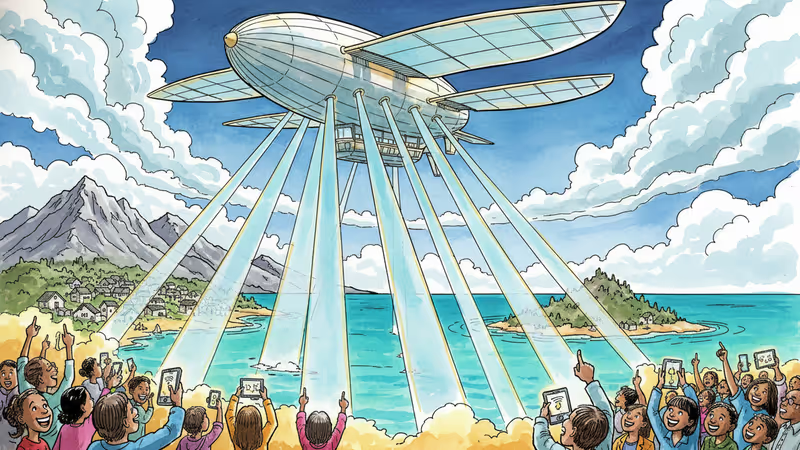
The Sky's the Limit: Can Airships Finally Bridge the Digital Divide?
While Starlink dominates headlines, stratospheric airships and drones are quietly preparing to connect 2.2 billion offline people. But can they succeed where Google's Loon failed?
2.2 billion people still live without reliable internet access in 2026. While Starlink satellites grab headlines with their space-based approach, a quieter revolution is brewing much closer to home—in the stratosphere, just 12 miles above our heads.
After Google's high-profile Loon balloon project crashed and burned in 2021, the dream of beaming internet from the sky seemed dead. But this year, companies like Aalto HAPS, Sceye, and World Mobile are preparing to prove that High-Altitude Platform Stations (HAPS) can succeed where balloons failed—using steerable airships and solar-powered drones that won't drift away with the wind.
The Altitude Advantage
The stratosphere occupies a unique sweet spot in connectivity delivery. Unlike satellites that race around Earth at 17,000 mph, HAPS can hover in place, maintaining constant coverage over specific regions. Unlike ground-based cell towers, they can cover vast areas—a single platform can serve the equivalent of 500 terrestrial towers.
Aalto HAPS proved this potential in April 2025 when their solar-powered Zephyr drone stayed airborne for 67 consecutive days—a HAPS endurance record. This year, they're partnering with NTT DOCOMO to test connectivity delivery to Japan's remote islands, where traditional infrastructure is too expensive to justify.
"For the user on the ground, there is no difference when they switch from the terrestrial network to the HAPS network," explains Pierre-Antoine Aubourg, Aalto's CTO. "It's exactly the same frequency and the same network."
Meanwhile, Sceye's65-meter helium airship is preparing for trials with SoftBank, promising to solve Loon's fatal flaw: unpredictable drift. Their airship can "point into the wind" and maintain position using electric fans powered by onboard batteries.
The Economics of Connection
The numbers tell a stark story about satellite internet's limitations. Starlink subscriptions start at $10 per month in Africa—still unaffordable for millions surviving on $2 per day. But cost isn't the only issue.

Starlink's bandwidth gets diluted as user density increases. Ukrainian forces report speeds dropping to just 10 Mbps during heavy combat operations, compared to peak speeds of 220 Mbps. Indonesian users faced similar degradation shortly after the service launched there in 2024.
The physics are unforgiving: satellite beams spread like flashlight cones across vast areas. Once user density exceeds one person per square kilometer—achievable even in remote island communities—performance suffers dramatically.
HAPS proponents claim they can deliver connectivity more efficiently. World Mobile says nine of their Stratomast aircraft could serve Scotland's 5.5 million residents for £40 million annually—equivalent to 60 pence per person monthly, compared to Starlink's£75 monthly subscription.
Regulatory Winds Shifting
The US Federal Aviation Administration released a 50-page framework in December 2025 for integrating HAPS into American airspace—a signal that regulators are taking the technology seriously. With 8 million US households still completely offline, HAPS could offer a cheaper alternative to traditional infrastructure.
Japan's geography makes it an ideal testing ground. The country's 430 inhabited islands are often too remote and mountainous for cost-effective terrestrial coverage. Space Compass, NTT DOCOMO's satellite partner, sees HAPS as transformative for Japan's communications ecosystem, particularly for emergency response.
The Skeptics' View
Despite the optimism, analysts remain cautious. The HAPS market is projected at just $1.9 billion by 2033, while satellite internet could reach $33.44 billion by 2030.
"The HAPS market has been really slow and challenging to develop," warns Dallas Kasaboski from consultancy Analysis Mason. "A few companies were very interested in it, very ambitious about it, and then it just didn't happen."
The technology has struggled since the 1990s, losing out to satellite mega-constellations as SpaceX drove down launch costs. Facebook's Aquila project also failed due to technical difficulties, joining Google's Loon in the graveyard of sky-high ambitions.
Current HAPS companies aren't just competing against technical challenges—they're racing to catch up with established satellite networks that have already captured market share and investor confidence.
Authors
Related Articles

Elon Musk's Starlink provides free internet to Iran in 2026 to bypass a total communications blackout. Explore the tech battle between satellites and state jamming.

Five stories from late September, traced to where the paper trail stops: Korea's export record, Nvidia's Hugging Face 8-K, a US-China AI channel, the UN on AI, and rising births.

Huawei's CANN is open source under a license barring software for non-Ascend chips. Inside China's second CUDA, and the two links still outside it: pre-training compute and 5nm capacity.
Samsung Electronics' union branch revealed that 84% of survey respondents oppose the government's roughly $290 billion (₩400 trillion) semiconductor megaproject in Gwangju. Government, management, the union and shareholders are all reading the same national project in sharply different ways.
Elon Musk's Starlink provides free internet to Iran in 2026 to bypass a total communications blackout. Explore the tech battle between satellites and state jamming.
Five stories from late September, traced to where the paper trail stops: Korea's export record, Nvidia's Hugging Face 8-K, a US-China AI channel, the UN on AI, and rising births.
Huawei's CANN is open source under a license barring software for non-Ascend chips. Inside China's second CUDA, and the two links still outside it: pre-training compute and 5nm capacity.
Samsung Electronics' union branch revealed that 84% of survey respondents oppose the government's roughly $290 billion (₩400 trillion) semiconductor megaproject in Gwangju. Government, management, the union and shareholders are all reading the same national project in sharply different ways.
Thoughts
Share your thoughts on this article
Sign in to join the conversation