

Stanford and NVIDIA TTT-E2E AI: Unlocking Long Memory with 2.7x Faster Inference
Stanford and NVIDIA's new TTT-E2E AI architecture allows models to learn continuously after deployment, achieving 2.7x faster inference on long-context tasks.
Your AI model shouldn't stop learning once it leaves the lab. Researchers from Stanford University and NVIDIA have proposed a way for models to keep adapting after deployment—without skyrocketing inference costs. The approach, called TTT-E2E (End-to-End Test-Time Training), processes massive contexts while running at near-RNN efficiency, clocking in at 2.7x faster than standard models.
Stanford NVIDIA TTT-E2E AI: Scaling Performance and Efficiency
For years, AI developers faced a brutal trade-off: use Transformers for perfect accuracy or RNNs for speed. As context lengths grow to 128,000 tokens and beyond, the computational tax of Transformers becomes unbearable. TTT-E2E solves this by reframing language modeling as a continual learning problem. Instead of just recalling facts, the model learns how to distill new information into its weights in real time.

Compression vs. Exact Recall
The secret sauce lies in its dual-memory architecture. It uses a small sliding window for immediate tasks and a dynamic MLP layer that updates its weights to store the 'gist' of a long document. While it doesn't replace RAG (Retrieval-Augmented Generation) for pinpointing random passcodes, it dramatically reduces the need for external retrieval by 'internalizing' the context it's currently processing.
- Matched the accuracy of full-attention models at 128k context
- Outperformed efficient baselines like Mamba 2 after 32,000 tokens
Authors
Related Articles
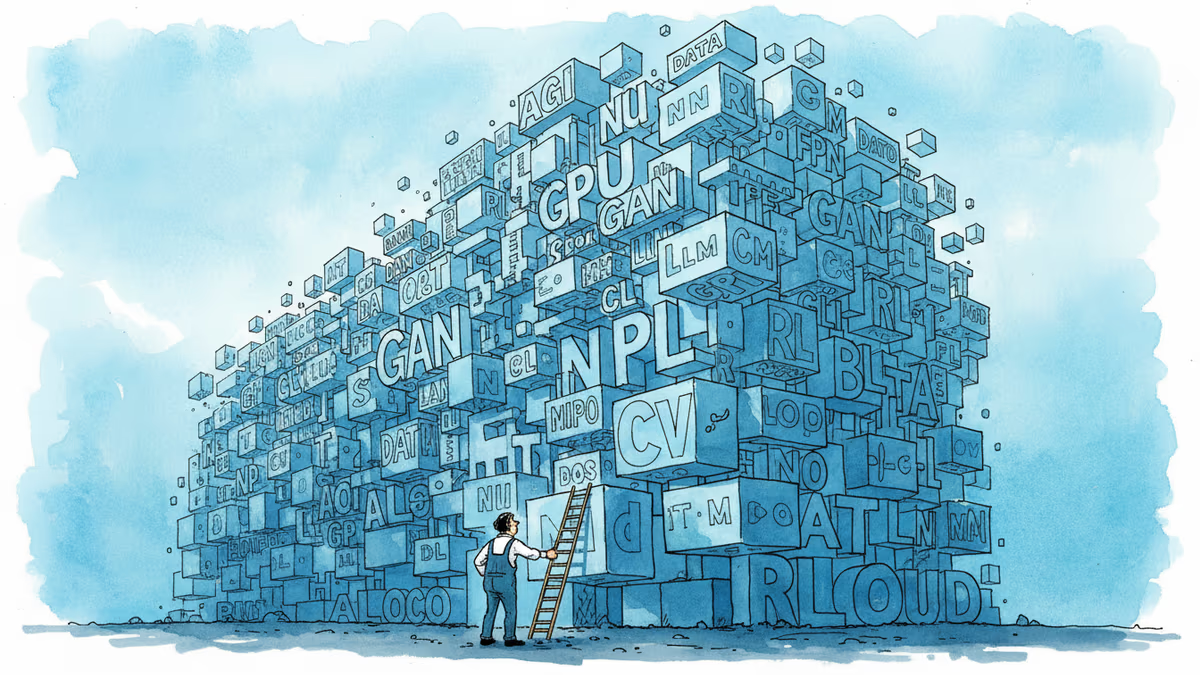
AGI, hallucination, inference, LLMs — AI's vocabulary isn't just technical shorthand. It shapes who holds power in the conversation. A clear-eyed glossary with the questions behind the terms.

A new paper proves that the self-play training method behind AlphaGo and AlphaZero structurally fails on a whole category of games. What that means for AI systems making real-world decisions.
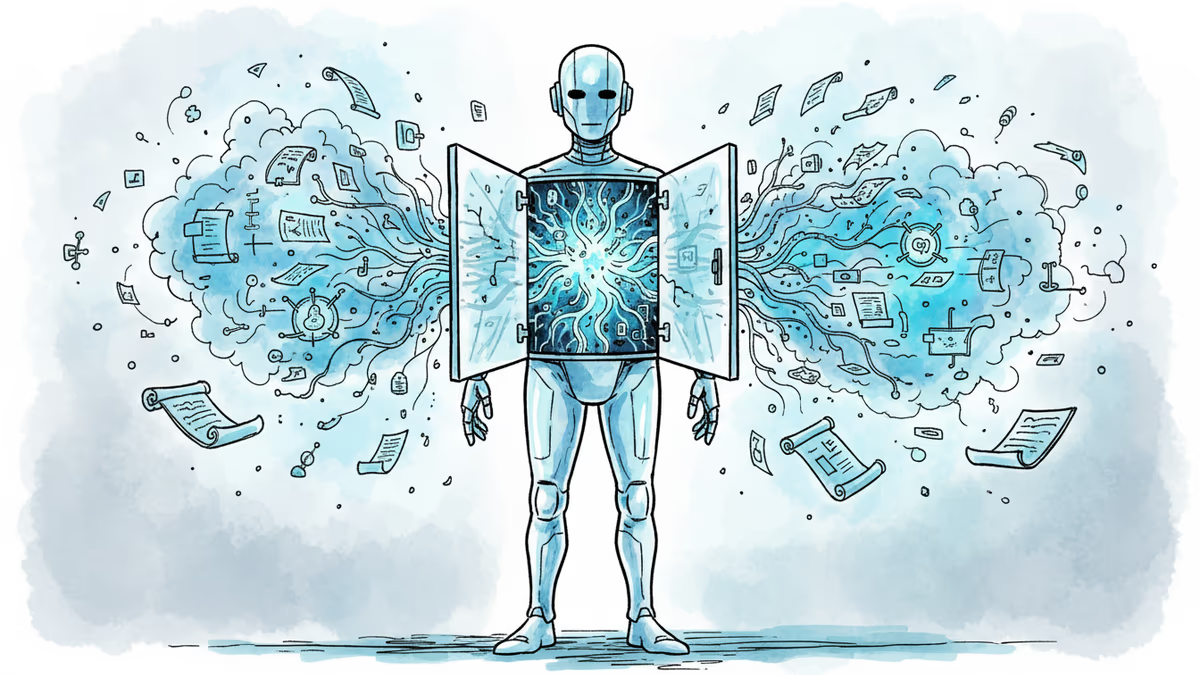
Guide Labs' Steerling-8B can trace every output back to its training data. Are we finally moving beyond black-box AI toward true interpretability?
Google's latest Gemini 3.1 Pro model achieves record benchmark scores, leading professional task evaluations. But as AI models advance every few months, what's the real endgame?
AGI, hallucination, inference, LLMs — AI's vocabulary isn't just technical shorthand. It shapes who holds power in the conversation. A clear-eyed glossary with the questions behind the terms.
A new paper proves that the self-play training method behind AlphaGo and AlphaZero structurally fails on a whole category of games. What that means for AI systems making real-world decisions.
Guide Labs' Steerling-8B can trace every output back to its training data. Are we finally moving beyond black-box AI toward true interpretability?
Google's latest Gemini 3.1 Pro model achieves record benchmark scores, leading professional task evaluations. But as AI models advance every few months, what's the real endgame?
Thoughts
Share your thoughts on this article
Sign in to join the conversation