
When AI Can Actually Explain Itself
Guide Labs' Steerling-8B can trace every output back to its training data. Are we finally moving beyond black-box AI toward true interpretability?
The $1 Trillion Question Nobody's Answering
Why did ChatGPT say that? It's the question haunting every AI interaction, from xAI's political struggles with Grok to routine hallucinations that make users second-guess every response. With billions of parameters swirling in neural networks, understanding AI behavior has been like performing neurosurgery blindfolded.
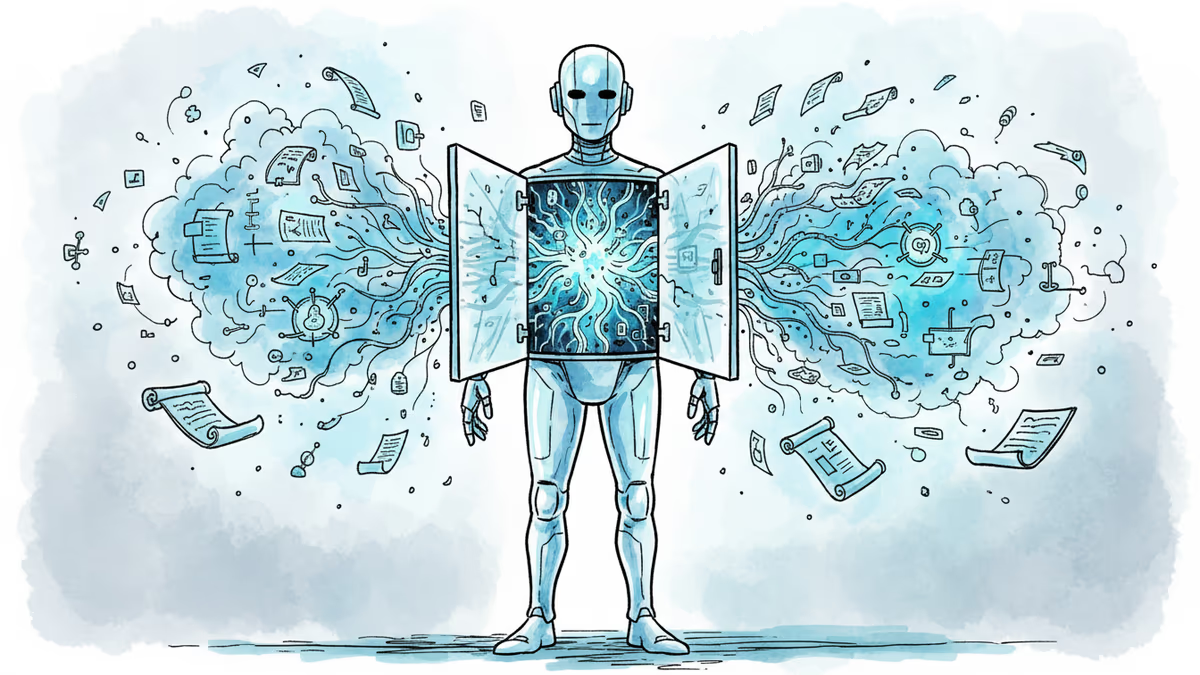
Guide Labs, a San Francisco startup, thinks they've cracked the code. On Monday, they open-sourced Steerling-8B, an 8 billion parameter LLM with a radical difference: every token it produces can be traced back to its origins in the training data.
Flipping the Script on AI Archaeology
Most AI interpretability work resembles digital archaeology—scientists dig through completed models trying to understand what happened. Guide Labs CEO Julius Adebayo calls this approach fundamentally flawed. "If I have a trillion ways to encode gender, and I encode it in 1 billion of those trillion things, you have to find all those billion encodings and reliably turn them on or off," he told TechCrunch.
Adebayo's insight came during his MIT PhD, where his widely-cited 2020 paper showed existing interpretability methods weren't reliable. Instead of post-hoc analysis, his team engineers interpretability from the ground up by inserting a "concept layer" that buckets data into traceable categories.
The Emergence Dilemma

Critics worry this approach might kill the magic—those surprising emergent behaviors that make LLMs so compelling. But Adebayo says emergence survives. His team tracks "discovered concepts" the model finds on its own, like quantum computing connections it wasn't explicitly taught.
The proof is in performance: Steerling-8B achieves 90% of existing models' capabilities while using less training data. The startup, which emerged from Y Combinator and raised $9 million from Initialized Capital in November 2024, plans to scale up and offer API access.
Why Wall Street Should Care
The business case extends far beyond academic curiosity. Consumer-facing LLMs could block copyrighted materials or better control outputs around violence and drug abuse. In regulated industries like finance, loan evaluation models need to consider credit history but ignore race—a distinction that requires surgical precision.
Scientific applications are equally compelling. Protein folding represents deep learning's biggest success story, but scientists need to understand why certain combinations work. "This demonstrates that training interpretable models is no longer science; it's now an engineering problem," Adebayo argues.
The Regulatory Reckoning
Timing matters. As AI systems become more powerful and pervasive, regulators worldwide are demanding explainability. The EU's AI Act, potential US federal legislation, and sector-specific rules all point toward transparency requirements that current black-box models can't meet.
For enterprises, interpretable AI isn't just about compliance—it's about trust. When an AI system makes decisions affecting loans, hiring, or medical diagnoses, stakeholders need more than "the algorithm said so."
Authors
Related Articles

Samsung and SK unveiled a chip and AI investment package worth thousands of trillions of won on June 29. The headline number swings wildly by outlet, but the real contest isn't capital — it's water and power.

Lucra Sports CEO Dylan Robbins landed Cathie Wood's ARK Invest as a Series B lead without building AI. The story behind his unconventional fundraising playbook.

Viral videos show 2026 graduates jeering executives who praise AI at commencement ceremonies. It's not just rudeness — it's a signal about who pays for technological optimism.
Filipino virtual assistants using AI to ghost-manage LinkedIn profiles for executives is now a structured industry. 30 comments a day, fake engagement rings, and a platform struggling to tell real from fabricated.
Samsung and SK unveiled a chip and AI investment package worth thousands of trillions of won on June 29. The headline number swings wildly by outlet, but the real contest isn't capital — it's water and power.
Lucra Sports CEO Dylan Robbins landed Cathie Wood's ARK Invest as a Series B lead without building AI. The story behind his unconventional fundraising playbook.
Viral videos show 2026 graduates jeering executives who praise AI at commencement ceremonies. It's not just rudeness — it's a signal about who pays for technological optimism.
Filipino virtual assistants using AI to ghost-manage LinkedIn profiles for executives is now a structured industry. 30 comments a day, fake engagement rings, and a platform struggling to tell real from fabricated.
Thoughts
Share your thoughts on this article
Sign in to join the conversation