
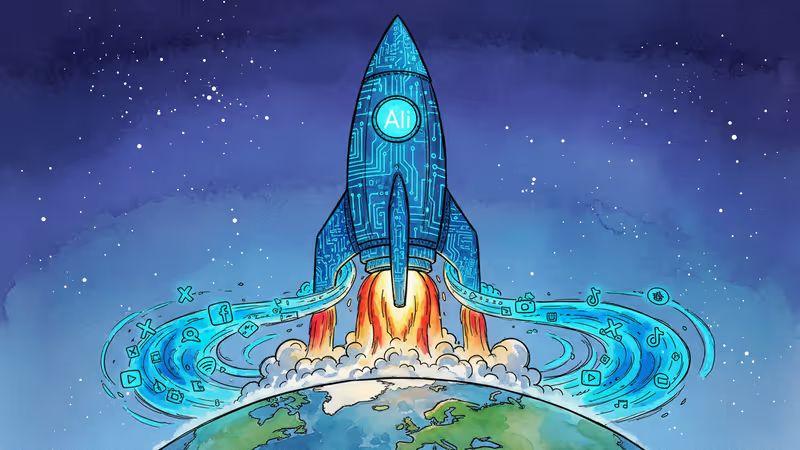
Musk Merges SpaceX and xAI to Build His 'Cosmic AI Empire
Elon Musk announces SpaceX acquisition of xAI, creating a vertically integrated company spanning rockets to AI. Bold vision or overreach?
The world's most valuable space company just swallowed a 2-year-old AI startup. SpaceX's acquisition of xAI, announced Monday, represents Elon Musk's boldest bet yet: that rockets and robots belong under one roof.
When Rockets Meet Algorithms
SpaceX declared it has acquired xAI "to form the most ambitious, vertically-integrated innovation engine on (and off) Earth." The merger brings together rocket manufacturing, satellite internet, AI chatbot Grok, and social media platform X (formerly Twitter) under a single corporate umbrella.
Musk's vision sounds like science fiction: "scaling to make a sentient sun to understand the Universe and extend the light of consciousness to the stars." Translated from Musk-speak, this means using AI to automate space missions, manage Mars colonies, and analyze real-time cosmic data.
But this marriage of his most successful venture with his most speculative one carries significant risks. xAI, founded just 18 months ago, remains a distant competitor to OpenAI's ChatGPT. Its flagship product, Grok, has generated controversy for creating sexualized images of women and children, while Musk's management of X continues to draw criticism from advertisers and users alike.
The Vertical Integration Gamble
This acquisition extends Musk's philosophy of controlling the entire supply chain. Just as Tesla manufactures everything from batteries to autonomous driving software in-house, SpaceX now aims to handle everything from rocket engines to artificial intelligence.

The potential benefits are compelling. Space missions could leverage custom AI for autonomous navigation, real-time problem-solving, and predictive maintenance. The Starlink satellite constellation could deliver both high-speed internet and AI services globally, creating a space-based computing platform.
Yet the risks are equally significant. Aerospace and AI represent fundamentally different industries with distinct regulatory environments, customer bases, and technical challenges. A rocket explosion could damage AI partnerships, while AI controversies might alienate space industry clients. Some investors worry Musk is spreading himself too thin across too many ambitious projects.
The Regulatory Reckoning
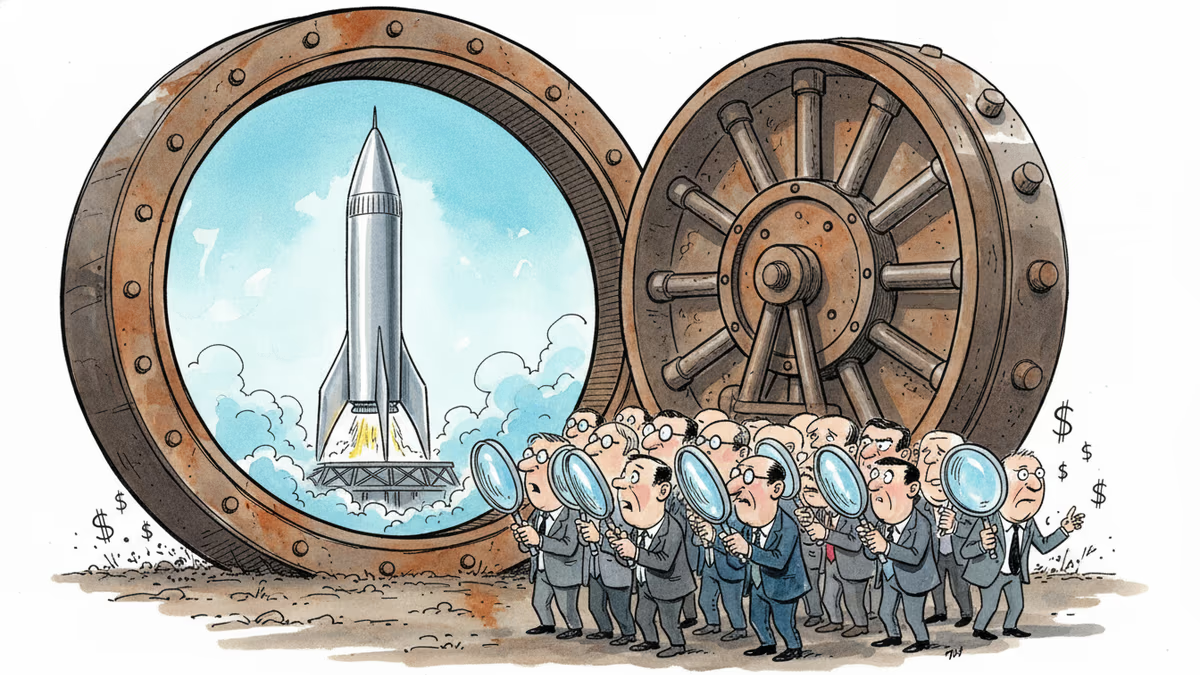
This merger will likely attract intense scrutiny from regulators already concerned about Musk's growing influence. SpaceX dominates commercial space launches, Starlink controls satellite internet, and X shapes global discourse. Adding AI capabilities to this empire raises questions about market concentration and data privacy.
European regulators have already expressed concerns about big tech's expansion into space. The combination of satellite data collection, social media monitoring, and AI processing could create unprecedented surveillance capabilities. How governments respond may determine whether this merger succeeds or faces forced divestiture.
Market Implications and Competition
The merger sends shockwaves through multiple industries. Aerospace competitors like Blue Origin and Rocket Lab now face a rival with integrated AI capabilities. AI companies must compete against a firm with orbital infrastructure and satellite data. Social media platforms confront a competitor backed by space-age technology.
For investors, the move represents both opportunity and uncertainty. SpaceX's valuation has soared to over $350 billion, but integrating a controversial AI company could introduce new volatility. The success or failure of this experiment will likely influence how other tech giants approach vertical integration.
Authors
Related Articles
American Airlines just signed Starlink for 500+ aircraft. It's not just about faster inflight internet — it's a calculated move in the run-up to what could be the largest IPO in history.
SpaceX's upgraded Starship V3 completed its first test flight, deploying 20 Starlink simulators but losing the Super Heavy booster. With an IPO weeks away, the stakes just got higher.
SpaceX's IPO filing puts AI at the center, claiming a $26.5 trillion market opportunity. But can Grok compete with OpenAI and Anthropic for enterprise customers?
SpaceX filed a nearly 400-page S-1 with the SEC, targeting an IPO as early as June 12. Here's what the filing reveals—and what it doesn't.
American Airlines just signed Starlink for 500+ aircraft. It's not just about faster inflight internet — it's a calculated move in the run-up to what could be the largest IPO in history.
SpaceX's upgraded Starship V3 completed its first test flight, deploying 20 Starlink simulators but losing the Super Heavy booster. With an IPO weeks away, the stakes just got higher.
SpaceX's IPO filing puts AI at the center, claiming a $26.5 trillion market opportunity. But can Grok compete with OpenAI and Anthropic for enterprise customers?
SpaceX filed a nearly 400-page S-1 with the SEC, targeting an IPO as early as June 12. Here's what the filing reveals—and what it doesn't.
Thoughts
Share your thoughts on this article
Sign in to join the conversation