
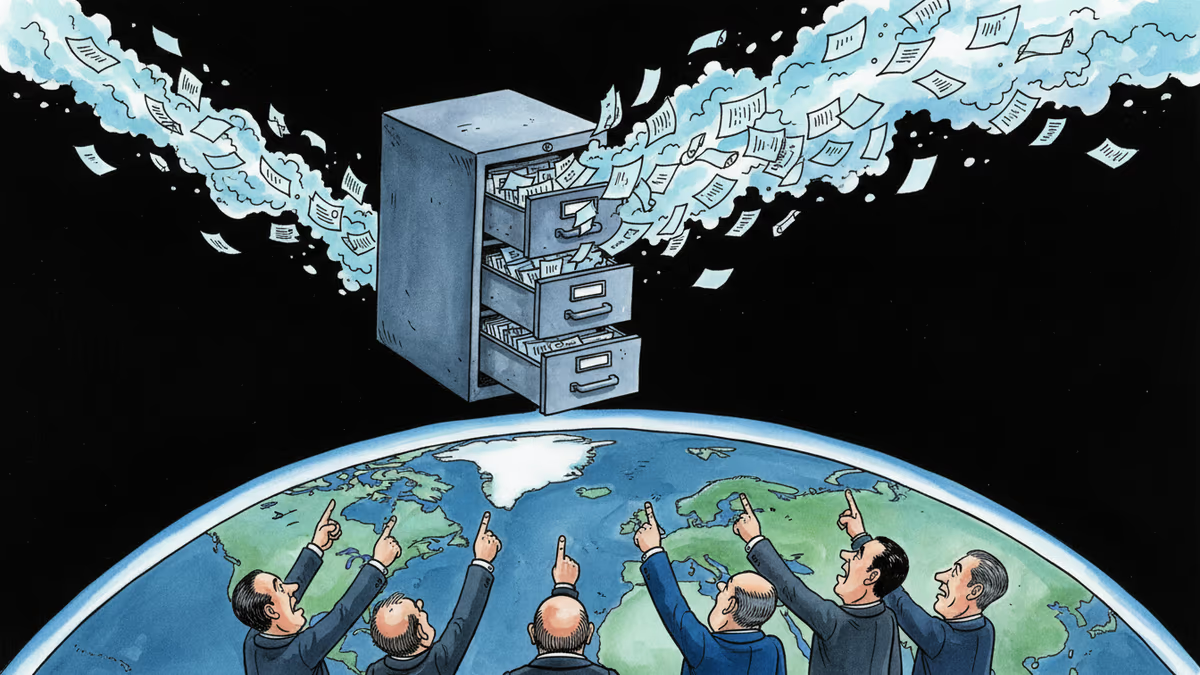
Trump's UFO Files Promise: Alien Truth or Political Theater?
Trump pledged to release government UFO files, but NASA and intelligence agencies found no alien evidence. What's really behind this timing?
The Promise That Broke the Internet
Last month, a single social media post sent conspiracy theorists into overdrive. President Trump announced he would direct the Pentagon to "begin the process" of disclosing government files on alien life and UAPs (unidentified anomalous phenomena). Within hours, the post had millions of views and sparked debates across news networks.
But here's what makes this announcement particularly intriguing: it comes despite years of official reports finding no evidence of extraterrestrial visitors.
What Science Actually Says
The scientific community has been remarkably consistent. NASA's 2023 blue-ribbon panel concluded there's "no conclusive evidence suggesting an extraterrestrial origin for UAP" in peer-reviewed literature. The Office of the Director of National Intelligence echoed this in 2021, noting that "limited high-quality reporting on unidentified aerial phenomena hampers our ability to draw firm conclusions."
Yet those 2020 military videos showing unexplained phenomena remain genuinely puzzling. The objects displayed flight characteristics that challenge our understanding of physics—if the footage is authentic and unedited.
The Political Calculus

Timing in politics is everything. UFO disclosure promises tend to surface during periods of domestic turbulence or international tension. The pattern isn't new: Project Blue Book emerged during Cold War anxieties, and recent UAP discussions coincided with rising China tensions.
For Trump, the UFO card serves multiple purposes. It positions him as the transparency candidate, distracts from other issues, and taps into a bipartisan fascination that crosses traditional political divides. Polls show 68% of Americans believe the government knows more about UFOs than it's sharing.
The Defense Industry Angle
There's another layer worth considering: military contractors. Companies like Lockheed Martin and Raytheon have significant interests in advanced aerospace research. UFO discussions often lead to increased funding for experimental aircraft programs and sensor technologies.
Some analysts suggest that many "unexplained" phenomena might actually be classified military tests of next-generation aircraft. The timing of UAP reports often correlates with known experimental flight programs.
Public Fascination vs. Scientific Rigor
The disconnect between public enthusiasm and scientific caution reveals something deeper about how we process uncertainty. Social media amplifies sensational claims while rigorous analysis gets buried in technical reports few people read.
Harvard's Avi Loeb, despite his controversial theories about interstellar objects, emphasizes the need for "scientific methodology" rather than "wishful thinking" in UAP research. The challenge isn't just finding evidence—it's distinguishing genuine anomalies from measurement errors, atmospheric phenomena, and human psychology.
Authors
Related Articles
Josh D'Amaro took over Disney with a bold Disney Plus vision. Days later, he's in a First Amendment fight with the Trump administration over The View. What does this mean for media freedom?
A gunman attacked a Secret Service checkpoint at the White House Correspondents' Dinner. Trump's first public reaction wasn't about security. It was about his $400M ballroom project.
Hours after an armed suspect attempted to breach the White House Correspondents Dinner, Trump used the security scare to publicly defend his White House ballroom project. What does that tell us?
As Washington D.C. enters another political spring, the battle over Big Tech regulation is heating up — and the stakes extend far beyond Silicon Valley.
Josh D'Amaro took over Disney with a bold Disney Plus vision. Days later, he's in a First Amendment fight with the Trump administration over The View. What does this mean for media freedom?
A gunman attacked a Secret Service checkpoint at the White House Correspondents' Dinner. Trump's first public reaction wasn't about security. It was about his $400M ballroom project.
Hours after an armed suspect attempted to breach the White House Correspondents Dinner, Trump used the security scare to publicly defend his White House ballroom project. What does that tell us?
As Washington D.C. enters another political spring, the battle over Big Tech regulation is heating up — and the stakes extend far beyond Silicon Valley.
Thoughts
Share your thoughts on this article
Sign in to join the conversation