
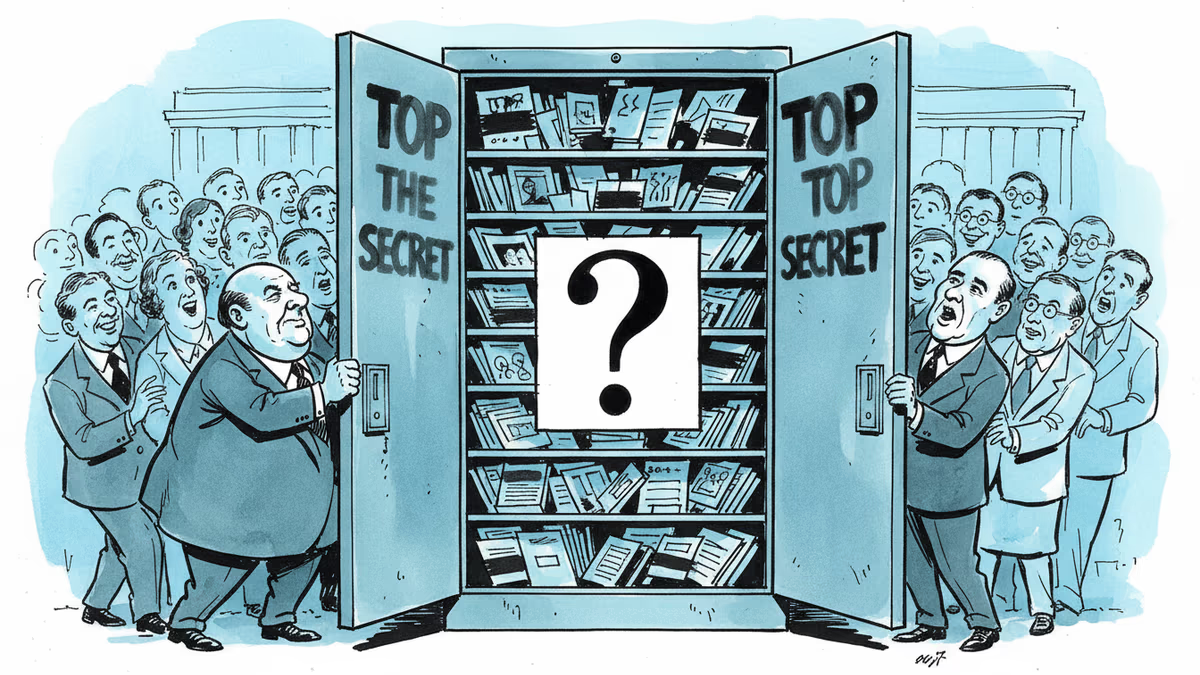
The UFO Files Are Coming. Don't Hold Your Breath.
Trump ordered the release of government UFO and alien files. History suggests we'll get radar data and redacted reports—not spaceships. Here's what's likely in, and what's almost certainly out.
It started with a podcast quiz. Barack Obama, asked offhand whether aliens are real, said yes—meaning, almost certainly, that life probably exists somewhere in a universe of 400 billion stars per galaxy. The internet didn't wait for that clarification. Within days, Donald Trump posted on Truth Social that his administration would "begin the process of identifying and releasing Government files related to alien and extraterrestrial life, unidentified aerial phenomena (UAP), and unidentified flying objects (UFOs)."
The files are coming. The question nobody's asking loudly enough: will they actually tell us anything?
What's Probably in the Files
The Pentagon's All-domain Anomaly Resolution Office (AARO)—the branch tasked with tracking UAP—confirmed to WIRED that it's coordinating with the White House to "consolidate existing UAP records collections and facilitate the expeditious release of never-before-seen UAP information." That's bureaucratic language for: we're sorting through the filing cabinets.
History offers a reasonable preview. Since the first major UFO craze in 1947, the US government has released material in waves: Project Blue Book (1947–1969), the 1994 Roswell Report, and the Pentagon UAP videos declassified after they were leaked. Each release followed a similar template—documented sightings, internal tracking programs, and occasionally, uncomfortable admissions.
The most memorable of those admissions came in a 1997 CIA report acknowledging that the Air Force had made "misleading and deceptive statements to the public" to protect a classified national security project. New files could contain similar records of how the government managed its public posture on UAP—what it said, what it didn't, and why.
Additional radar data or unreleased visuals of UAP sightings are also possible. But anything that reveals the location of military assets or the methods behind intelligence collection will almost certainly stay classified. As Greg Eghigian, a professor of history and bioethics at Penn State who studies UAP, explains: "Classifying stuff is often not about the information itself. By releasing it, you might reveal something about the technology used to detect it. That's the real concern."
Anamaria Berea, an associate professor at George Mason University who served on NASA's UAP Independent Study Team, adds useful nuance: UAP "can be a number of things. Many are eventually explained—balloons, aircraft, atmospheric phenomena. Then there's a small category where it's still not clear what they are." That last category is what everyone's really waiting on.

What's Almost Certainly Not in the Files
Let's be direct about what the public actually wants: a spaceship. Alien bodies. Some physical, irrefutable proof of nonhuman intelligence. Congressional testimony in recent years—including claims about "nonhuman biological or technological materials" held by the government—has pushed those expectations to a fever pitch.
Adam Frank, professor of astrophysics at the University of Rochester, cuts through it plainly: "Unless you actually release real data—the spaceship or the alien body these congressional testimonies have said existed—it's just going to be more smoke and mirrors."
As for files about alien life specifically? The scientific search for extraterrestrial life has been conducted almost entirely in public for decades. There's no classification rationale for it. Berea notes that the government has already produced "a huge amount of work, all of which is actually transparent about the study of life in the universe." If a telescope had detected an artificial signal from a distant star system, it would have been hashed out in peer-reviewed journals and press conferences—not buried in a Pentagon filing cabinet.
She also raises a point that often gets lost in American-centric coverage: "It's not like all the reports come from the US government. The UK, France, Brazil—governments around the world have released UAP documents. It would be really, really hard to believe there is such a global conspiracy."
The Deeper Problem: No File Will Be Enough
Here's the uncomfortable truth that the excitement around this release tends to obscure. Even if the files contained something genuinely remarkable, it might not matter.
Eghigian is blunt: "Even some sort of really remarkable and extraordinary revelation would certainly not satisfy the social-media-verse. 'Is this another hoax? Is this another game the government is playing with us? What else are they keeping from us?' I don't foresee almost any way for this thing to be definitively resolved in terms of public interest."
This isn't just about distrust of government. Berea frames it as something more fundamental: "Is it just us, or are there others out there? If they're out there, are they friendly? This is existential to our humanity. It's beyond science." A question that touches that nerve doesn't get resolved by a declassified PDF.
Meanwhile, the actual scientific search continues—Mars surface missions, surveys for alien artifacts in the solar system, telescopes scanning for biosignatures in other star systems. Frank lands on the pragmatic conclusion: "If these files don't give us the spaceship or a biological sample, you're going to have to actually go out and do the science anyway."
Authors
Related Articles
Josh D'Amaro took over Disney with a bold Disney Plus vision. Days later, he's in a First Amendment fight with the Trump administration over The View. What does this mean for media freedom?
A gunman attacked a Secret Service checkpoint at the White House Correspondents' Dinner. Trump's first public reaction wasn't about security. It was about his $400M ballroom project.
Hours after an armed suspect attempted to breach the White House Correspondents Dinner, Trump used the security scare to publicly defend his White House ballroom project. What does that tell us?
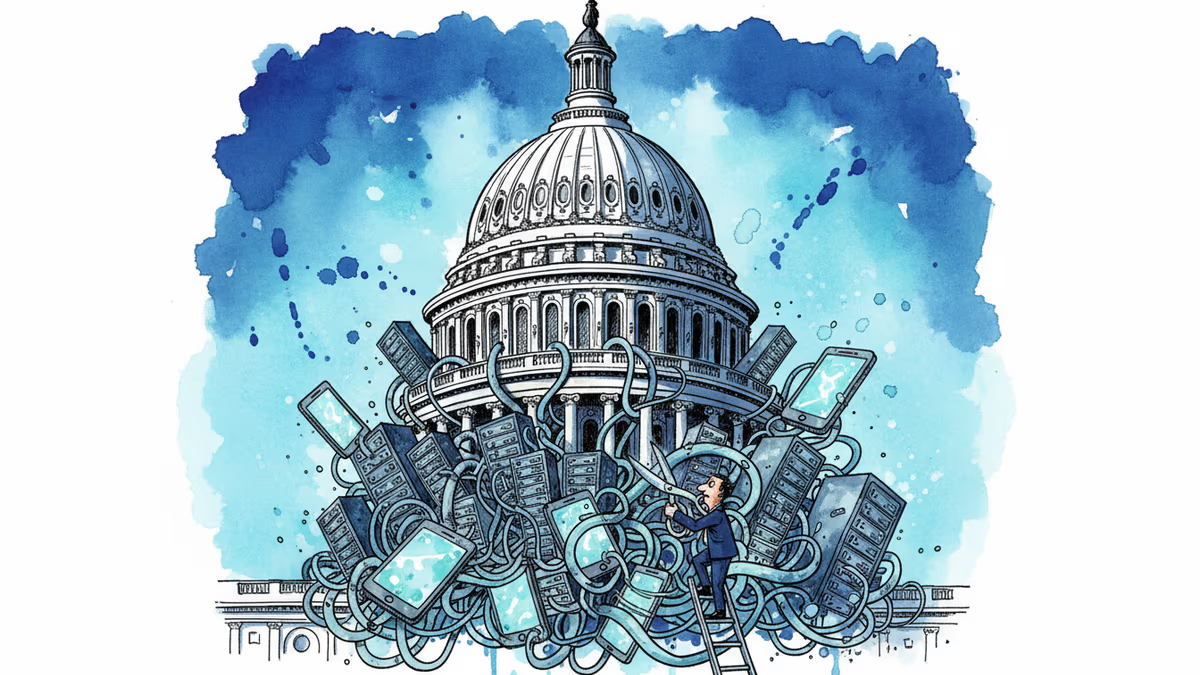
As Washington D.C. enters another political spring, the battle over Big Tech regulation is heating up — and the stakes extend far beyond Silicon Valley.
Josh D'Amaro took over Disney with a bold Disney Plus vision. Days later, he's in a First Amendment fight with the Trump administration over The View. What does this mean for media freedom?
A gunman attacked a Secret Service checkpoint at the White House Correspondents' Dinner. Trump's first public reaction wasn't about security. It was about his $400M ballroom project.
Hours after an armed suspect attempted to breach the White House Correspondents Dinner, Trump used the security scare to publicly defend his White House ballroom project. What does that tell us?
As Washington D.C. enters another political spring, the battle over Big Tech regulation is heating up — and the stakes extend far beyond Silicon Valley.
Thoughts
Share your thoughts on this article
Sign in to join the conversation