
AI Ate the Smartphone Industry's Lunch Money
Smartphone shipments to plummet 12.9% as AI giants hoard RAM. Prices hit record $523 while memory-hungry data centers squeeze out mobile manufacturers.
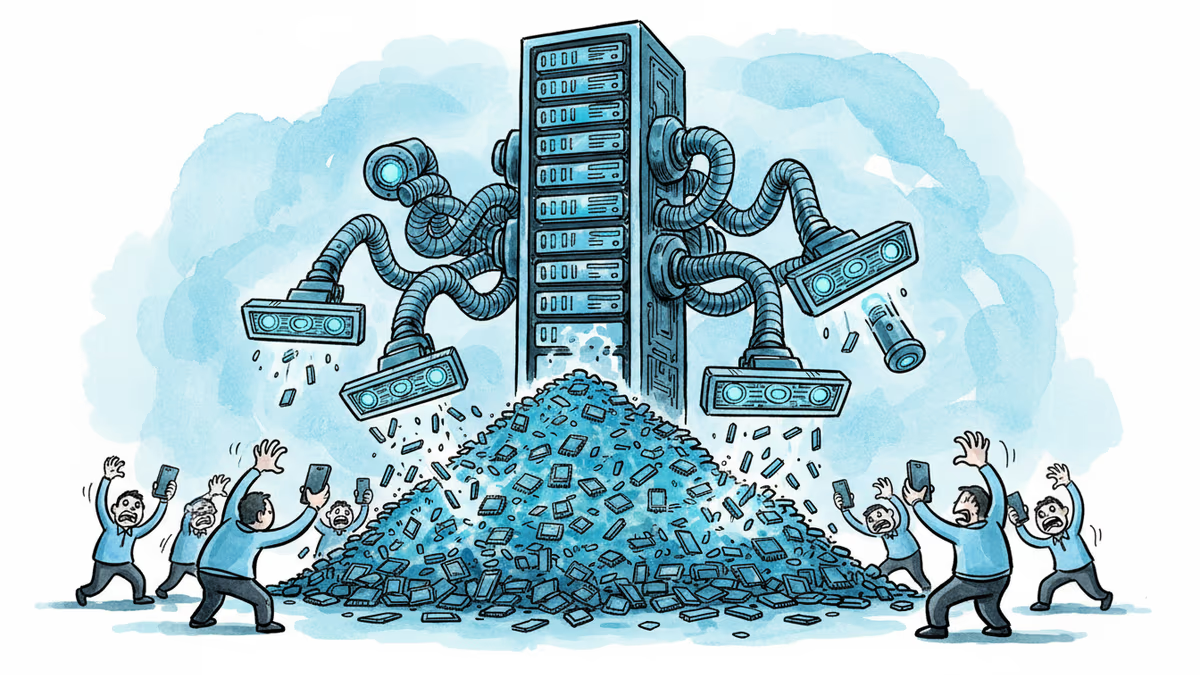
$523. That's what you'll pay for an average smartphone this year—a record high. Meanwhile, shipments are cratering by 12.9%, marking the industry's worst performance in over a decade. The culprit isn't market saturation or economic downturn. It's something far more unexpected: AI is eating the smartphone industry's supply chain.
According to IDC's latest forecast, 2026 will see smartphone shipments hit their "lowest annual volume in more than a decade" as memory-hungry AI data centers monopolize RAM supplies. While tech giants celebrate AI breakthroughs, smartphone manufacturers are scrambling for scraps.
The Great Memory Grab
Here's the math that's breaking the mobile industry: A single NVIDIA H100 GPU requires up to 80GB of high-bandwidth memory (HBM). That's enough RAM for 100 smartphones. As OpenAI, Google, and Microsoft race to build massive AI infrastructure, they're outbidding phone makers for the same memory chips.
Samsung and SK Hynix are laughing all the way to the bank—their memory divisions are posting record profits. But smartphone OEMs? They're caught in a supply squeeze that's forcing impossible choices: pay premium prices or cut production.
"Memory prices are projected to stabilize by mid-2027, but they're unlikely to return to previous levels," warns IDC. Translation: the cheap smartphone era is over.

Apple vs. Everyone Else
The shortage isn't hitting everyone equally. Apple, with its massive purchasing power and long-term supplier contracts, has secured better access to premium memory. Chinese manufacturers like Xiaomi and Oppo are feeling the pinch hardest, potentially reshuffling global market share.
Interestingly, consumers might not mind paying more. Smartphone replacement cycles have stretched to 4.2 years, suggesting people want devices that last longer—even if they cost more upfront. This could actually benefit manufacturers willing to bet on premium positioning.
The Unintended Consequences
The RAM shortage is triggering unexpected ripple effects. Some manufacturers are exploring alternative memory architectures, potentially accelerating innovation. Others are reconsidering their AI features—those on-device language models suddenly look expensive when every gigabyte of RAM costs premium prices.
Meanwhile, the used smartphone market is heating up. When new phones cost 14% more and supplies are constrained, suddenly that two-year-old iPhone looks pretty attractive.
Authors
Related Articles
Nothing launches Phone (4a) Pro in the US for $499, but without carrier partnerships, the UK company still faces an uphill battle against established players.
Apple's new MacBook Pro costs up to $400 more due to RAM shortages caused by AI data center demand, signaling broader tech industry pricing shifts ahead.
MWC 2026 showcases Honor's Robot Phone and other shape-shifting devices that challenge everything we know about mobile design. Are we ready for phones that transform themselves?
MWC 2026 promises breakthrough innovations from Xiaomi's European push to Honor's robot pivot. Here's what matters beyond the headlines.
Nothing launches Phone (4a) Pro in the US for $499, but without carrier partnerships, the UK company still faces an uphill battle against established players.
Apple's new MacBook Pro costs up to $400 more due to RAM shortages caused by AI data center demand, signaling broader tech industry pricing shifts ahead.
MWC 2026 showcases Honor's Robot Phone and other shape-shifting devices that challenge everything we know about mobile design. Are we ready for phones that transform themselves?
MWC 2026 promises breakthrough innovations from Xiaomi's European push to Honor's robot pivot. Here's what matters beyond the headlines.
Thoughts
Share your thoughts on this article
Sign in to join the conversation