

When Smartphones Become Transformers
MWC 2026 showcases Honor's Robot Phone and other shape-shifting devices that challenge everything we know about mobile design. Are we ready for phones that transform themselves?
Four months after its initial tease, Honor's Robot Phone finally showed what it can actually do. At MWC 2026 in Barcelona, the Chinese brand demonstrated a working prototype that bends, folds, and repositions itself without human touch.
But this isn't just another tech demo. It's the mobile industry asking a fundamental question that's been 20 years in the making: What if the rectangular slab in your pocket isn't the final form?
The Shape-Shifting Revolution
Honor's Robot Phone does exactly what its name suggests—it transforms. The device automatically adjusts its screen angle for video calls, morphs into a gaming controller configuration, and even stands itself up as a makeshift tripod. No manual folding required.
The timing isn't coincidental. While Samsung and other manufacturers have been pushing foldable displays, Chinese brands are leapfrogging to autonomous transformation. Xiaomi, Oppo, and several others showcased similar concepts at MWC, suggesting this isn't a one-off experiment.
What's striking isn't the technology itself—motorized hinges and flexible displays have existed for years. It's the convergence around a single idea: physical adaptability.
The American Consumer Dilemma
U.S. smartphone users have grown accustomed to incremental updates: better cameras, faster processors, longer battery life. The idea of a phone that physically transforms itself represents a paradigm shift that many aren't sure they want.

Early focus groups reveal mixed reactions. Tech enthusiasts are intrigued, but mainstream users express concerns about durability and complexity. "I just want my phone to work," said one participant in a recent study. "I don't need it to do gymnastics."
Apple has remained notably silent about shape-shifting devices, sticking to its philosophy of refined simplicity. This creates an interesting dynamic: while Chinese brands push radical innovation, American consumers might prefer evolutionary improvements.
The $1,500 Question
Pricing remains the elephant in the room. Honor's Robot Phone is expected to retail for over $1,500, putting it in premium territory. That's a significant ask for technology that's essentially unproven in real-world conditions.
Durability concerns are legitimate. More moving parts mean more potential failure points. Early prototypes have shown issues with hinge mechanisms after 10,000 transformations—roughly six months of heavy use.
Yet pre-order interest from tech early adopters suggests there's appetite for radical innovation, even at premium prices. The question is whether this enthusiasm will translate to mainstream adoption.
Beyond the Gimmick
The real test isn't whether Robot Phones can transform—it's whether transformation serves a genuine purpose. Current demonstrations focus on convenience features: hands-free video calls, optimized gaming angles, photography stands.
But critics argue these benefits don't justify the complexity. Existing accessories already solve most of these problems at a fraction of the cost and risk.
The counterargument is more philosophical: smartphones have become too predictable. After years of incremental improvements, the industry needs breakthrough innovation to reignite consumer excitement.
Authors
Related Articles

MWC 2026 unveiled a smartphone with built-in fire starter. Is this the future of mobile innovation or a step too far?
Nothing launches Phone (4a) Pro in the US for $499, but without carrier partnerships, the UK company still faces an uphill battle against established players.
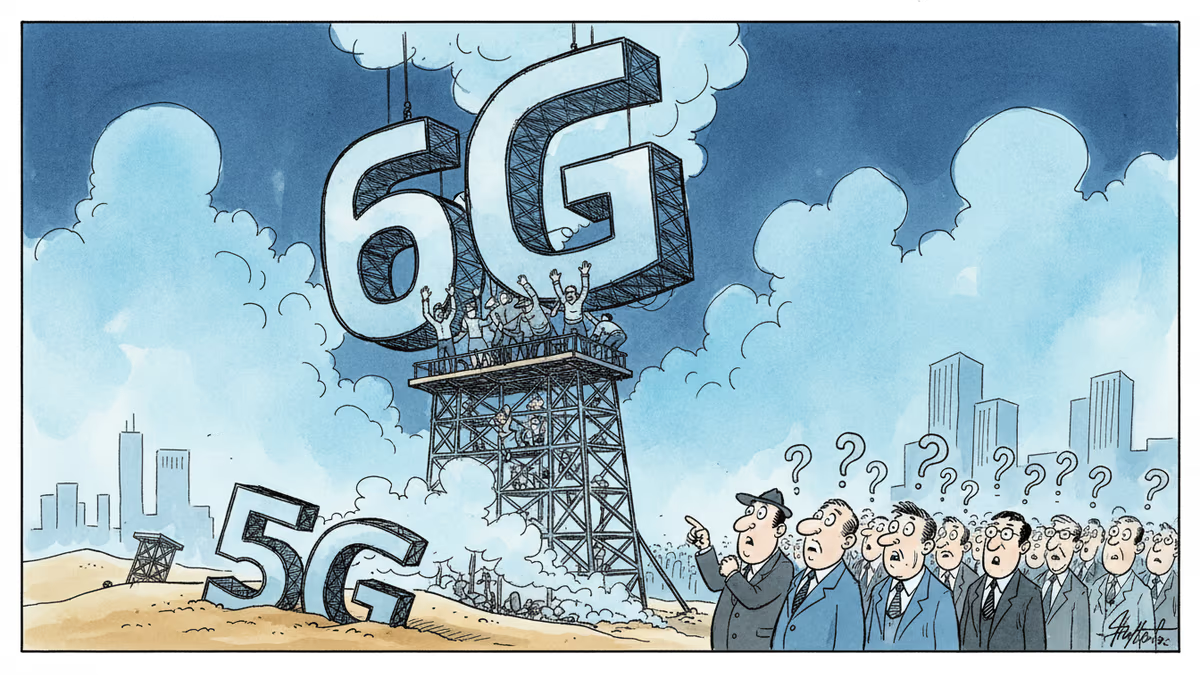
Mobile World Congress 2026 kicks off with 6G discussions, but 5G's promised revolution remains largely unfulfilled. What does the next generation really mean?

Lenovo's MWC 2026 concepts include a laptop with a detachable second screen, a folding gaming handheld, and a 3D workstation with magnetic tools. Are these the computers we actually want?
MWC 2026 unveiled a smartphone with built-in fire starter. Is this the future of mobile innovation or a step too far?
Nothing launches Phone (4a) Pro in the US for $499, but without carrier partnerships, the UK company still faces an uphill battle against established players.
Mobile World Congress 2026 kicks off with 6G discussions, but 5G's promised revolution remains largely unfulfilled. What does the next generation really mean?
Lenovo's MWC 2026 concepts include a laptop with a detachable second screen, a folding gaming handheld, and a 3D workstation with magnetic tools. Are these the computers we actually want?
Thoughts
Share your thoughts on this article
Sign in to join the conversation