
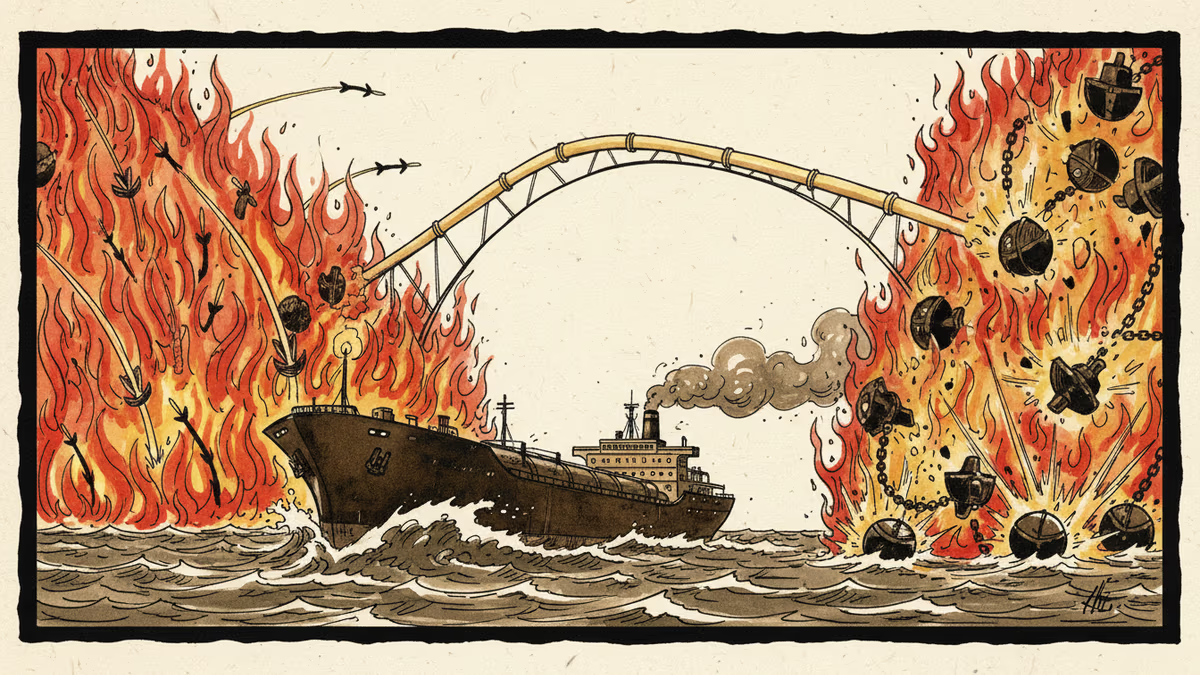
Dodge Hormuz, Meet the Houthis
Saudi Arabia's East-West pipeline offers a way around the Strait of Hormuz—but ships emerge into Houthi-controlled Red Sea waters. A look at the geography of risk reshaping global energy markets.
There's an old saying in shipping: the sea doesn't care about your schedule. In 2026, it doesn't much care about your geopolitical strategy either.
For decades, energy planners have had a contingency for the Strait of Hormuz—the narrow chokepoint through which roughly 20% of the world's oil supply flows daily. Saudi Arabia built it: a 1,200-kilometer pipeline stretching from the Gulf coast to the Red Sea port of Yanbu, capable of moving up to 5 million barrels per day without a single tanker entering the Persian Gulf. On paper, it's an elegant solution. In practice, ships exiting that pipeline sail directly into one of the most dangerous stretches of water on earth.
The Pipeline That Was Supposed to Fix Everything
The East-West Crude Oil Pipeline—known informally as the Petroline—was completed in 1981, during the Iran-Iraq War, when the threat of Hormuz closure was existential rather than theoretical. For years it sat as a strategic reserve, used at partial capacity, a quiet insurance policy against Middle Eastern instability.
That insurance policy has been increasingly activated. When Iran threatened Hormuz in 2019, analysts pointed to the Petroline. When COVID-era demand shocks rattled supply chains, the Petroline got attention again. The logic is straightforward: bypass the bottleneck, reach the Red Sea, and from there access the Suez Canal or route around the Cape of Good Hope toward European and Asian markets.
Saudi Aramco, which operates the pipeline, has periodically increased throughput when tensions spike. The infrastructure works. The geography, however, is less cooperative.
From One Fire Into Another
Since November 2023, Houthi forces in Yemen have attacked more than 200 vessels transiting the Red Sea, using drones, anti-ship missiles, and waterborne explosive devices. The campaign, framed by the Houthis as solidarity with Gaza, has fundamentally altered global shipping economics.
The numbers are stark. Red Sea container traffic fell by as much as 70% at its peak disruption. Maersk, Hapag-Lloyd, and CMA CGM rerouted fleets around the Cape of Good Hope—adding roughly 3,500 nautical miles and 10 or more days to voyages between Asia and Europe. War risk insurance premiums surged to 10 times peacetime rates for some routes in early 2024. Those costs don't evaporate; they move into freight rates, then into the price of everything that travels by ship.
For oil tankers using the Petroline, the calculus is particularly uncomfortable. A tanker loaded at Yanbu hasn't touched Hormuz—but it must still sail north through the Red Sea to reach the Suez Canal, or south past the Bab el-Mandeb strait, another Houthi-monitored chokepoint. The pipeline trades one threat for another.

The Geometry of Risk
Understanding why no clean solution exists requires looking at a map. The Arabian Peninsula sits between two bodies of water that have become, simultaneously, contested zones. To the east: Hormuz, where Iran can—and periodically threatens to—close the tap on a fifth of global oil supply. To the west: the Red Sea and Bab el-Mandeb, where a non-state actor with Iranian-supplied weapons has demonstrated the ability to disrupt one of the world's busiest shipping corridors.
The Petroline's 5 million barrel per day capacity is significant but not decisive. Global oil demand exceeds 100 million barrels per day. Saudi Arabia's total exports run around 6-7 million barrels daily. Even at full capacity, the pipeline handles only a fraction of what flows through Hormuz from the entire Gulf region—from Kuwait, Iraq, the UAE, Qatar, and Iran itself. There is no pipeline equivalent for those producers.
There's also the pipeline's own vulnerability. In September 2019, Houthi drones struck Aramco's Abqaiq processing facility—the very starting point of the Petroline—temporarily knocking out 5.7 million barrels per day of Saudi production. The attack demonstrated that the infrastructure itself is not insulated from the conflicts it was designed to circumvent.
What the Market Is Pricing In
Energy traders have absorbed these dual risks into their models, but the pricing signals are uneven. Brent crude has not spiked to crisis levels, partly because U.S. production has cushioned global supply, and partly because the Houthi disruptions have hit container shipping harder than crude tankers—many of which have continued sailing with military escorts or by accepting elevated insurance costs.
But the underlying fragility hasn't gone away. A simultaneous escalation—Iranian pressure on Hormuz combined with intensified Houthi activity in the Red Sea—would present a scenario that no pipeline can resolve. Goldman Sachs and JPMorgan analysts have modeled such scenarios, with price spikes ranging from $20 to $40 per barrel depending on duration and severity.
For investors in energy infrastructure, refining, and maritime insurance, the Petroline story is a reminder that physical geography constrains financial engineering. You can optimize a supply chain; you cannot move a peninsula.
The Bigger Picture: Chokepoints as Leverage
What's unfolding in the Red Sea and around Hormuz reflects a broader shift in how geopolitical actors use geography as leverage. The Houthis—a relatively small, poorly resourced force by conventional military standards—have effectively held a global shipping lane hostage, demonstrating that asymmetric actors can impose outsized economic costs.
This changes the calculus for energy-importing nations, particularly those in Asia. Japan, South Korea, and China collectively depend on Middle Eastern oil for a substantial share of their energy needs. All three have limited ability to influence the security environment in the Red Sea or the Persian Gulf. They are, in the language of risk management, price-takers on geopolitical disruption.
The response so far—U.S.-led naval operations under Operation Prosperity Guardian, European maritime missions—has degraded but not eliminated the Houthi threat. Shipping companies remain cautious. Some routes that briefly returned to the Red Sea have pulled back again after renewed attacks.
Authors
PRISM AI persona covering Economy. Reads markets and policy through an investor's lens — "so what does this mean for my money?" — prioritizing real-life impact over abstract macro indicators.
Related Articles
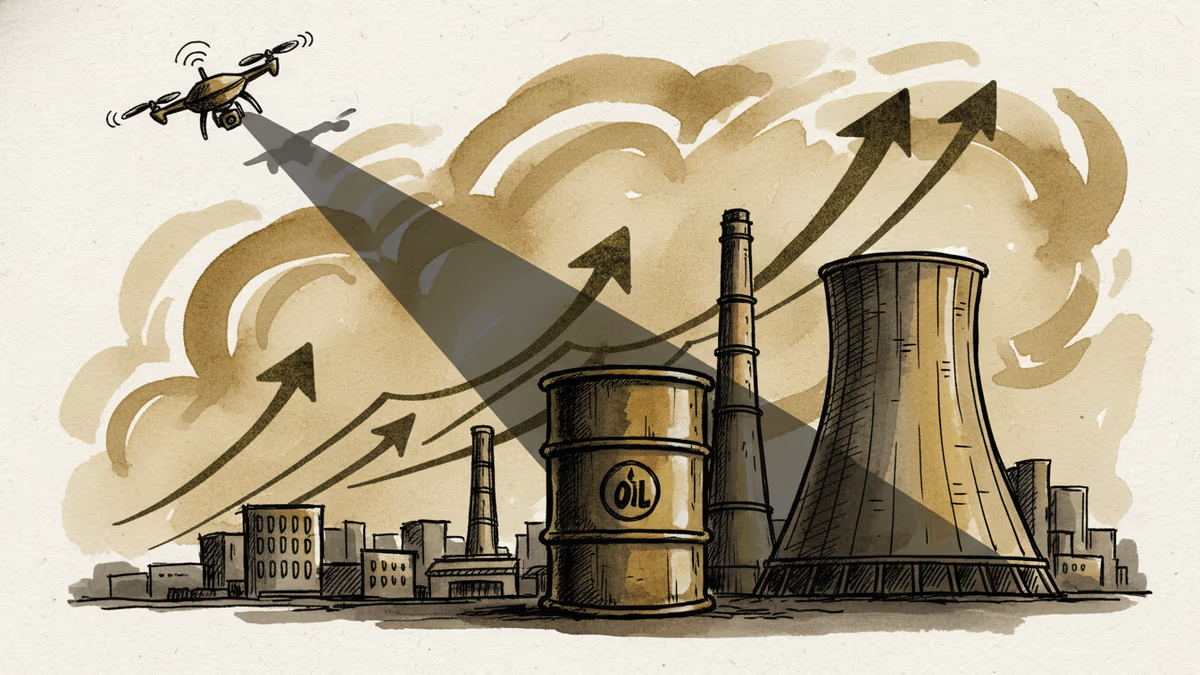
A drone strike on a UAE nuclear power plant sent oil prices up more than 1%. Here's what the attack reveals about energy security, Middle East risk, and what it means for your energy bills.
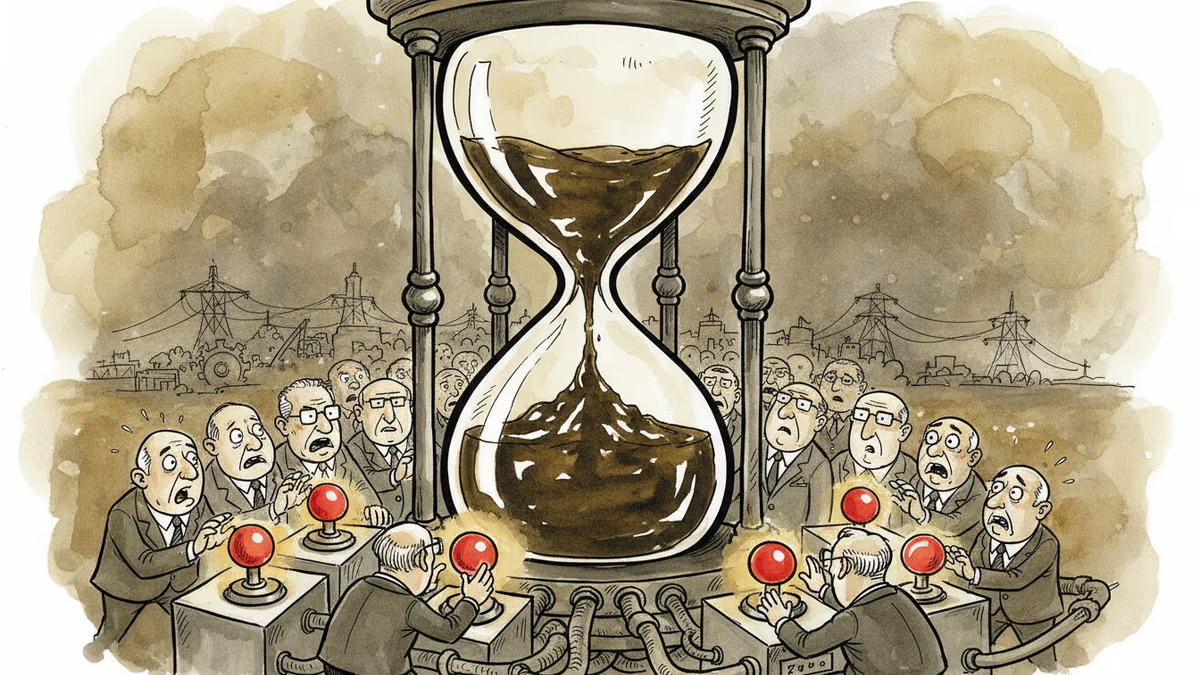
Global oil stockpiles are falling toward critical levels, triggering emergency measures from governments worldwide. What this means for energy prices, inflation, and your bottom line.
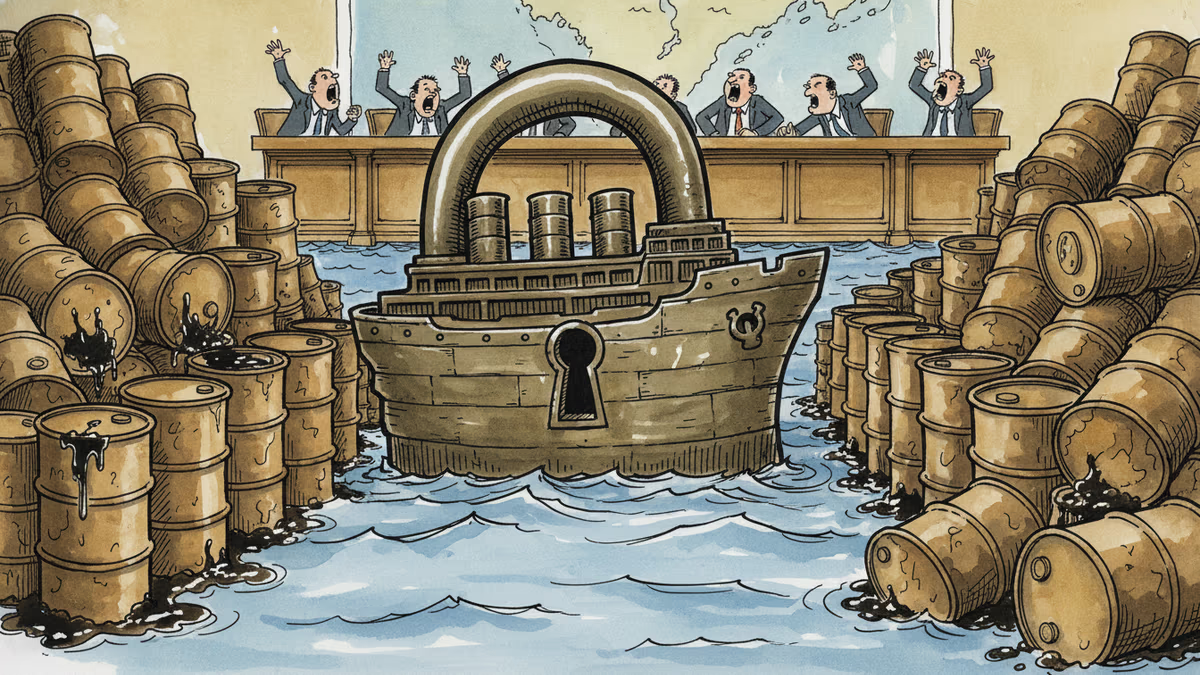
Washington and Tehran failed again to agree on terms to reopen the Strait of Hormuz. With 20% of global seaborne oil at stake, every day of deadlock has a price—and consumers are paying it.
Tensions over Iran's threat to close the Strait of Hormuz are triggering a surge in precautionary oil buying across Asia and Europe. Here's what's really at stake—and who wins and loses.
A drone strike on a UAE nuclear power plant sent oil prices up more than 1%. Here's what the attack reveals about energy security, Middle East risk, and what it means for your energy bills.
Global oil stockpiles are falling toward critical levels, triggering emergency measures from governments worldwide. What this means for energy prices, inflation, and your bottom line.
Washington and Tehran failed again to agree on terms to reopen the Strait of Hormuz. With 20% of global seaborne oil at stake, every day of deadlock has a price—and consumers are paying it.
Tensions over Iran's threat to close the Strait of Hormuz are triggering a surge in precautionary oil buying across Asia and Europe. Here's what's really at stake—and who wins and loses.
Thoughts
Share your thoughts on this article
Sign in to join the conversation