
A $290 Billion Chip Plant in Gwangju, and Samsung's Own Union Says No: 84% Oppose
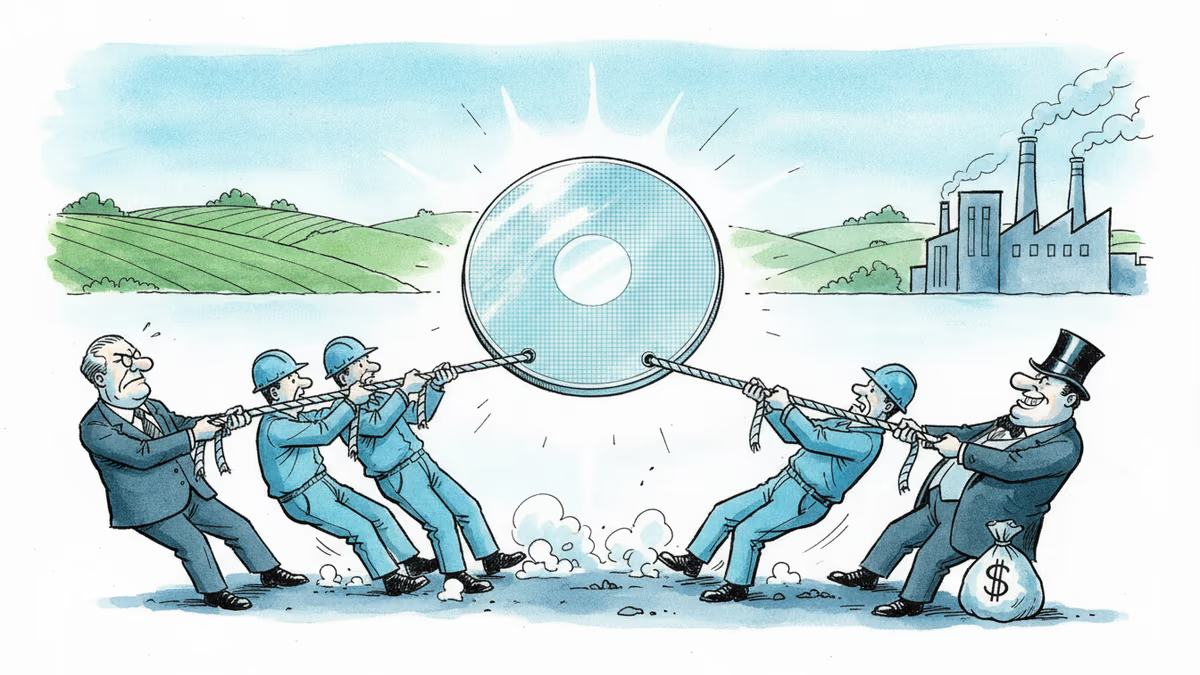
Samsung Electronics' union branch revealed that 84% of survey respondents oppose the government's roughly $290 billion (₩400 trillion) semiconductor megaproject in Gwangju. Government, management, the union and shareholders are all reading the same national project in sharply different ways.
The government is pushing it, and Samsung Electronics says it would pour ₩400 trillion (roughly $290 billion) into it: a semiconductor plant in Gwangju. The first loud objection to the plan came from inside the company.
Samsung Electronics is the crown jewel of Korea's largest chaebol, one of the family-controlled conglomerates that dominate the economy. Its union branch, part of a cross-affiliate "super-enterprise" union spanning multiple Samsung units, said on July 13 that 84% of members who answered a survey opposed the government's Honam semiconductor megaproject. According to the union, Samsung is weighing an investment of about ₩400 trillion (roughly $290 billion) to build two chip fabs (production plants) in Gwangju. That 84% reflects members who responded to the survey, not the full membership, and the union didn't disclose how many people responded or the response rate. Both the ₩400 trillion figure and the 84% come from the union's own announcement, so they should be read separately from any investment the company has officially confirmed.
Why Gwangju? The project surfaced right after President Lee Jae-myung's government put "mega projects" front and center of its growth strategy at a national fiscal strategy meeting on July 13. The idea is to pull advanced industry, heavily concentrated in the greater Seoul area, down to Honam, the southwestern region where Gwangju is the hub, as a symbol of balanced regional development. Underneath sits a plan to hit two targets at once: a core national industry in chips, and the revival of a long-underdeveloped region.
The instinct is a global one. From Washington's CHIPS Act to the EU Chips Act to the subsidies that drew TSMC to Kumamoto in Japan, governments everywhere are blending industrial strategy with regional politics. Building where the jobs are wanted, rather than where the supply chain already sits, is a familiar trade-off.

The objection starts with working conditions. The union argues that running a Gwangju plant would mean reassigning a large share of Seoul-area staff to the provinces, which amounts to uprooting entire households. Add the exception to the 52-hour workweek that's floated for a new fab's early ramp-up, and the worry spreads that the workload could get heavier. The sentiment that employees shouldn't have to shoulder the burden of a national project came out as that 84%.
The government drew a line. The Ministry of Employment and Labor said the project is not a matter for collective bargaining or labor disputes. Investment and site decisions belong to corporate management and national policy, its position goes, not to something labor and management hash out at the negotiating table.
The discontent isn't confined to the union. On July 14, pushback also emerged among some shareholders, worried that a ₩400 trillion price tag is too large against the outlook for profitability and payback. It's the point where the policy rationale of regional balance runs into shareholder value.
This content is AI-generated based on source articles. While we strive for accuracy, errors may occur. We recommend verifying with the original source.
Related Articles
IBM has unveiled 'nanostack,' the world's first sub-1nm (0.7nm) chip research. Some say it adds a decade to Moore's Law; others say a lab demo is a long way from a fab. Either way, mass production isn't IBM's job.
Samsung and SK unveiled a chip and AI investment package worth thousands of trillions of won on June 29. The headline number swings wildly by outlet, but the real contest isn't capital — it's water and power.

As Trump and Xi meet in Beijing, five tech flashpoints—chips, AI rivalry, supply chains, EVs, and rare earths—will quietly shape the global economy more than any diplomatic communiqué.

Consumer SSD prices have surged up to 400% since late 2025. WD, Samsung, SanDisk all affected. We unpack the NAND supply crunch, tariff effects, and what comes next.
IBM has unveiled 'nanostack,' the world's first sub-1nm (0.7nm) chip research. Some say it adds a decade to Moore's Law; others say a lab demo is a long way from a fab. Either way, mass production isn't IBM's job.
Samsung and SK unveiled a chip and AI investment package worth thousands of trillions of won on June 29. The headline number swings wildly by outlet, but the real contest isn't capital — it's water and power.
As Trump and Xi meet in Beijing, five tech flashpoints—chips, AI rivalry, supply chains, EVs, and rare earths—will quietly shape the global economy more than any diplomatic communiqué.
Consumer SSD prices have surged up to 400% since late 2025. WD, Samsung, SanDisk all affected. We unpack the NAND supply crunch, tariff effects, and what comes next.
Thoughts
Share your thoughts on this article
Sign in to join the conversation