
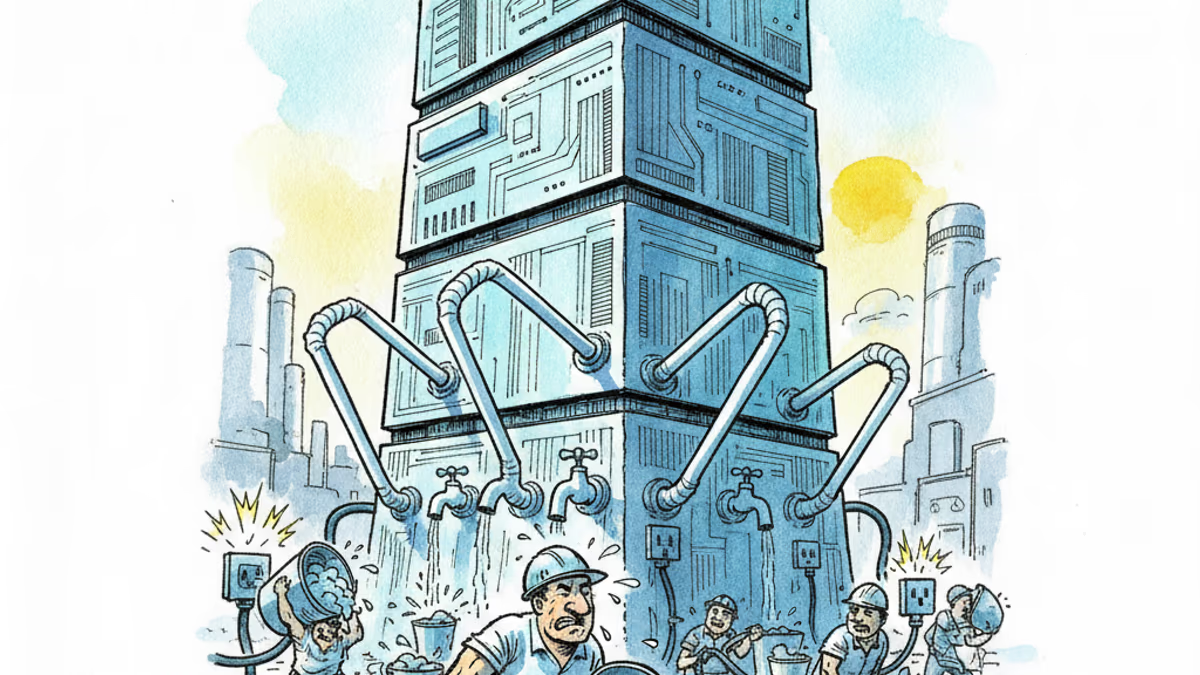
The Trillion-Won Bet: How Samsung and SK Are Redrawing the AI Chip Map — and Why Water and Power Will Decide It
Samsung and SK unveiled a chip and AI investment package worth thousands of trillions of won on June 29. The headline number swings wildly by outlet, but the real contest isn't capital — it's water and power.
On June 29, 2026, inside the presidential compound in Seoul, President Lee Jae-myung hosted a national briefing he called Korea's “Three Mega-Projects for a Great Leap Forward.” Seated side by side were Samsung Electronics Chairman Lee Jae-yong and SK Chairman Chey Tae-won — and between them, the country's two largest conglomerates pledged to pour thousands of trillions of won into chips and AI on home soil. The number is so big that even the number is in dispute. Depending on which outlet you read, the combined Samsung-plus-SK figure runs anywhere from 3,100 to 4,755 trillion won. What's actually cross-confirmed is narrower: SK Group alone at 2,100 trillion won (roughly $1.5 trillion, a rough conversion), and a shared memory hub in the country's southwest — around the city of Gwangju — where the two firms are jointly committing more than 800 trillion won (roughly $570 billion).
The government's “three mega-projects” are semiconductors, physical AI, and AI data centers. But the exact grand total matters less than the direction of travel. Two of a single nation's flagship companies just declared they'll build the production backbone of the AI era at home over the next decade. Which leaves the real questions on the table: what is all this money actually buying, and can the ambition survive contact with reality?
What, Where, and Why
The clearest figures come from SK. The group says it'll invest 2,100 trillion won (roughly $1.5 trillion) domestically — 1,000 trillion won of it in AI data centers, and 1,100 trillion won in expanding chip capacity. That chip slice breaks down further: about 600 trillion won for DRAM in Yongin, roughly 100 trillion won for NAND flash in Cheongju, and about 400 trillion won for a new cluster in the southwest.
Samsung's total is where reporting gets messy. Estimates range from the low 1,000-trillion-won territory to as high as 2,600 trillion won, depending on the outlet. The shape of the spending is more consistent than the sum: the Pyeongtaek and Yongin chip clusters, southwestern fabs including Gwangju, HBM packaging in the Chungcheong region, and robotics and physical AI. The Gwangju-area memory hub the two companies are building together comes in at more than 800 trillion won combined, according to Korea JoongAng Daily.
The logic is straightforward. As AI swallows the data center, demand for both memory and foundry capacity is exploding in tandem. Every one of Nvidia's AI accelerators carries a stack of high-bandwidth memory (HBM) — a market Samsung and SK effectively split between them. The bet is to lock in capacity now, while the demand is here. And it dovetails with policy: the Lee administration has made chips and AI its national growth engine, with the two companies answering the call in the largest possible currency.

Where Ambition Meets the Skeptics
Here's the catch: chip fabs don't run on money alone. Powering a single southwestern complex would take 6.3 gigawatts of electricity and 646,000 tons of water a day, by Korea JoongAng Daily's estimate — enough power for several large nuclear reactors, and enough water to supply a mid-sized city. That's why doubts surfaced the moment the plans went public.
The water question landed directly on the president. On June 27, Lee pushed back, arguing in essence that Samsung and SK aren't foolish enough to build fabs where the water runs out, according to The Asia Business Daily. The companies weighed the economics and picked the sites, he said, so don't worry about it. But the fact that a head of state had to step in and put out the fire is itself telling: this project's fate rests less on capital than on infrastructure.
Talent is no smaller a hurdle. Landing enough senior engineers is as urgent as water and power, Korea JoongAng Daily noted in the same piece. A fab isn't finished when it's built; it needs people inside to run it. And that sets up the core tension over the southwestern sites — regional development as political cause, colliding with infrastructure and efficiency as hard reality.
Does Taiwan Feel Threatened, or See a Windfall?
Across the strait, Taiwan's reaction runs in two directions at once. In the home market of foundry leader TSMC, Taiwanese outlets have published two opposing readings side by side.
The pressure case goes like this: Korea's buildout intensifies the scramble for leading-edge tooling at 2nm and below, potentially disrupting the next-generation ramps at TSMC and Intel. When a limited supply of critical gear — think extreme ultraviolet (EUV) lithography systems — gets bid up by aggressive Samsung and SK orders, Taiwan can't sit comfortably either. Commercial Times and others read Korea's drive as a bid for AI supremacy.
The windfall case says the opposite. Some Taiwanese outlets, including Economic Daily News and United Daily News, argue Korea's expansion could actually benefit Taiwan's memory and back-end packaging firms. If Samsung and SK scale up memory output, demand for materials, equipment, and back-end processing rises with it — and Taiwanese suppliers can catch the runoff. Voices in Taiwan's memory sector even floated a “defense in place of offense” strategy. The tone: no need to panic.
That both readings coexist tells you something about the nature of this bet. What Samsung and SK are doing isn't simply pushing Taiwan aside — it's a variable that shakes the entire Asian chip supply chain. Who ends up threatened and who ends up better off is still an open question.
The Question Marks That Remain
The first thing that catches is the numbers themselves. A day after the announcement, Samsung's total and the combined figure still diverged by more than 1,000 trillion won across outlets. In other words, the country's largest-ever industrial plan couldn't be pinned to a single settled number at the moment it was unveiled. Announced dollars and deployed dollars are another matter entirely. These trillions get spread across a decade, and the annual pace can flex with the economy and with where AI demand actually goes.
If AI demand doesn't hold up the way the plan assumes, aggressive memory expansion could come back as an oversupply problem — a scenario worth keeping in view. And with US restrictions on chip exports to China and pressure to reshore, how a massive buildout on Korean soil squares with US fab investment remains unclear. These are variables to watch play out during execution, not things to call now.
The first real test of whether this announcement holds will be the groundbreaking and completion timeline for the southwestern memory fabs. Whether these trillions stay numbers in a press briefing or turn into actual capacity gets decided on that construction site. How much of the year-by-year spending gets disclosed and honored along the way is what will set this bet's credibility.
PRISM Insight — From a Capital Game to an Infrastructure Game
Read this not as one-off news but as one pillar of the AI capex super-cycle. Watch the timing. That same June, the seven US tech giants (the Magnificent Seven) shed roughly $2.3 trillion in combined market value on fears of AI overspending. At the exact moment Western investors were backing away — worried the money pouring into AI had gone too far — Korea's two champions placed the opposite bet, sizing it in the trillions.
That's where the center of gravity in the chip race is shifting. The contest is no longer about who spends the most. Announcing trillions of won and actually delivering 6.3 gigawatts of power and 646,000 tons of water a day are games of entirely different difficulty. Capital can be written into a press release; infrastructure can only be built with land and time. The decisive front in the AI chip race is moving from the capital game to the infrastructure game.
This content is AI-generated based on source articles. While we strive for accuracy, errors may occur. We recommend verifying with the original source.
Related Articles
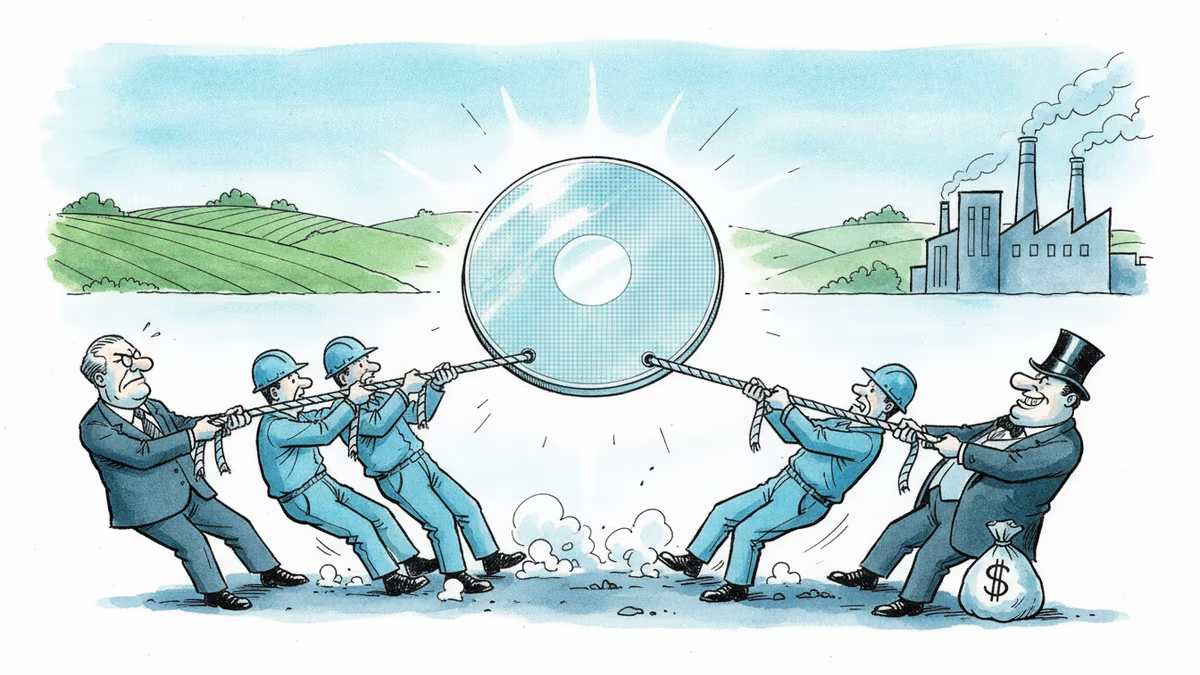
Samsung Electronics' union branch revealed that 84% of survey respondents oppose the government's roughly $290 billion (₩400 trillion) semiconductor megaproject in Gwangju. Government, management, the union and shareholders are all reading the same national project in sharply different ways.
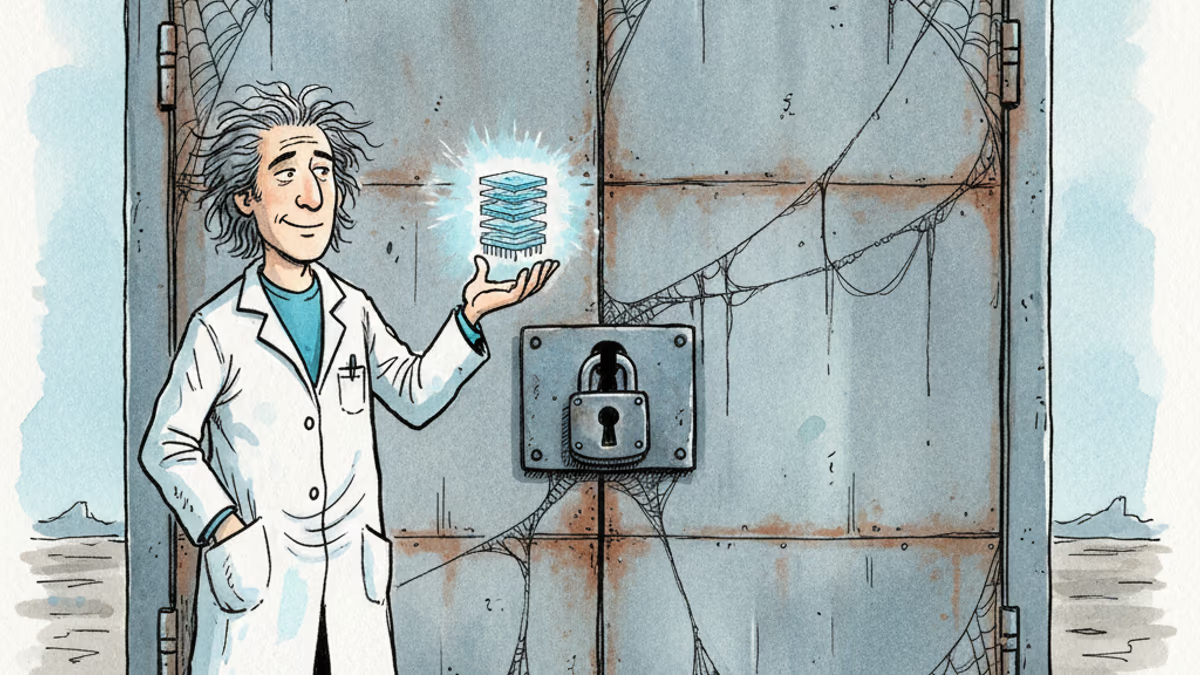
IBM has unveiled 'nanostack,' the world's first sub-1nm (0.7nm) chip research. Some say it adds a decade to Moore's Law; others say a lab demo is a long way from a fab. Either way, mass production isn't IBM's job.

Viral videos show 2026 graduates jeering executives who praise AI at commencement ceremonies. It's not just rudeness — it's a signal about who pays for technological optimism.

Filipino virtual assistants using AI to ghost-manage LinkedIn profiles for executives is now a structured industry. 30 comments a day, fake engagement rings, and a platform struggling to tell real from fabricated.
Samsung Electronics' union branch revealed that 84% of survey respondents oppose the government's roughly $290 billion (₩400 trillion) semiconductor megaproject in Gwangju. Government, management, the union and shareholders are all reading the same national project in sharply different ways.
IBM has unveiled 'nanostack,' the world's first sub-1nm (0.7nm) chip research. Some say it adds a decade to Moore's Law; others say a lab demo is a long way from a fab. Either way, mass production isn't IBM's job.
Viral videos show 2026 graduates jeering executives who praise AI at commencement ceremonies. It's not just rudeness — it's a signal about who pays for technological optimism.
Filipino virtual assistants using AI to ghost-manage LinkedIn profiles for executives is now a structured industry. 30 comments a day, fake engagement rings, and a platform struggling to tell real from fabricated.
Thoughts
Share your thoughts on this article
Sign in to join the conversation