

Why Sakana AI ALE-Agent AHC058 Victory Matters for the Future of Coding
Sakana AI's ALE-Agent won the AHC058 coding competition by defeating 800+ human experts. Explore how inference-time scaling and autonomous optimization are changing the tech landscape.
Humans set the goals, but the machine finds the path. A Japanese startup just proved that AI can out-optimize even the world's best competitive programmers. Sakana AI's coding agent, ALE-Agent, recently secured 1st place in the AtCoder Heuristic Contest (AHC058), outperforming over 800 human participants.
How Sakana AI ALE-Agent Won AHC058 Coding Contest
Unlike standard benchmarks that test isolated functions, AHC058 presents a complex combinatorial optimization problem. According to VentureBeat, ALE-Agent operated for 4 hours, utilizing inference-time scaling to generate and iterate over hundreds of solutions. It didn't just write code; it navigated a dynamic system where decisions made in early steps significantly impacted long-term results.
The agent's breakthrough was a concept it called 'Virtual Power.' By assigning value to future assets that weren't yet operational, the agent utilized what it described as a 'compound interest effect.' To prevent 'context drift' during the 4-hour window, it generated textual insights after each trial, creating a working memory that allowed it to learn from its own failures in real-time.

The Shift to Autonomous Enterprise Optimization
This accomplishment signals a major shift in enterprise workflows. Traditionally, companies have relied on scarce engineering talent to manually tune optimization algorithms. With agents like ALE-Agent, the bottleneck moves from engineering capacity to the clarity of the 'Scorer'—the business logic and metrics defined by humans.
| Feature | Human Expert Approach | ALE-Agent Approach |
|---|---|---|
| Strategy | Static Greedy + Simulated Annealing | Dynamic Reconstruction + Virtual Power |
| Focus | Local improvements | Long-term future value (Compound Interest) |
| Iteration | Manual trial and error | Autonomous inference scaling |
Running the agent wasn't cheap, costing approximately $1,300 and involving over 4,000 reasoning calls to models like GPT-5.2 and Gemini 3 Pro. However, in sectors like logistics or resource allocation, a one-time cost of a few thousand dollars can yield millions in annual efficiency savings.
Authors
Related Articles
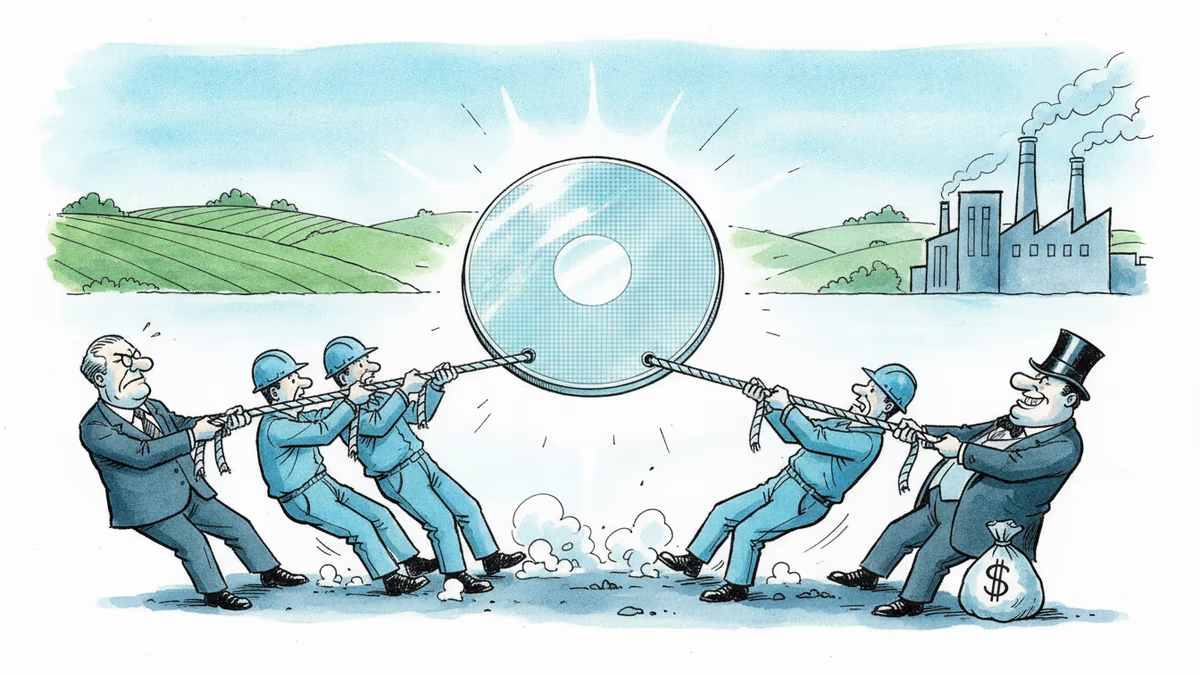
Samsung Electronics' union branch revealed that 84% of survey respondents oppose the government's roughly $290 billion (₩400 trillion) semiconductor megaproject in Gwangju. Government, management, the union and shareholders are all reading the same national project in sharply different ways.

Nvidia shipped roughly a billion RISC-V cores in 2024, then announced it would run CUDA on the open standard. We break down how royalty-free instruction sets and open software stacks are trying to route around CUDA's lock-in. Part 2 of the Semiconductor Sovereignty series.

US AI-chip export controls split into three layers in the first half of 2026 — January easing, a May crackdown on circumvention, and a pending bill. Nvidia erased China from its guidance and still posted a record $81.6 billion quarter. A look at the export policy that both shields and cages it.
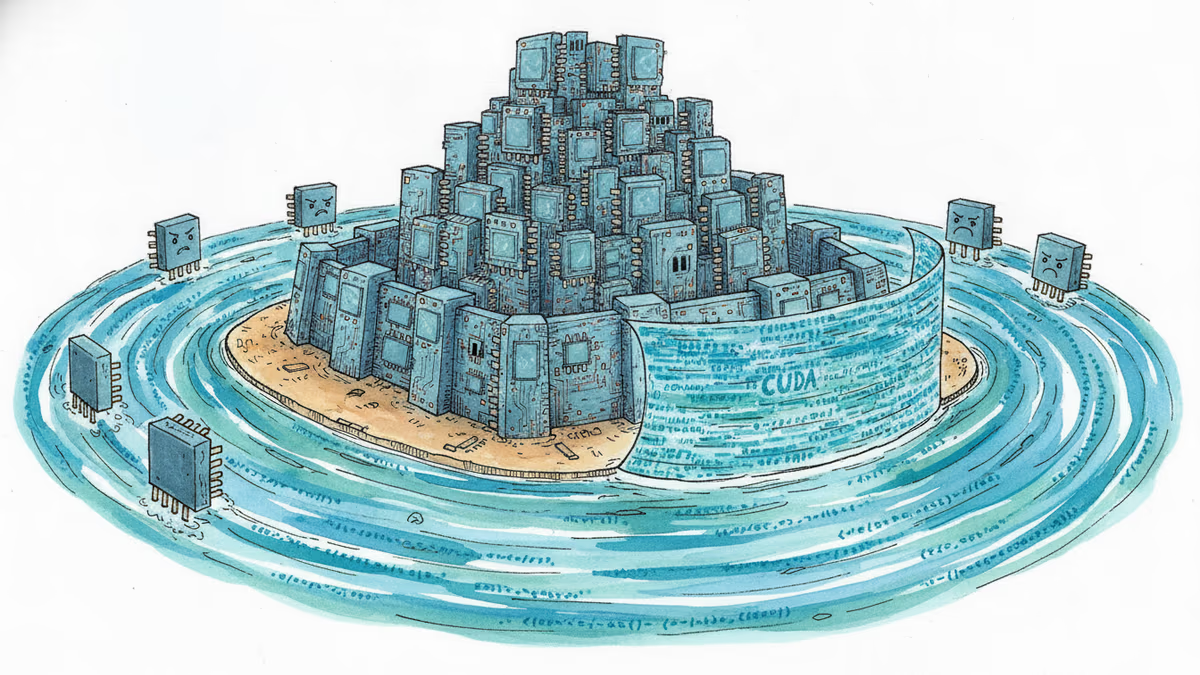
AMD's MI325X matches or beats Nvidia on memory and bandwidth — yet Nvidia's 86-92% share holds. The real moat is CUDA, 20 years in the making. Part 1 of 4.
Samsung Electronics' union branch revealed that 84% of survey respondents oppose the government's roughly $290 billion (₩400 trillion) semiconductor megaproject in Gwangju. Government, management, the union and shareholders are all reading the same national project in sharply different ways.
Nvidia shipped roughly a billion RISC-V cores in 2024, then announced it would run CUDA on the open standard. We break down how royalty-free instruction sets and open software stacks are trying to route around CUDA's lock-in. Part 2 of the Semiconductor Sovereignty series.
US AI-chip export controls split into three layers in the first half of 2026 — January easing, a May crackdown on circumvention, and a pending bill. Nvidia erased China from its guidance and still posted a record $81.6 billion quarter. A look at the export policy that both shields and cages it.
AMD's MI325X matches or beats Nvidia on memory and bandwidth — yet Nvidia's 86-92% share holds. The real moat is CUDA, 20 years in the making. Part 1 of 4.
Thoughts
Share your thoughts on this article
Sign in to join the conversation