

Ancient Floods, Modern Warning: What Shang Dynasty China Tells Us About Today's Climate
A new study links Pacific Ocean temperature cycles, oracle bone inscriptions, and abandoned Bronze Age settlements to explain catastrophic floods 3,000 years ago — and what it means for climate science today.
Three thousand years ago, a civilization fell. The reason was written in the ocean — but no one could read it yet.
A team led by Ke Ding, a meteorologist at Nanjing University, has just published a study that stitches together three wildly different types of evidence — oracle bone inscriptions, Bronze Age archaeological abandonment patterns, and Pacific Ocean temperature records — to explain a chain of catastrophic floods that swept through the heartland of ancient Chinese civilization during the Shang Dynasty. The findings are being read not just as history, but as a data point with direct implications for how we model climate risk today.
Three Clues, One Story
The Shang Dynasty, flourishing roughly 3,000 years ago in China's Yellow River Valley, left behind the earliest known Chinese writing — carved into animal bones and turtle shells used for divination. These oracle bones recorded weather events, harvests, and ritual sacrifices at the capital, Yinxu. Simultaneously, on the Chengdu Plain in southwestern China, the Sanxingdui culture was crafting enormous bronze heads, gold foil masks, and jade tools, which they buried in massive sacrificial pits.
Both civilizations appear to have faced sudden, severe disruption. Archaeological evidence shows multiple settlements in the Yellow River Valley being abandoned around the same period — a pattern consistent with catastrophic flooding forcing mass displacement.
That's the first two threads: written records of extreme weather, and physical evidence of civilizational stress.
The third thread comes from the ocean. By analyzing coral cores and marine sediment records, Ding and colleagues reconstructed Pacific Ocean surface temperature patterns from the same era. What they found was a pronounced shift in the El Niño-Southern Oscillation (ENSO) cycle — the same Pacific temperature dynamic that drives weather extremes across much of the globe today.
The Chain Reaction
The mechanism the researchers propose is a cascade. Warmer Pacific waters intensified typhoons forming in the South China Sea and western Pacific. Those stronger typhoons made landfall along China's southern coast, driving enormous volumes of moisture deep into the continent. That moisture translated into extreme rainfall events over the Yellow River basin — hundreds of kilometers from where the storms first struck land.

The people of the Shang Dynasty experiencing those floods had no way to trace the disaster back to ocean temperatures thousands of kilometers away. They couldn't have known that the typhoons battering the southern coast were the intermediary, or that a shift in Pacific temperature cycles was the root cause. They recorded what they saw. They buried their treasures. Some of them left.
With 3,000 years of hindsight and modern paleoclimatology, Ding's team could finally connect the dots.
Why This Study Matters Now
The timing of this research is not incidental. The ENSO cycle is changing. The frequency and intensity of El Niño events have shifted over recent decades, and climate models consistently project greater variability as global temperatures rise. What the Shang Dynasty case provides is something climate science often lacks: a long-horizon empirical example of how Pacific temperature shifts cascade into regional civilizational disruption.
This matters for a field called climate attribution — the science of tracing specific weather disasters back to their root causes. It's a discipline with increasingly direct legal and financial consequences. Courts in multiple countries are now hearing cases where plaintiffs argue that specific floods, droughts, or storms were made more likely or more severe by human-driven climate change. The stronger the historical evidence base for these cascade mechanisms, the more precise attribution science can become.
For researchers studying East Asia specifically, the study adds empirical weight to concerns about how warming Pacific waters will affect typhoon behavior and downstream rainfall patterns across China, Japan, the Korean Peninsula, and Southeast Asia. The 2021 Zhengzhou floods — which dropped a year's worth of rain on the city in three days — and the 2023 record rainfall events across central and eastern Asia are already being studied through this lens.
Perspectives Worth Holding
Not everyone will read this study the same way, and that tension is part of what makes it interesting.
For archaeologists and historians, the study offers a new interpretive frame for some of the more puzzling aspects of Sanxingdui culture — particularly the sudden, large-scale burial of precious objects in sacrificial pits. Were these acts of religious desperation in the face of catastrophe? The study doesn't answer that, but it raises the question with new force.
For climate scientists, the methodological achievement here may be as significant as the findings. Integrating textual records, settlement archaeology, and paleoclimate proxies into a single coherent causal argument is difficult to do rigorously. If the methodology holds up to peer scrutiny, it opens a template for similar studies across other ancient civilizations and climate events.
For skeptics of climate-civilization linkages, a fair challenge remains: a single regional case study, however well-constructed, cannot by itself establish universal principles. The Earth experienced significant natural climate variability long before industrial emissions, and distinguishing natural ENSO variability from anthropogenically amplified variability requires careful handling. The researchers are aware of this — but the debate will continue.
For policymakers and urban planners, particularly those responsible for flood infrastructure in typhoon-prone regions, the study poses a quietly uncomfortable question: flood defenses are typically designed around historical worst-case scenarios. But if the climate system is shifting in ways that change the frequency and intensity of those worst cases, historical baselines may be structurally inadequate.
Authors
Related Articles
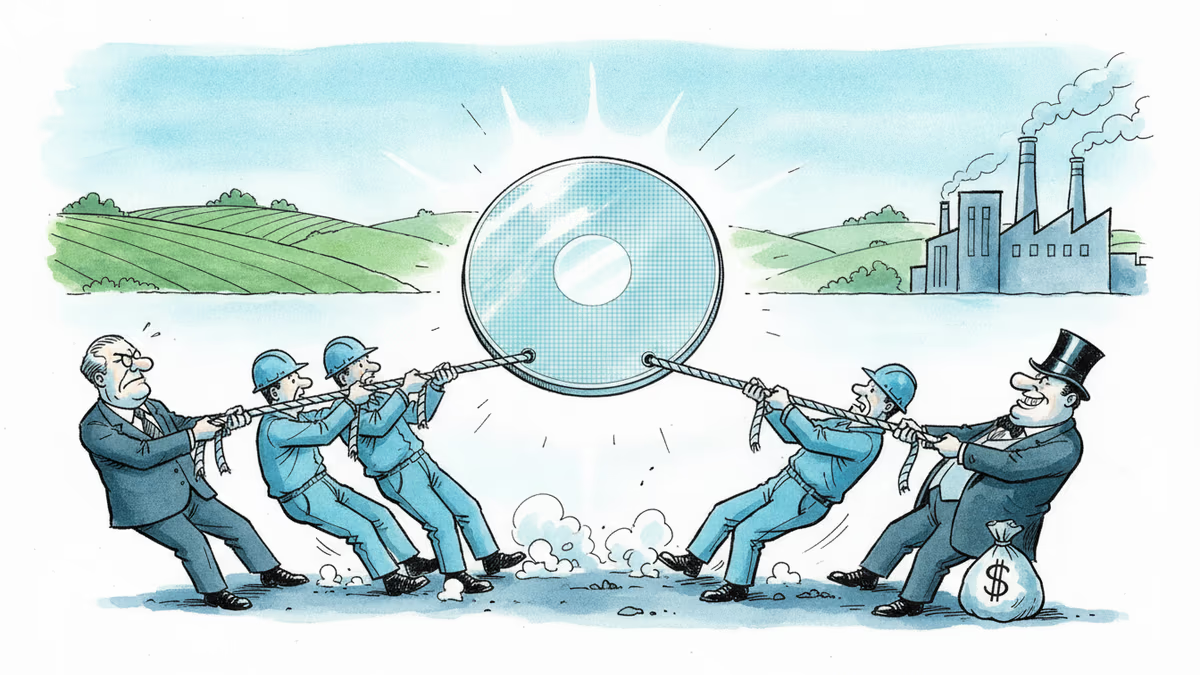
Samsung Electronics' union branch revealed that 84% of survey respondents oppose the government's roughly $290 billion (₩400 trillion) semiconductor megaproject in Gwangju. Government, management, the union and shareholders are all reading the same national project in sharply different ways.

Nvidia shipped roughly a billion RISC-V cores in 2024, then announced it would run CUDA on the open standard. We break down how royalty-free instruction sets and open software stacks are trying to route around CUDA's lock-in. Part 2 of the Semiconductor Sovereignty series.

US AI-chip export controls split into three layers in the first half of 2026 — January easing, a May crackdown on circumvention, and a pending bill. Nvidia erased China from its guidance and still posted a record $81.6 billion quarter. A look at the export policy that both shields and cages it.
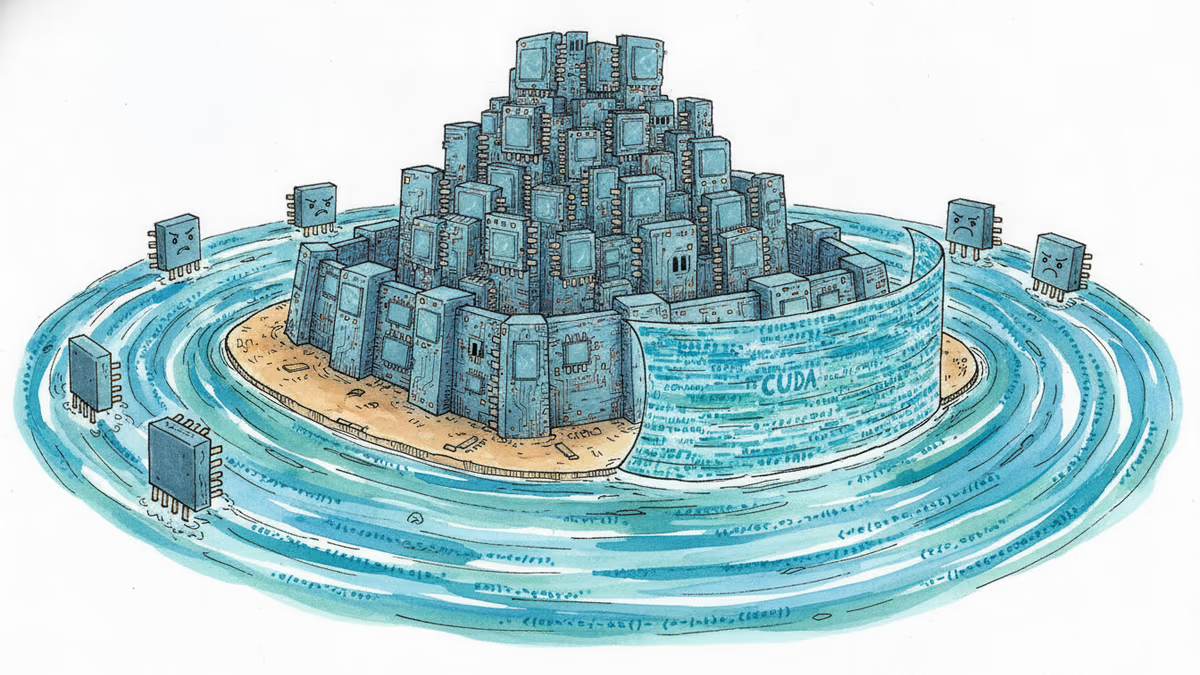
AMD's MI325X matches or beats Nvidia on memory and bandwidth — yet Nvidia's 86-92% share holds. The real moat is CUDA, 20 years in the making. Part 1 of 4.
Samsung Electronics' union branch revealed that 84% of survey respondents oppose the government's roughly $290 billion (₩400 trillion) semiconductor megaproject in Gwangju. Government, management, the union and shareholders are all reading the same national project in sharply different ways.
Nvidia shipped roughly a billion RISC-V cores in 2024, then announced it would run CUDA on the open standard. We break down how royalty-free instruction sets and open software stacks are trying to route around CUDA's lock-in. Part 2 of the Semiconductor Sovereignty series.
US AI-chip export controls split into three layers in the first half of 2026 — January easing, a May crackdown on circumvention, and a pending bill. Nvidia erased China from its guidance and still posted a record $81.6 billion quarter. A look at the export policy that both shields and cages it.
AMD's MI325X matches or beats Nvidia on memory and bandwidth — yet Nvidia's 86-92% share holds. The real moat is CUDA, 20 years in the making. Part 1 of 4.
Thoughts
Share your thoughts on this article
Sign in to join the conversation