

The $20B Bet That AI Doesn't Have to Be American
Cohere and Aleph Alpha are merging to build a transatlantic AI challenger valued at $20 billion. Their pitch: sovereignty, not just performance. Can it work?
For most enterprise software buyers, choosing an AI platform means choosing between three American giants. On Friday, two companies on opposite sides of the Atlantic decided that wasn't good enough.
Cohere, the Canadian enterprise AI unicorn, announced a merger with Aleph Alpha, a German AI startup that has quietly built a client list of European governments and regulated industries. The combined entity will be valued at $20 billion, according to the Financial Times. Schwarz Group—the German retail conglomerate behind Lidl and Kaufland, and one of Aleph Alpha's biggest backers—is putting $600 million into Cohere's Series E round, expected to close later this year.
The stated ambition: a "transatlantic AI powerhouse" that gives businesses and governments a credible alternative to the dominant Silicon Valley players.
What Each Side Brings to the Table
This isn't a rescue merger. Both companies arrived at the negotiating table with distinct, complementary strengths.
Cohere has spent years building deployment-flexible enterprise AI—models that run inside a company's own infrastructure, not just on a public cloud. That matters enormously to industries like finance, healthcare, and law, where data can't freely leave the building. The company has also built a reputation for focusing on reliability and customization over headline benchmark scores.
Aleph Alpha brings something harder to replicate: trust from European governments. The Heidelberg-based startup positioned itself from day one around the concept of AI sovereignty—the idea that organizations should be able to run powerful AI without handing their data to a foreign tech giant. That pitch landed. German federal agencies, European defense contractors, and public sector clients that would never run sensitive workloads on Azure or AWS became Aleph Alpha customers.
Together, the merged company's pitch is coherent: we're not just an alternative on paper, we're the alternative that governments and regulated enterprises can actually use.
Why This Merger Makes Sense Right Now
The timing is not accidental. Two forces are converging to make this moment ripe.

First, the capital gap is widening. OpenAI just closed a $40 billion funding round. Google and Microsoft are spending tens of billions annually on AI infrastructure. For any independent AI company, trying to compete on raw compute and model scale alone is increasingly a losing game. Merging pools resources, reduces redundancy, and creates a combined balance sheet that can sustain the long development cycles enterprise AI requires.
Second, geopolitical anxiety is reshaping enterprise procurement. The EU's AI Act is already in force. European institutions are under real pressure—some legal, some political—to demonstrate they aren't wholesale outsourcing critical AI decisions to American platforms. Aleph Alpha was built for exactly this regulatory and cultural moment. The merger gives Cohere a credible European foothold that would have taken years to build organically.
The Skeptic's View
Not everyone will read this as a triumph of strategic vision. There's a less flattering interpretation available.
Aleph Alpha raised money at a $500 million valuation in 2023. The $20 billion figure attached to the merged entity is a significant step up, but it's worth noting that the deal hasn't closed yet, and valuations announced before closing have a way of shifting. The company also faced questions in European tech circles about whether its sovereign AI pitch was a genuine technical differentiator or primarily a regulatory arbitrage play.
Mergers between companies with different national cultures, tech stacks, and customer bases are notoriously difficult to execute. The history of enterprise software is littered with combinations that looked strategically elegant on paper and operationally messy in practice. Retaining top AI researchers—who have no shortage of options—across a transatlantic integration will be a real test.
And the core market question remains open: do enterprise buyers actually prioritize data sovereignty enough to accept any trade-off in ecosystem breadth or tooling convenience? Microsoft Copilot is already embedded in millions of enterprise workflows. Displacing incumbent platforms requires more than a better philosophy.
What It Means for the AI Landscape
The merger is the most visible signal yet that the AI industry's consolidation phase is not just about big players getting bigger—it's also about challengers deciding that scale requires coalition.
For enterprise tech buyers, a credible $20 billion alternative to the hyperscaler AI stack is genuinely useful, even if they never switch. Competition creates negotiating leverage. The existence of a well-funded, sovereignty-focused option gives procurement teams something to point to when pushing back on vendor lock-in terms.
For investors, the deal signals that the "enterprise AI" category is maturing past the point where every startup can grow independently to meaningful scale. Expect more consolidation among the second tier of AI companies over the next 18-24 months.
For regulators—particularly in the EU—a merged Cohere-Aleph Alpha with deep European government relationships and a data sovereignty mandate could become a useful policy instrument, a private sector player whose interests align with public sector goals around AI independence.
Authors
Related Articles
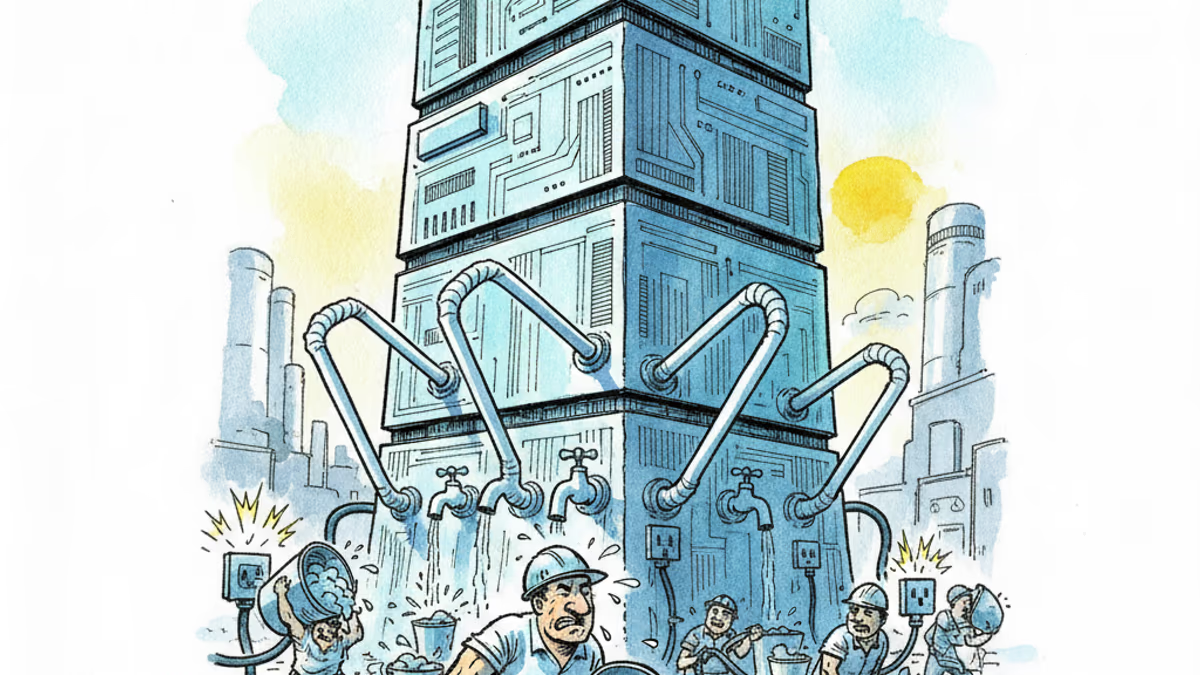
Samsung and SK unveiled a chip and AI investment package worth thousands of trillions of won on June 29. The headline number swings wildly by outlet, but the real contest isn't capital — it's water and power.

Viral videos show 2026 graduates jeering executives who praise AI at commencement ceremonies. It's not just rudeness — it's a signal about who pays for technological optimism.

Filipino virtual assistants using AI to ghost-manage LinkedIn profiles for executives is now a structured industry. 30 comments a day, fake engagement rings, and a platform struggling to tell real from fabricated.
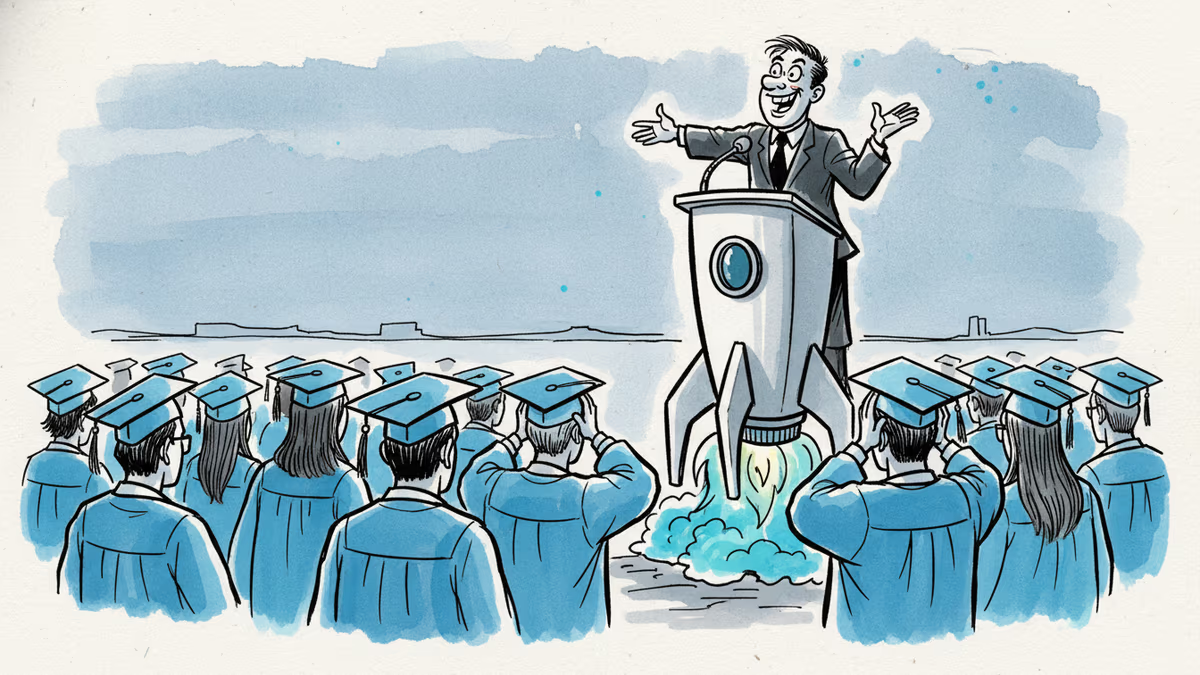
Two commencement speakers learned the hard way that AI enthusiasm doesn't land well with today's graduates. The backlash reveals a widening gap between tech optimism and Gen Z's economic reality.
Samsung and SK unveiled a chip and AI investment package worth thousands of trillions of won on June 29. The headline number swings wildly by outlet, but the real contest isn't capital — it's water and power.
Viral videos show 2026 graduates jeering executives who praise AI at commencement ceremonies. It's not just rudeness — it's a signal about who pays for technological optimism.
Filipino virtual assistants using AI to ghost-manage LinkedIn profiles for executives is now a structured industry. 30 comments a day, fake engagement rings, and a platform struggling to tell real from fabricated.
Two commencement speakers learned the hard way that AI enthusiasm doesn't land well with today's graduates. The backlash reveals a widening gap between tech optimism and Gen Z's economic reality.
Thoughts
Share your thoughts on this article
Sign in to join the conversation