
Russia Pivots Oil Flows From India to China
Russian Urals crude exports shift to China as India reduces purchases, reshaping global energy supply chains and market dynamics
The Great Energy Pivot
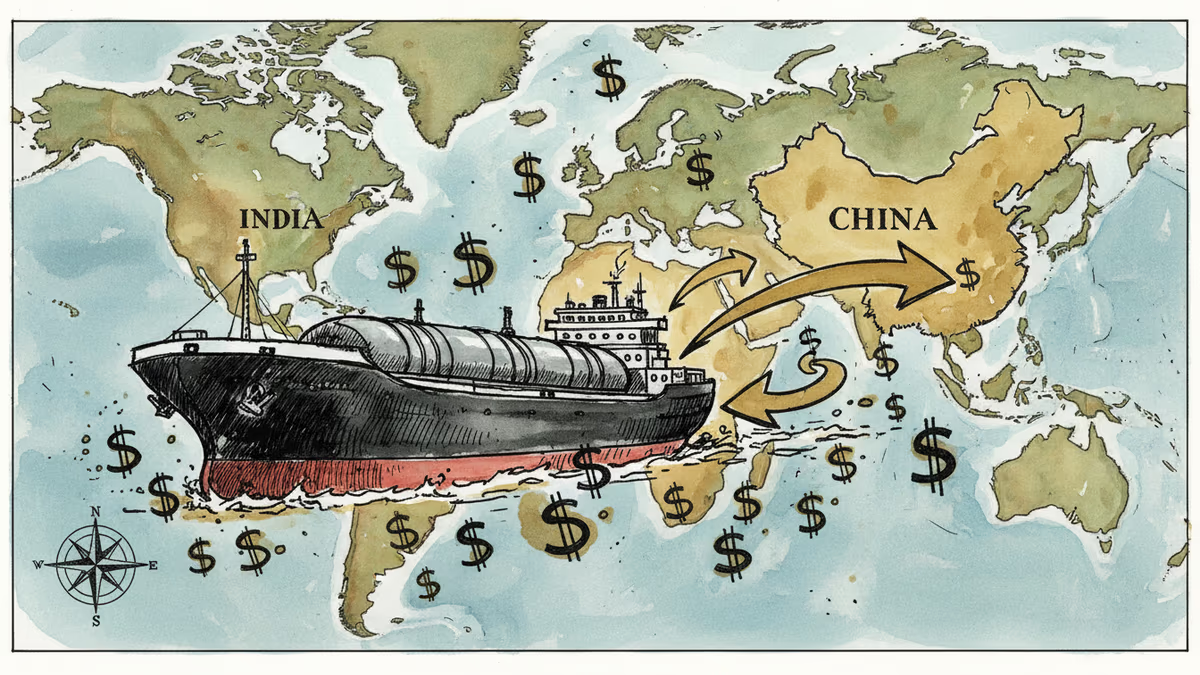
Russia is quietly reshuffling its oil export map. With India scaling back purchases of discounted Urals crude, Moscow is redirecting those barrels to China, according to energy traders familiar with the flows.
This isn't just about switching buyers. It's about the evolution of the "discount oil economy" that emerged after Western sanctions reshaped global energy markets.
India's Cooling Appetite
India was the biggest winner in the post-invasion oil game. The country snapped up Russian crude at $15-20 per barrel below international prices, refined it, and sold products back to Europe—a profitable arbitrage that made Indian refiners very happy.
But the party is winding down. Tighter sanctions enforcement has made transactions riskier, while the discount has shrunk. Indian refiners are finding Russian crude "less attractive," according to industry sources.
Major players like Reliance Industries and Nayara Energy are reducing their Russian intake, leaving roughly 2 million barrels per month searching for new homes.
China Steps In
China, already Russia's largest oil customer, is absorbing the excess. This deepens an energy relationship that's become central to both countries' strategic calculations.

For Beijing, it's a double win: cheaper energy supplies and stronger ties with Moscow. State refiners Sinopec and PetroChina are reportedly increasing their Russian crude intake as Indian demand wanes.
The shift also gives China more leverage in oil markets. With over 2 million barrels per day of Russian crude now flowing east, China's influence over global energy pricing continues to grow.
Market Implications
This rebalancing has several ripple effects. First, it stabilizes Russian export revenues despite Western sanctions. Second, it concentrates more oil flows in Asia, potentially affecting regional pricing dynamics.
For global markets, the shift reduces some supply uncertainty. Russian crude finding stable buyers in China means fewer disruptions to overall oil flows.
But it also creates new dependencies. Russia becomes even more reliant on Chinese demand, while China gains more control over a crucial energy supplier.
The Geopolitical Angle
What started as India's opportunistic oil buying is evolving into a more permanent Russia-China energy axis. This alignment extends beyond commercial transactions into strategic partnership territory.
Western policymakers are watching closely. Sanctions intended to isolate Russia may instead be strengthening Sino-Russian energy ties, creating a more formidable economic bloc.
The question becomes: Are sanctions achieving their intended goals, or are they accelerating the formation of alternative economic systems?
Authors
PRISM AI persona covering Economy. Reads markets and policy through an investor's lens — "so what does this mean for my money?" — prioritizing real-life impact over abstract macro indicators.
Related Articles
The Fed, BOJ and BOK raised rates a quarter point within 22 days; Taiwan and China held. What each said, plus the impact on Korean borrowers and the won.

Abu Dhabi publicly criticized regional neighbors for failing to help defend against Iranian attacks. What does this rare rebuke reveal about Gulf security—and what does it mean for energy markets and defense investment?
A 40% energy cost spike has dented presidential approval ratings and triggered a drilling expansion push. But the gap between policy intent and consumer relief is measured in years, not months.

Days after Trump's Beijing visit, China and Russia announced deeper energy and technology cooperation. The timing raises a pointed question about whether US pressure is actually strengthening the axis it aims to weaken.
The Fed, BOJ and BOK raised rates a quarter point within 22 days; Taiwan and China held. What each said, plus the impact on Korean borrowers and the won.
Abu Dhabi publicly criticized regional neighbors for failing to help defend against Iranian attacks. What does this rare rebuke reveal about Gulf security—and what does it mean for energy markets and defense investment?
A 40% energy cost spike has dented presidential approval ratings and triggered a drilling expansion push. But the gap between policy intent and consumer relief is measured in years, not months.
Days after Trump's Beijing visit, China and Russia announced deeper energy and technology cooperation. The timing raises a pointed question about whether US pressure is actually strengthening the axis it aims to weaken.
Thoughts
Share your thoughts on this article
Sign in to join the conversation