
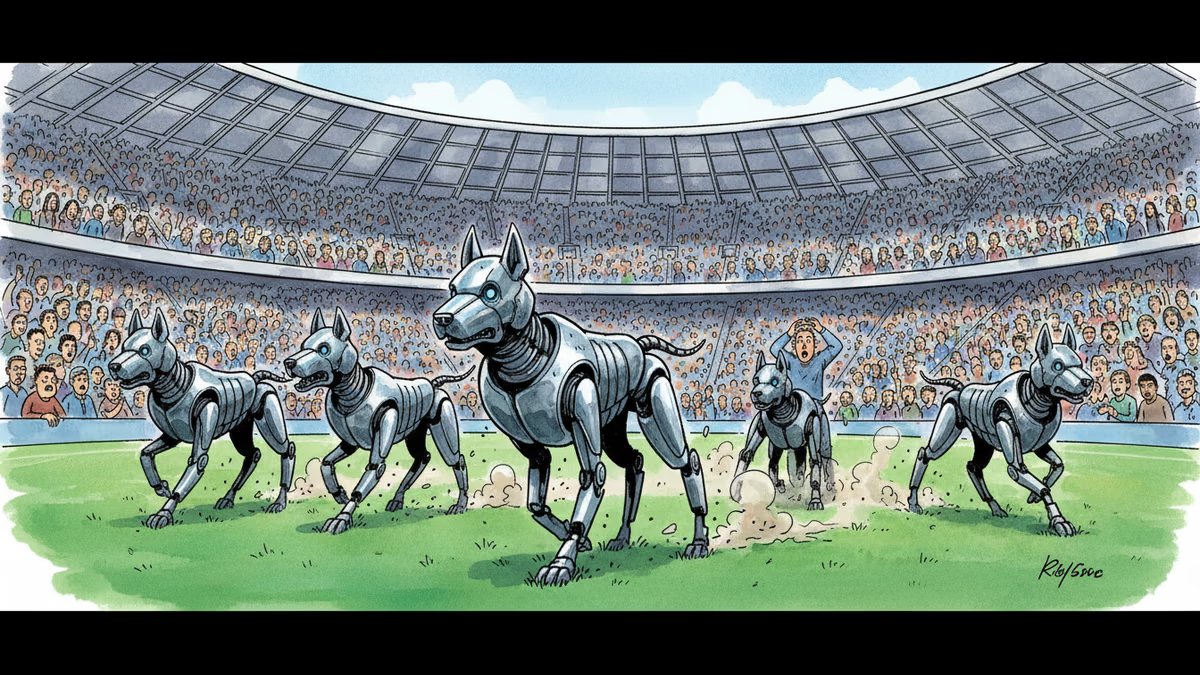
Robot Dogs Are Now Patrolling World Cup Stadiums
Mexico's Guadalupe deploys four K9-X robot dogs at BBVA Stadium for 2026 World Cup security. The unarmed robots patrol crowds and scout dangerous areas before human officers intervene.
When Your Stadium Security Has Four Legs and No Heartbeat
Picture this: You're watching a soccer match in Mexico, and suddenly you notice something unusual patrolling the perimeter. It's not a guard dog—it's a four-legged robot with cameras for eyes and speakers for a bark.
This became reality last week at BBVA Stadium in Guadalupe, Nuevo León, where four K9-X robot dogs made their official debut during a Monterrey FC match. They're not just a tech demo—they're the advance guard for 2026 World Cup security.
The robots don't carry weapons, but they're packed with video cameras, night vision, and communication systems. Their job? Deter illegal activity, spot suspicious behavior, identify dangerous objects, and control crowds—all before human officers need to step in.
Semi-Autonomous Means Human-Controlled (For Now)
Don't worry about robot uprising scenarios just yet. These K9-X units operate like sophisticated drones—they need human operators controlling every movement. Think of it as playing a very expensive, very serious video game where the stakes are public safety.
Héctor García, Guadalupe's mayor, explained their role: "These robot dogs will support police with initial intervention, providing video and entering high-risk locations before public security forces go in, protecting officers' physical safety."

But here's the tension: While human control addresses some concerns about autonomous weapons, it raises new questions about surveillance scope and accountability. Who's watching the watchers when the watchers are robots?
The World Cup as a Security Testing Ground
BBVA Stadium will host four World Cup matches in 2026—three group stage games and one round of 16. The robot dogs are just the beginning. Guadalupe plans to deploy advanced surveillance drones and anti-drone technology for the tournament.
What's concerning is the opacity. Authorities haven't disclosed the K9-X manufacturer, model, or technical specifications. Citizens and visitors have no clear picture of what data is being collected or how it's being used.
This mirrors a global trend where major sporting events become testing grounds for surveillance technology. From facial recognition at Super Bowls to AI-powered crowd monitoring at Olympics, sports venues are becoming laboratories for security innovation.
The Privacy Price of Safety
For sports fans, this raises uncomfortable questions. How much surveillance are we willing to accept for the promise of safety? And who decides where that line is drawn?
The robot dogs represent a broader shift in how we think about security. Traditional human guards are expensive, can be overwhelmed, and have limited capabilities. Robots don't get tired, don't miss details, and can access dangerous areas without risking human lives.
But they also don't exercise human judgment, can't build rapport with crowds, and create an atmosphere of constant monitoring that might fundamentally change the experience of attending live events.
Authors
Related Articles

Samsung Electronics' union branch revealed that 84% of survey respondents oppose the government's roughly $290 billion (₩400 trillion) semiconductor megaproject in Gwangju. Government, management, the union and shareholders are all reading the same national project in sharply different ways.
Nvidia shipped roughly a billion RISC-V cores in 2024, then announced it would run CUDA on the open standard. We break down how royalty-free instruction sets and open software stacks are trying to route around CUDA's lock-in. Part 2 of the Semiconductor Sovereignty series.
US AI-chip export controls split into three layers in the first half of 2026 — January easing, a May crackdown on circumvention, and a pending bill. Nvidia erased China from its guidance and still posted a record $81.6 billion quarter. A look at the export policy that both shields and cages it.

AMD's MI325X matches or beats Nvidia on memory and bandwidth — yet Nvidia's 86-92% share holds. The real moat is CUDA, 20 years in the making. Part 1 of 4.
Samsung Electronics' union branch revealed that 84% of survey respondents oppose the government's roughly $290 billion (₩400 trillion) semiconductor megaproject in Gwangju. Government, management, the union and shareholders are all reading the same national project in sharply different ways.
Nvidia shipped roughly a billion RISC-V cores in 2024, then announced it would run CUDA on the open standard. We break down how royalty-free instruction sets and open software stacks are trying to route around CUDA's lock-in. Part 2 of the Semiconductor Sovereignty series.
US AI-chip export controls split into three layers in the first half of 2026 — January easing, a May crackdown on circumvention, and a pending bill. Nvidia erased China from its guidance and still posted a record $81.6 billion quarter. A look at the export policy that both shields and cages it.
AMD's MI325X matches or beats Nvidia on memory and bandwidth — yet Nvidia's 86-92% share holds. The real moat is CUDA, 20 years in the making. Part 1 of 4.
Thoughts
Share your thoughts on this article
Sign in to join the conversation