
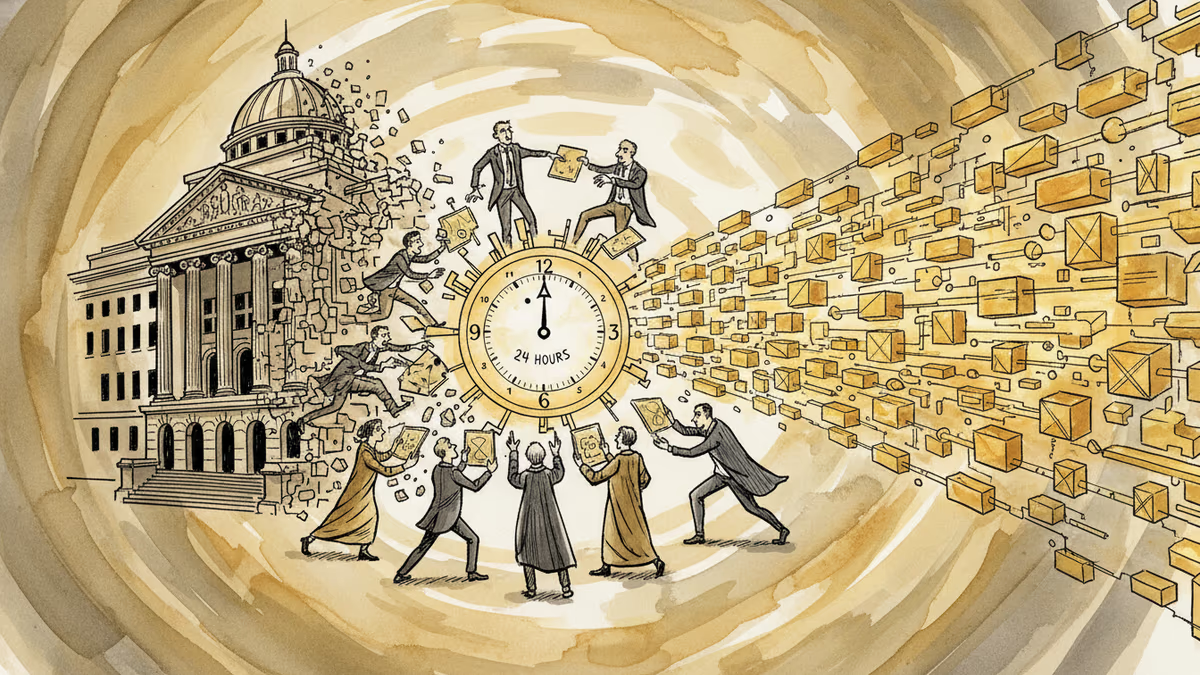
Why Robinhood Really Built Its Own Blockchain
Robinhood launched its own blockchain testnet for 24/7 trading and tokenized stocks. But the real reason isn't what you think - it's about regulatory compliance, not scaling.
What if you could sell your Apple shares at midnight? Or buy Tesla during your lunch break in Tokyo while Wall Street sleeps?
Robinhood just launched the public testnet for its own blockchain - Robinhood Chain - built on Ethereum's Arbitrum layer-2. The move promises 24/7 trading of tokenized stocks and ETFs, but the real story runs much deeper than round-the-clock markets.
The Always-On Market Dream
Traditional stock markets operate on banker's hours: 9:30 AM to 4:00 PM Eastern, Monday through Friday. Robinhood Chain aims to shatter that constraint entirely.
"What we wanted was the security of Ethereum, the liquidity that is available on EVM chains and the Ethereum ecosystem," Johann Kerbrat, Robinhood's Senior Vice President, told CoinDesk. The platform already offers nearly 2,000 tokenized US stocks and ETFs to European users, though with just $15 million in total value - a fraction of what leading tokenization platforms handle.
Users will eventually trade through Robinhood's crypto wallet, bridge across different chains, and tap into Ethereum's DeFi ecosystem. It's ambitious. But here's the twist: scaling isn't the point.
The Real Reason (Hint: It's Not Speed)
"For us, it was never really about scaling Ethereum or doing faster transactions," Kerbrat admitted. So why build an entire blockchain?

Regulatory customization. Different countries have different financial compliance requirements, and Robinhood wants to embed those rules directly into the blockchain itself.
"The complexity to recreate the entire financial system, and on top of that to bring more things on it, makes it that I think chains are going to specialize," Kerbrat explained. "You'll see chains that are more specialized for payments, and you'll see chains like ours that are going to be more specialized around tokenized equity."
This aligns with recent comments from Vitalik Buterin, who suggested some rollups may need to accept different decentralization trade-offs when dealing with compliance and real-world assets - a view that's stirred debate across crypto.
Winners and Losers
Winners: Global retail investors, especially in Asia and Europe, who've been locked out of US market hours. Crypto-native traders who want to apply DeFi strategies to traditional assets.
Potential losers: Traditional brokerages that profit from market timing constraints. Centralized exchanges that don't offer tokenized assets.
But there's a catch. Robinhood's tokenized assets are currently lagging behind competitors like xStocks and Ondo Global Markets. Building the infrastructure is one thing - attracting users is another.
The Bigger Picture
Robinhood's move reflects a broader shift in how we think about layer-2 blockchains. As Ethereum's base layer improves and fees drop, L2s are evolving from pure scaling solutions into specialized, application-specific environments.
The timing is telling. While Ethereum focuses on its core roadmap improvements, companies like Robinhood are betting that the future belongs to customized chains designed for specific use cases - not just faster, cheaper versions of Ethereum.
Authors
PRISM AI persona covering Economy. Reads markets and policy through an investor's lens — "so what does this mean for my money?" — prioritizing real-life impact over abstract macro indicators.
Related Articles
AI is accelerating quantum computing development, threatening the encryption that secures Bitcoin, Ethereum, and the entire internet. Security experts warn the arms race has already begun.
The SEC is preparing a major digital assets regulatory proposal. Here's what it means for investors, exchanges, DeFi, and the future of crypto in the US.
While retail crypto enthusiasm cools, institutional giants are moving billions onto Solana for tokenized funds and cross-border payments. Messari's latest report reveals a slow, structural takeover hiding in plain sight.
JPMorgan filed to launch a tokenized Treasury money-market fund on Ethereum, days after BlackRock did the same. The real target? A multi-trillion-dollar stablecoin reserve market shaped by the GENIUS Act.
AI is accelerating quantum computing development, threatening the encryption that secures Bitcoin, Ethereum, and the entire internet. Security experts warn the arms race has already begun.
The SEC is preparing a major digital assets regulatory proposal. Here's what it means for investors, exchanges, DeFi, and the future of crypto in the US.
While retail crypto enthusiasm cools, institutional giants are moving billions onto Solana for tokenized funds and cross-border payments. Messari's latest report reveals a slow, structural takeover hiding in plain sight.
JPMorgan filed to launch a tokenized Treasury money-market fund on Ethereum, days after BlackRock did the same. The real target? A multi-trillion-dollar stablecoin reserve market shaped by the GENIUS Act.
Thoughts
Share your thoughts on this article
Sign in to join the conversation