
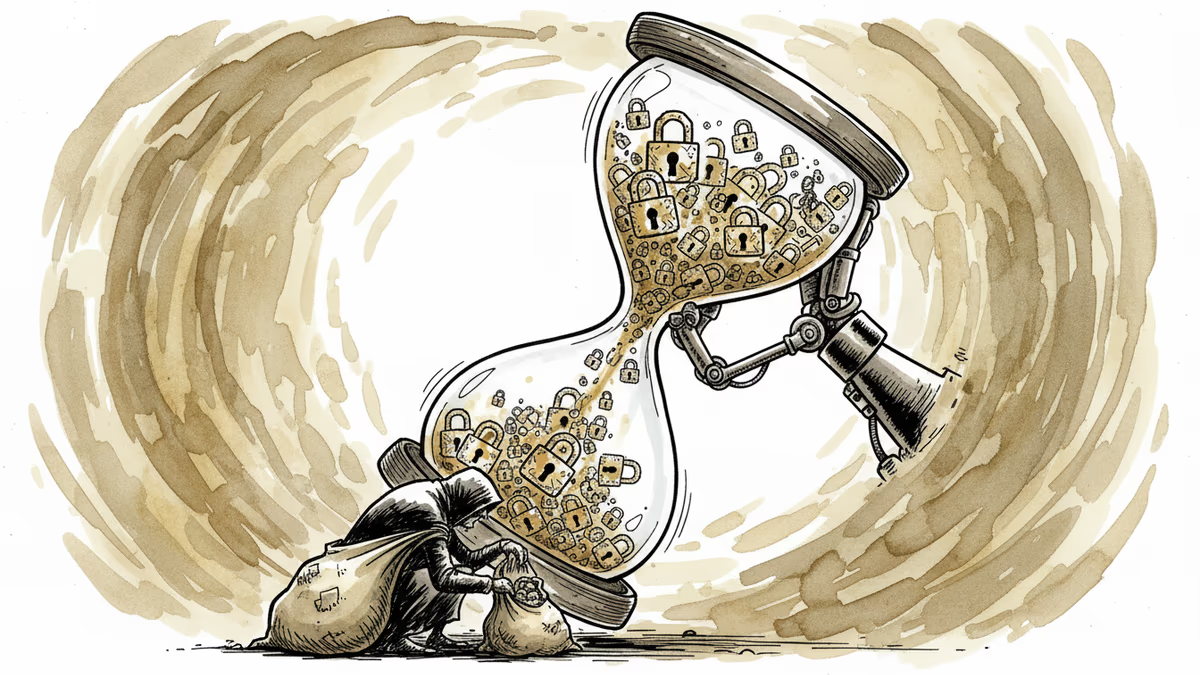
AI Is Closing the Window on Safe Encryption
AI is accelerating quantum computing development, threatening the encryption that secures Bitcoin, Ethereum, and the entire internet. Security experts warn the arms race has already begun.
Someone may already be storing your encrypted data right now — not because they can read it, but because they're betting they will be able to in two years.
This is the "harvest now, decrypt later" strategy, and security researchers believe it's not hypothetical. Nation-state actors and sophisticated threat groups are widely suspected of collecting encrypted internet traffic today, waiting for quantum computers powerful enough to crack it. What's changed recently is the accelerant: artificial intelligence.
The Convergence Nobody Fully Priced In
The crypto industry has long debated whether quantum computing poses an existential threat to blockchains. The math has always been clear in theory: a sufficiently powerful quantum computer could derive private keys from public keys using Shor's algorithm, effectively emptying any wallet whose public key has been exposed on-chain. For Bitcoin alone, researchers estimate that millions of coins in older address formats carry some degree of exposure.
But the debate has mostly centered on timing. Cryptographically relevant quantum computers — machines capable of breaking modern encryption at scale — have consistently been described as a decade or more away. That buffer has given the industry room to treat post-quantum migration as a future problem.
AI is eroding that buffer. Alex Pruden, CEO of Project Eleven, a firm focused on quantum-resistant infrastructure, puts it directly: "AI is definitely being used to accelerate the development of quantum computing." The specific bottleneck being unlocked is quantum error correction — the engineering challenge that has kept today's quantum machines too noisy and unreliable for cryptographic attacks. Machine learning systems are now being applied to optimize error correction in ways that human researchers couldn't achieve alone.
Illia Polosukhin, co-founder of NEAR Protocol and a former Google AI researcher, describes a feedback loop that compounds the concern. "It might be that the next generation quantum computer will be built with AI and quantum computers of this generation," he said. "It's feeding into itself." He points to 2016, when ML systems at Google were already being used to discover new materials — a capability that has since expanded dramatically.
Two Threats for the Price of One

The quantum timeline compression is one problem. But researchers increasingly argue the more immediate threat is AI itself, operating independently of quantum hardware.
AI models are becoming effective at identifying implementation flaws in cryptographic code — the kind of subtle bugs that human auditors miss. "I would expect the advent of AI to accelerate even more hacks," Pruden said. "You have these AI models that are able to find either implementation bugs in the underlying cryptography or, increasingly, break the cryptography itself."
The defensive side is deploying the same tools. Developers are using AI for code auditing, formal verification, and automated testing of post-quantum systems. Pruden notes that AI-assisted formal verification could theoretically make new cryptographic implementations more reliable than anything built before.
The result is a permanent arms race dynamic. Security can no longer be treated as infrastructure that gets a major upgrade every decade and then runs quietly in the background. "Nothing is going to be as static as it's been in the future," Pruden said. "Either a quantum computer comes online to break some fundamental assumption, or AI gets smart enough to break that assumption too."
Who's Preparing — and the Gap That Remains
Several blockchain ecosystems are already moving. Ethereum, Zcash, Solana, Ripple, and NEAR are all researching or implementing post-quantum migration strategies. NEAR recently announced plans to integrate post-quantum cryptography directly into its account infrastructure, allowing users to rotate cryptographic schemes without migrating assets to entirely new wallets — a design choice Polosukhin says was baked in from the beginning in 2018.
The technical obstacles are real, however. Post-quantum cryptographic standards are significantly larger and slower than current systems. For high-throughput networks processing thousands of transactions per second, that translates directly into higher fees and slower finality. "The cryptography that's currently standardized for post-quantum is very big and slow," Polosukhin acknowledged.
Bitcoin presents a distinct governance challenge. Any cryptographic migration would require broad consensus across a decentralized network with deeply conservative upgrade culture. The technical path exists; the social and political path is considerably harder.
For ordinary crypto holders, the practical question is more immediate: wallets that have ever broadcast a public key on-chain — which includes any address that has sent a transaction — carry theoretical long-term exposure. The window to migrate to quantum-resistant addresses exists today. Most users haven't thought about it.
This content is AI-generated based on source articles. While we strive for accuracy, errors may occur. We recommend verifying with the original source.
Related Articles

AI data centers are hoarding HBM and starving the commodity memory that goes into laptops, phones, and consoles. Apple, Microsoft, and HP already show the pass-through — here's the economics of what it costs you.

As AI reshapes warfare, nations outpaced by the US and China are betting on quantum, photonic, and neuromorphic computing to close the gap. Here's what's at stake.

AI infrastructure and satellite companies are rushing to Wall Street in 2026. What's driving the IPO wave, and what should investors watch for?

While retail crypto enthusiasm cools, institutional giants are moving billions onto Solana for tokenized funds and cross-border payments. Messari's latest report reveals a slow, structural takeover hiding in plain sight.
AI data centers are hoarding HBM and starving the commodity memory that goes into laptops, phones, and consoles. Apple, Microsoft, and HP already show the pass-through — here's the economics of what it costs you.
As AI reshapes warfare, nations outpaced by the US and China are betting on quantum, photonic, and neuromorphic computing to close the gap. Here's what's at stake.
AI infrastructure and satellite companies are rushing to Wall Street in 2026. What's driving the IPO wave, and what should investors watch for?
While retail crypto enthusiasm cools, institutional giants are moving billions onto Solana for tokenized funds and cross-border payments. Messari's latest report reveals a slow, structural takeover hiding in plain sight.
Thoughts
Share your thoughts on this article
Sign in to join the conversation