
An AI Server Just Set the Price of Your Next Phone — The Memory Crunch Reaches Your Wallet
AI data centers are hoarding HBM and starving the commodity memory that goes into laptops, phones, and consoles. Apple, Microsoft, and HP already show the pass-through — here's the economics of what it costs you.
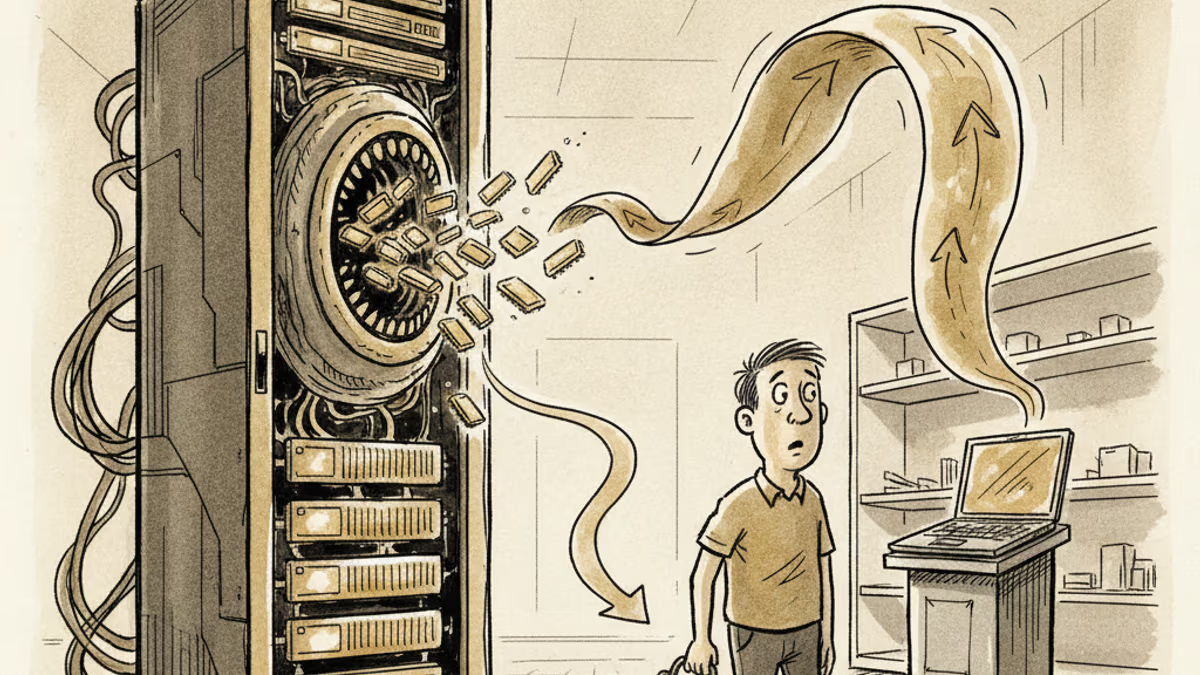
The price of your next laptop is already being decided somewhere inside an AI server rack.
That's not a metaphor. Last month, Apple raised the MacBook Pro from $1,699 to $1,999 — a $300 jump. The entry-level MacBook Neo climbed from $599 to $699, and Microsoft pushed Xbox prices up by $100 to $150 while quietly killing off its top-spec 2TB model altogether. Fortune reported the details on June 28, 2026. The reason was the same across the board: memory got too expensive to absorb.
HP's chief financial officer, Kevin Parkhill, told the same report that memory prices had “roughly doubled quarter over quarter.” He added that the PC unit's operating margin would “run below its long-term range through year-end.” When your input cost doubles, one of two things happens: the company eats the margin, or the customer pays more. Right now, both are happening at once.
Why memory, and why now
The cause sits outside the consumer aisle entirely. It's the AI data center.
High-bandwidth memory (HBM) — the kind bolted onto Nvidia's AI accelerators — carries much fatter margins than ordinary DRAM. So Samsung, SK Hynix, and Micron are steering the same fabs and the same wafers toward HBM and high-margin server parts. S&P Global calls this not a temporary shortage but a “fundamental capacity reallocation.” The catch: every wafer that goes to HBM is a wafer that doesn't become the commodity DRAM and NAND inside your laptop or phone.
The numbers make the tilt obvious. According to TrendForce, commodity DRAM contract prices were projected to rise 55% to 60% quarter over quarter in the first quarter of 2026 (1Q26), with NAND flash seen up 33% to 38%. Server DRAM reportedly jumped 60% to 70% (citing TrendForce). IDC estimates 2026 supply growth of just 16% for DRAM and 17% for NAND — both below historical averages. Demand is exploding on the AI side while supply grows slower than a normal year. That's a structure that can only push prices up.
The more AI data centers soak up HBM, the less commodity memory comes out of the same cleanroom. S&P Global (Visible Alpha consensus) estimates that per-bit revenue for Samsung's commodity DRAM will rise 116% in 2026 versus a year earlier ($0.36 to $0.79). Great news for suppliers — a bill for everyone else. The margin on a single slice of HBM decides how the wafers get allocated, and that decision trickles down to the RAM in your next laptop. In effect, part of the cost of the AI boom that data centers are carrying gets passed straight to consumers.

It arrives three ways: a hike, a downgrade, a discontinuation
Higher input costs don't reach shoppers through a single door. Follow TrendForce's analysis and there are roughly three.
The first, and most visible, is the straight price hike — Apple's $300 on the MacBook Pro is the textbook case. The second is the spec downgrade: leave the sticker price alone and cut the memory instead. Same money, less storage — a quiet increase that never shows up on the price tag. The third is killing the top tier, which is exactly what Microsoft did by dropping the 2TB Xbox. The configurations that eat the most RAM and storage are the first to vanish from the lineup.
In phones, the squeeze is even sharper. TrendForce says the memory contract price for the mainstream 8GB RAM plus 256GB storage combo hit roughly three times its year-ago level in the first quarter (about 200% year over year). As a result, memory's share of a smartphone's bill of materials jumped from 10% to 15% historically up to 30% to 40%. In laptops, memory's share has crossed 20%. When a single component runs more than a third of your cost, you can't hold the finished price steady while that component triples.
So how much will prices climb? From here, it's a forecast
This is where observed fact ends and prediction begins — and the forecasters don't agree.
Investment bank Jefferies is cited (a secondhand citation) as projecting that consumer device prices could rise 10% to 20% by year-end. IDC paints a gentler picture: PC average selling prices (ASPs) up 4% to 6%, smartphones up 3% to 5%. TrendForce figures that if the costs get passed through, laptop retail prices could climb 5% to 15%. The spread is wide enough that it's more honest to read it as a range — “single digits at the low end, high teens at the top” — than to nail down any one number.
The forward curve for memory prices themselves is just as split. Jefferies projected quarter-over-quarter hikes of 40% to 50% in the third quarter and 30% to 40% in the fourth, and reportedly sees no meaningful relief before 2028 (some headlines pinned it a touch higher, at 50% for Q3 and 40% for Q4). Taiwan's cnyes reported an outlook of a further 40% to 45% rise in DRAM contract prices in the second half. Take all of it as forecast — and note that the range shifts depending on who you're reading.
A supercycle, or a bottleneck that passes?
Expert diagnoses split into two camps.
One side sees a structural supercycle. S&P Global's “fundamental capacity reallocation” call is the starting point. Supply growth running below historical averages (IDC), the big three memory makers refusing long-term contracts and switching to quarterly deals (TrendForce), and word that Japan's Kioxia has essentially sold out its 2026 NAND all point the same way. From this vantage, higher consumer prices are unavoidable.
The other side sees relief after the peak. A Harvard semiconductor expert warned back in May, in Fortune, against reading too much into the boom — “this too shall pass.” Yokohama Research, in a March report, judged that even if memory prices stay elevated through 2027, the hit to Japanese electronics-component makers would be limited — a check on the tidy assumption that “supercycle” means damage everywhere. And if the price spike dents device demand — TrendForce sees global smartphone production potentially falling about 10% in 2026 — memory demand can correct on its own. Most forecasters leave the door open to easing after a third- or fourth-quarter peak.
Nobody knows yet which camp is right. But both put the price peak in the same place — the third and fourth quarters. What they disagree on is the path after that peak.
The pain won't land evenly. Top brands like Apple and Samsung can absorb some of the cost shock through vertical integration and product mix — the same lever that lets a Dell or an HP shuffle margin across a broad lineup. Brands leaning on cheap, entry-level lines, like Xiaomi or Transsion, have a thinner buffer (TrendForce). So the burden falls hardest on people buying budget devices — the thinner wallets. It's a regressive structure: a cost created by AI servers climbs back down the income ladder in reverse. Next time you upgrade, check the quietly shrunken storage before you check the higher price.
If you're not swapping phones this week, none of this may feel like your problem yet. But contract prices already jumped in the first quarter, and it's only a matter of months before they show up at retail. Apple's and Microsoft's price tags are the signal that the lag is running out. When you pick your next device, don't just read the price — start with how much RAM and storage got trimmed at the same price. That gap is the real bill this cycle has handed you.
This content is AI-generated based on source articles. While we strive for accuracy, errors may occur. We recommend verifying with the original source.
Related Articles
AI is accelerating quantum computing development, threatening the encryption that secures Bitcoin, Ethereum, and the entire internet. Security experts warn the arms race has already begun.
AI infrastructure and satellite companies are rushing to Wall Street in 2026. What's driving the IPO wave, and what should investors watch for?
Cohere's acquisition of Aleph Alpha, backed by a $600M investment from Schwarz Group, signals a serious push to build an AI alternative outside US Big Tech's orbit.
Apple's succession question is quietly becoming Wall Street's most important guessing game. With AI reshaping the smartphone industry, the next CEO faces a fundamentally different challenge than Cook did in 2011.
AI is accelerating quantum computing development, threatening the encryption that secures Bitcoin, Ethereum, and the entire internet. Security experts warn the arms race has already begun.
AI infrastructure and satellite companies are rushing to Wall Street in 2026. What's driving the IPO wave, and what should investors watch for?
Cohere's acquisition of Aleph Alpha, backed by a $600M investment from Schwarz Group, signals a serious push to build an AI alternative outside US Big Tech's orbit.
Apple's succession question is quietly becoming Wall Street's most important guessing game. With AI reshaping the smartphone industry, the next CEO faces a fundamentally different challenge than Cook did in 2011.
Thoughts
Share your thoughts on this article
Sign in to join the conversation