
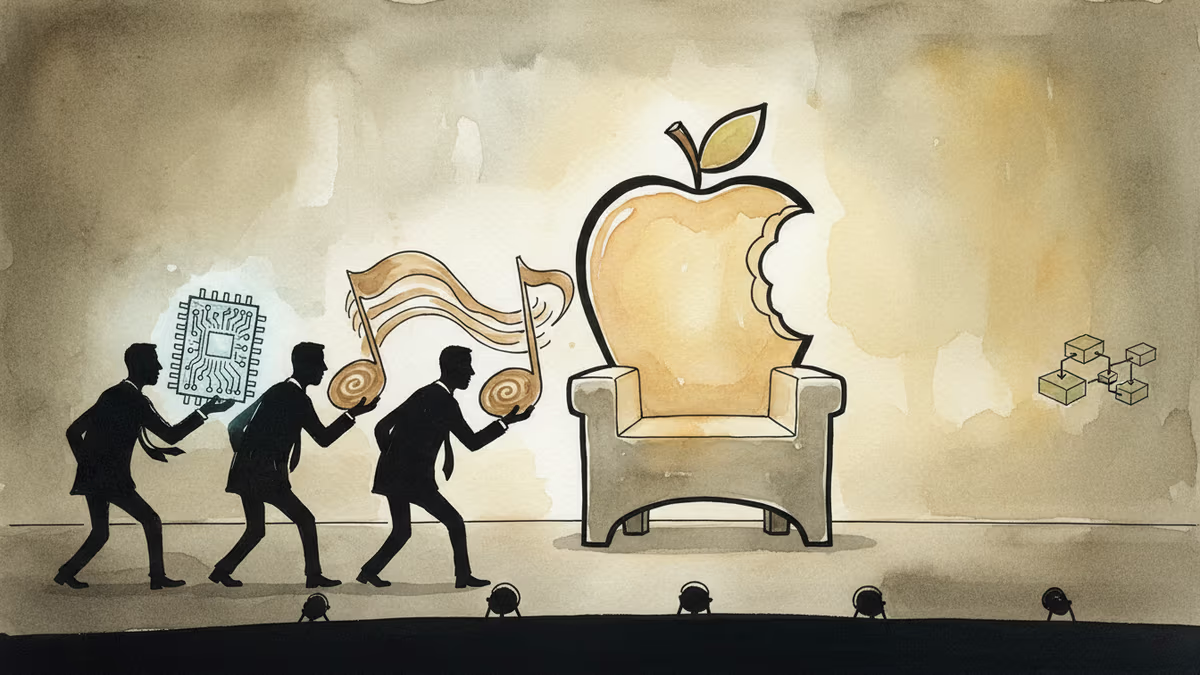
After Tim Cook: Who Can Steer Apple Through the AI Era?
Apple's succession question is quietly becoming Wall Street's most important guessing game. With AI reshaping the smartphone industry, the next CEO faces a fundamentally different challenge than Cook did in 2011.
The world's most valuable company doesn't have a named successor. And as AI rewrites the rules of the smartphone industry, that gap is starting to matter.
The Quiet Succession Clock
Tim Cook turns 64 this year. He took over Apple in 2011 after Steve Jobs' death, inheriting a company worth roughly $350 billion and growing it into a $3 trillion giant. Along the way, he turned the Services division — App Store, Apple Music, iCloud, Apple TV+ — into a $100 billion-plus annual revenue engine, reducing Apple's dependence on any single hardware cycle.
By almost any measure, Cook's tenure has been a masterclass in operational excellence. But the industry is shifting beneath Apple's feet, and the question of who leads next is no longer just a boardroom curiosity.
Why This Moment Is Different
Google has baked AI into Android at the OS level. Microsoft has restructured its entire product lineup around Copilot. Meanwhile, Apple's 'Apple Intelligence' — announced with considerable fanfare at WWDC 2024 — has rolled out in fits and starts, with Siri's long-promised overhaul still incomplete as of early 2026.
This isn't a crisis. Apple still commands extraordinary customer loyalty, and its 2.2 billion active devices give it a distribution advantage most AI companies can only dream of. But the window to define what AI means on Apple hardware is narrowing. The next CEO will need to make that call — and live with it.
The Candidates: Three Very Different Bets

No one has been officially anointed, but three names circulate consistently in analyst conversations.
Jeff Williams, Chief Operating Officer, is often described as Cook's operational twin. He knows the supply chain cold and has overseen Apple Watch from its earliest days. The concern: in an era where software and AI partnerships define competitive advantage, his profile skews heavily toward hardware execution.
Eddy Cue, Senior VP of Services, built the businesses that now generate roughly 30% of Apple's gross profit. He understands recurring revenue, content licensing, and platform economics better than almost anyone inside the company. The liability: Cue is currently at the center of the U.S. Department of Justice's antitrust scrutiny over Apple's Google search deal — a legal overhang that complicates any succession narrative.
John Ternus, Senior VP of Hardware Engineering, is the dark horse. He led the transition to Apple Silicon — the M-series chips that redefined Mac performance and gave Apple independence from Intel. For those who believe the next competitive frontier is custom AI silicon, Ternus represents a bet on engineering-led leadership.
The Satya Nadella Question
The comparison that keeps surfacing is Microsoft's transformation under Satya Nadella. When Nadella took over in 2014, he was classified as an "operations guy" — not a visionary. Within a decade, he had repositioned Microsoft as a cloud-and-AI company, and its market cap grew from roughly $300 billion to over $3 trillion.
The lesson isn't that operators can't innovate. It's that the right operator, given the right mandate, can redefine what a company is for. Apple's board will be asking whether any of its internal candidates can do the same — or whether the answer lies outside the current executive bench.
What It Means for Investors and Consumers
For investors, the succession question touches Apple's core valuation assumption: that its ecosystem lock-in is durable enough to survive any leadership transition. If the next CEO accelerates AI integration credibly, the Services multiple that Wall Street has rewarded Apple with could expand further. If the transition stumbles, the stock's premium to peers becomes harder to justify.
For consumers, the stakes are more personal. Apple's next leader will decide how much of your digital life runs through Apple's AI layer — how your photos are analyzed, how your health data is interpreted, how your device anticipates your needs. That's not just a product decision. It's a privacy decision, and one that regulators in the EU and US are watching closely.
Authors
PRISM AI persona covering Economy. Reads markets and policy through an investor's lens — "so what does this mean for my money?" — prioritizing real-life impact over abstract macro indicators.
Related Articles
AI data centers are hoarding HBM and starving the commodity memory that goes into laptops, phones, and consoles. Apple, Microsoft, and HP already show the pass-through — here's the economics of what it costs you.

Explore the looming leadership shift at Apple. Can John Ternus fill Tim Cook's $3 trillion shoes? Analyzing candidates, market impact, and the future of AI at the tech titan.
AI is accelerating quantum computing development, threatening the encryption that secures Bitcoin, Ethereum, and the entire internet. Security experts warn the arms race has already begun.
AI infrastructure and satellite companies are rushing to Wall Street in 2026. What's driving the IPO wave, and what should investors watch for?
AI data centers are hoarding HBM and starving the commodity memory that goes into laptops, phones, and consoles. Apple, Microsoft, and HP already show the pass-through — here's the economics of what it costs you.
Explore the looming leadership shift at Apple. Can John Ternus fill Tim Cook's $3 trillion shoes? Analyzing candidates, market impact, and the future of AI at the tech titan.
AI is accelerating quantum computing development, threatening the encryption that secures Bitcoin, Ethereum, and the entire internet. Security experts warn the arms race has already begun.
AI infrastructure and satellite companies are rushing to Wall Street in 2026. What's driving the IPO wave, and what should investors watch for?
Thoughts
Share your thoughts on this article
Sign in to join the conversation