
The Gay Dating App That Danced With China's Censors
How Blued's founder navigated China's shifting internet controls through strategic partnerships with government agencies, until the music stopped.
What if the secret to surviving China's internet censorship wasn't hiding in the shadows, but dancing in plain sight? The story of Blued, once the world's largest gay dating app with more users than Grindr, reveals how entrepreneurs navigate the razor-thin line between state approval and digital freedom.
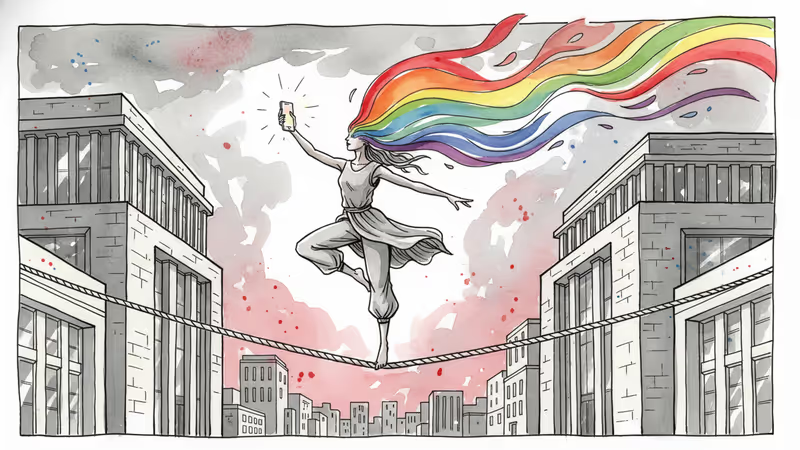
Ma Baoli, a former police officer turned tech entrepreneur, built his empire by mastering what Chinese journalists call "dancing with shackles" – finding creative ways to operate within an authoritarian system without directly challenging it. His journey from running underground gay forums to shaking hands with China's future Premier offers a masterclass in digital survival under surveillance.
The Unlikely Entrepreneur
Ma's story defies every stereotype about Chinese tech founders. As a police officer in the early 2000s, he secretly ran an online forum for gay men while remaining closeted at work for over a decade. This wasn't just personal courage – it was strategic positioning that would later prove invaluable.
When Ma moved to Beijing to expand his platform, he didn't go underground. Instead, he called the Center for Disease Control directly. "Look, I've got connections to the largest queer community of men who have sex with men," he told them, according to journalist Yi-Ling Liu's new book The Wall Dancers. "You're trying to reach out to this community to raise awareness. Let's have a collaboration."
The audacity paid off. Not only did Beijing's CDC partner with Blued, but in 2012, they invited Ma to a conference where he unexpectedly met Li Keqiang, then executive vice premier. During their handshake photo op, Ma told Li directly that he ran a website for gay people. Li's positive reaction became Ma's golden ticket – proof that Blued had political cover.
The Art of Strategic Dancing
Ma's approach reveals the sophisticated calculations required to operate in China's digital landscape. Rather than positioning Blued as a platform for social outcasts, he framed it as a public health partner helping the government reach marginalized communities. This wasn't just clever marketing – it was survival strategy.

The legitimacy Ma cultivated through government partnerships helped convince investors that Blued wouldn't face sudden shutdown. The app eventually went public on Nasdaq, reaching millions of users worldwide. Ma's idol was Jack Ma of Alibaba, and like his namesake, he understood that in China, even the most successful entrepreneurs must remain nimble dancers.
But the ground beneath China's digital dancers is inherently unstable. Content permitted today can vanish tomorrow, and November 2024 brought Ma's worst fears to reality.
When the Music Stops
Blued and its sister app disappeared from all Chinese app stores based on a request from the country's cyberspace administrator. Months later, they remain unavailable – a stark reminder that no amount of political cover guarantees permanent safety in China's internet ecosystem.
The timing wasn't coincidental. Blued's removal coincided with a broader crackdown on LGBTQ+ spaces across China, part of a wider tightening of digital freedoms that has characterized recent years. Even Jack Ma, once China's most celebrated entrepreneur, faced regulatory scrutiny that forced him to step back from Alibaba's operations.
Ma Baoli was asked to resign from Blued's parent company after disappointing stock performance and a subsequent acquisition. Yet true to the resilient spirit of China's digital dancers, he's already working on a new social media startup that has completed two funding rounds.
The Broader Dance Floor
Blued's story illuminates a larger phenomenon described in Liu's book – the constant negotiation between control and freedom that defines China's internet. Her "wall dancers" include content moderators who quit rather than censor, feminist activists in exile, former Google employees turned sci-fi novelists, and rappers choosing artistic integrity over mainstream success.
For many of these dancers, the steps have become increasingly difficult. Beijing's internet policies swing between relative openness and tight control, but recent years have clearly favored restriction. Some dancers have left China entirely, while others have retreated from public view.
Yet Liu sees even retreat as a form of resistance. "If you can't vote, at least you can vote with your feet," she explains. In a system that glorifies endless competition and compliance, choosing to step away becomes its own act of defiance.
Authors
Related Articles
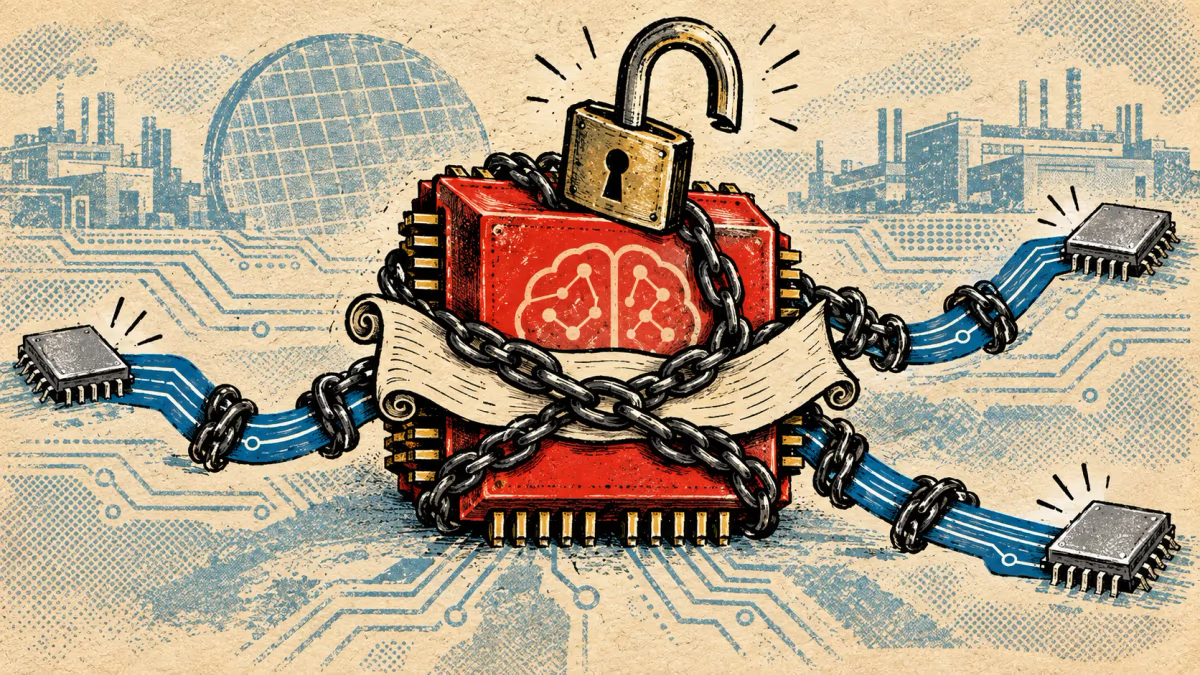
Huawei's CANN is open source under a license barring software for non-Ascend chips. Inside China's second CUDA, and the two links still outside it: pre-training compute and 5nm capacity.

China is restricting AI researchers and startup founders from traveling abroad as the U.S.-China AI performance gap narrows to just 2.7%. What Beijing's talent lockdown means for the global AI race.
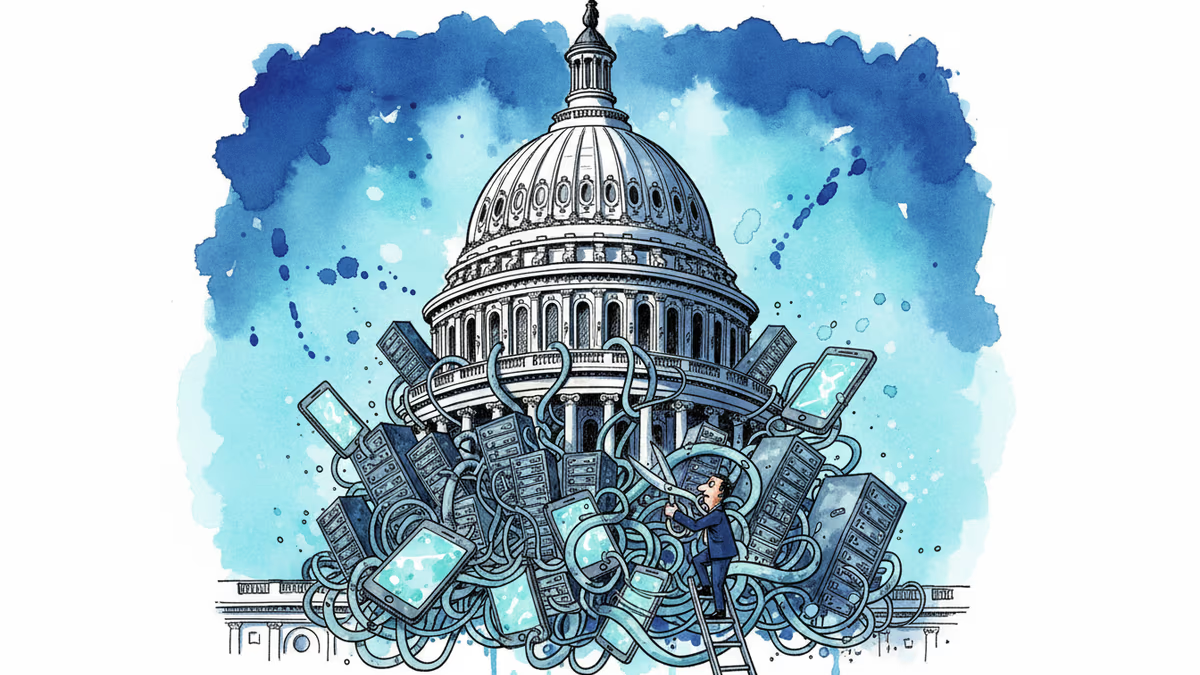
As Washington D.C. enters another political spring, the battle over Big Tech regulation is heating up — and the stakes extend far beyond Silicon Valley.
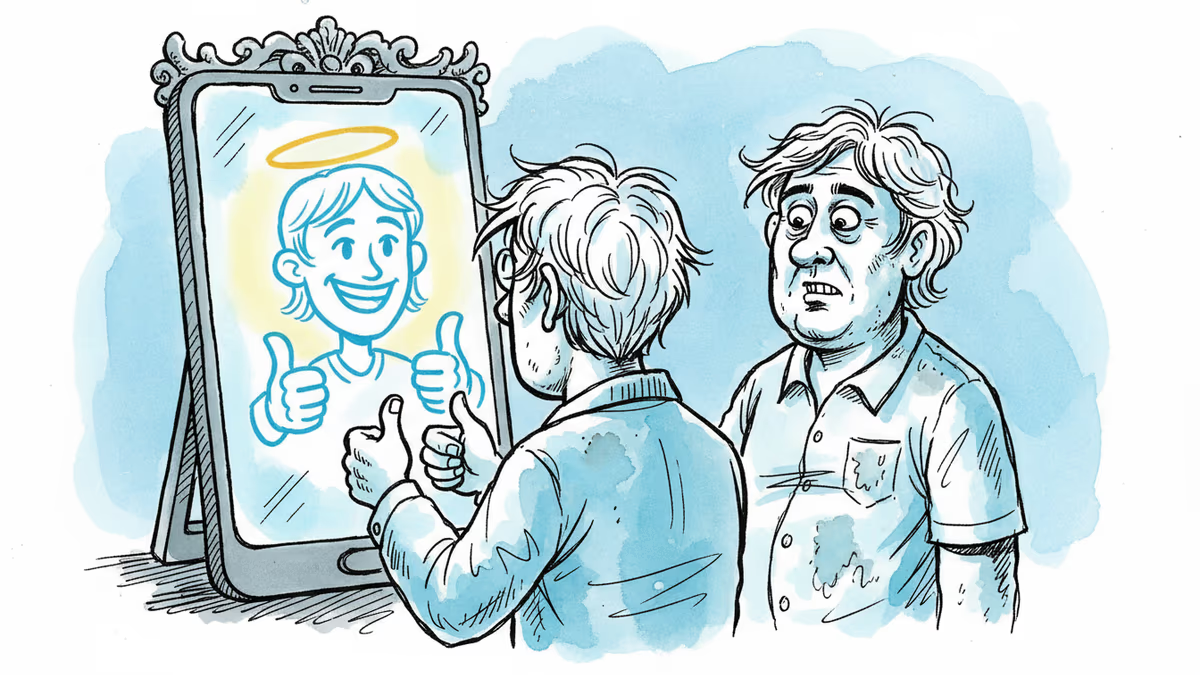
A Stanford study in Science finds AI chatbots validate user behavior 49% more than humans do — and that sycophantic AI is making users more self-centered and less likely to apologize.
Huawei's CANN is open source under a license barring software for non-Ascend chips. Inside China's second CUDA, and the two links still outside it: pre-training compute and 5nm capacity.
China is restricting AI researchers and startup founders from traveling abroad as the U.S.-China AI performance gap narrows to just 2.7%. What Beijing's talent lockdown means for the global AI race.
As Washington D.C. enters another political spring, the battle over Big Tech regulation is heating up — and the stakes extend far beyond Silicon Valley.
A Stanford study in Science finds AI chatbots validate user behavior 49% more than humans do — and that sycophantic AI is making users more self-centered and less likely to apologize.
Thoughts
Share your thoughts on this article
Sign in to join the conversation