
China's $431M AI Red Envelope War: What's Really at Stake This Lunar New Year?
Chinese AI giants are spending hundreds of millions on Lunar New Year marketing campaigns. Here's why this holiday timing could reshape the global AI landscape and what it means for Western competitors.
When a company commits $431 million to a single marketing campaign, they're not just buying ads—they're buying the future.
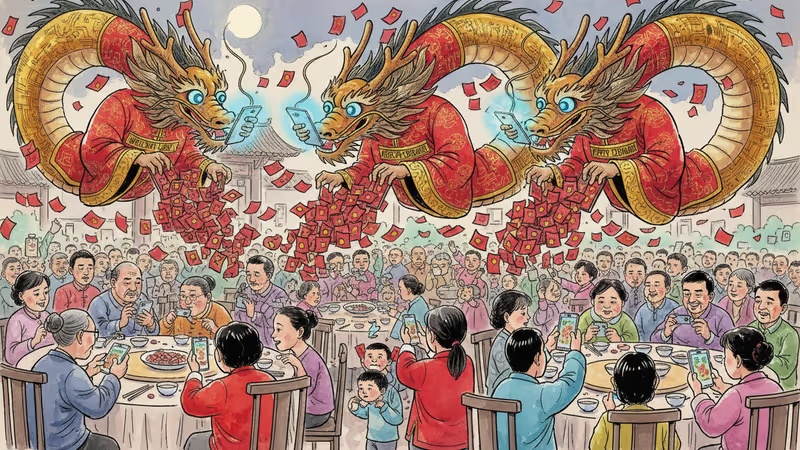
Chinese AI titans are unleashing an unprecedented marketing blitz ahead of Lunar New Year, with Alibaba pledging 3 billion yuan ($431 million) through its Qwen chatbot and Tencent committing 1 billion yuan ($140 million) via Yuanbao. But this isn't just about holiday marketing. It's about capturing hearts, minds, and market share during the most culturally significant moment in the Chinese calendar.
Why Lunar New Year is AI's Golden Hour
The nine-day holiday starting February 15 transforms China into a massive tech incubator. Hundreds of millions travel home, creating the perfect storm for viral adoption: work stops, families gather, and three generations share the same dinner table. "Consumers are more receptive to marketing efforts as work and study are paused," explains Shenghao Bai from Counterpoint Research, "and family gatherings accelerate the spread of new trends."
The strategy is already working. Tencent'sYuanbao rocketed from 9th to 1st place on China's App Store after launching its campaign Sunday. Users are sharing screenshots of their digital "red envelopes"—ranging from less than a penny to $8—creating organic viral loops that no Western marketing budget could buy.
ByteDance'sDoubao, currently China's most popular chatbot, will make a sponsored appearance at the state broadcaster's New Year's Eve Gala—a program with several times more viewers than the Super Bowl.
The Subscription-Free Battleground
Here's where China's AI market fundamentally differs from the West: Chinese users don't pay for subscriptions. With ChatGPT, Gemini, and Claude blocked, domestic players must first capture massive user bases, then monetize through advertising and e-commerce—a model that demands scale over immediate revenue.
Alibaba'sQwen recently added "agentic features" allowing users to order food delivery and book train tickets through conversation. It's not just a chatbot anymore—it's becoming a digital assistant integrated into daily life. This practical approach contrasts sharply with Western AI companies' focus on premium subscription models.

The DeepSeek Effect: National Pride Meets Innovation
Last year's DeepSeek phenomenon looms large over this year's campaigns. The Chinese startup shocked the world by training top-performing models with a fraction of Western computational resources, becoming a symbol of national technological pride. During the holiday, hundreds of millions of Chinese users flocked to DeepSeek—not just for its capabilities, but for what it represented.
This success has inspired a wave of model releases timed around this year's holiday. Alibaba, Moonshot AI, and StepFun have unveiled upgrades in recent weeks, while ByteDance, Zhipu, and Minimax are expected to follow. Everyone's racing to get attention before DeepSeek potentially dominates headlines again with its anticipated V4 model.
"Attention is all you need," notes Tiezhen Wang from Hugging Face. "They're likely thinking that if V4 has been released, no one will be paying attention to my model."
Beyond the Great Firewall: Global Implications
This isn't just a domestic Chinese story. While Western AI companies fight over enterprise customers and subscription revenues, Chinese firms are perfecting mass consumer adoption strategies that could eventually scale globally. They're learning how to make AI feel culturally native, personally relevant, and practically useful—lessons that could prove invaluable as they expand beyond China's borders.
The massive marketing spend also serves another purpose: AI literacy. Wang from Hugging Face points out that these campaigns help "elevate AI literacy among the non-tech population, which could benefit the entire AI ecosystem." Rural workers and elderly users who might never have tried AI are now getting their first taste through culturally familiar red envelope traditions.
The Cultural Advantage
Perhaps most intriguingly, Chinese AI companies are discovering something Western firms haven't fully grasped: technology adoption isn't just about features or pricing—it's about cultural resonance. By embedding AI into traditional holiday practices, they're making artificial intelligence feel less artificial and more like a natural extension of existing social behaviors.
This cultural integration strategy could become China's secret weapon in the global AI race. While Western companies optimize for individual productivity, Chinese firms are optimizing for social connection and cultural participation.
Authors
Related Articles
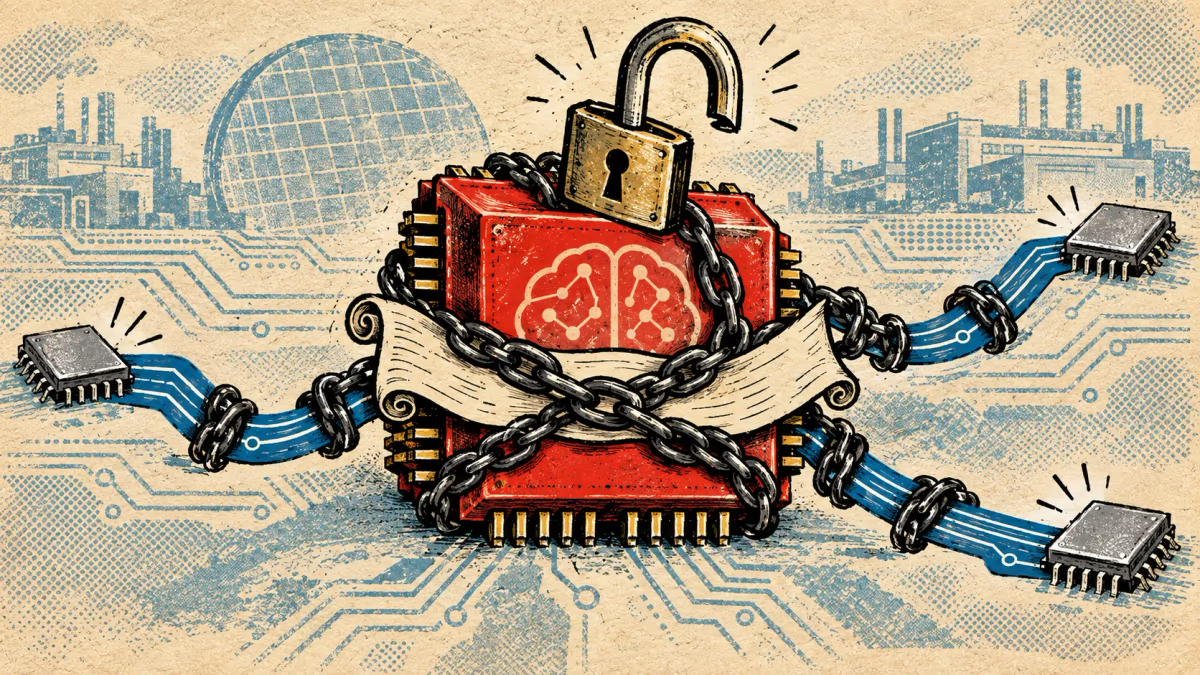
Huawei's CANN is open source under a license barring software for non-Ascend chips. Inside China's second CUDA, and the two links still outside it: pre-training compute and 5nm capacity.

Samsung and SK unveiled a chip and AI investment package worth thousands of trillions of won on June 29. The headline number swings wildly by outlet, but the real contest isn't capital — it's water and power.

China is restricting AI researchers and startup founders from traveling abroad as the U.S.-China AI performance gap narrows to just 2.7%. What Beijing's talent lockdown means for the global AI race.

Viral videos show 2026 graduates jeering executives who praise AI at commencement ceremonies. It's not just rudeness — it's a signal about who pays for technological optimism.
Huawei's CANN is open source under a license barring software for non-Ascend chips. Inside China's second CUDA, and the two links still outside it: pre-training compute and 5nm capacity.
Samsung and SK unveiled a chip and AI investment package worth thousands of trillions of won on June 29. The headline number swings wildly by outlet, but the real contest isn't capital — it's water and power.
China is restricting AI researchers and startup founders from traveling abroad as the U.S.-China AI performance gap narrows to just 2.7%. What Beijing's talent lockdown means for the global AI race.
Viral videos show 2026 graduates jeering executives who praise AI at commencement ceremonies. It's not just rudeness — it's a signal about who pays for technological optimism.
Thoughts
Share your thoughts on this article
Sign in to join the conversation