
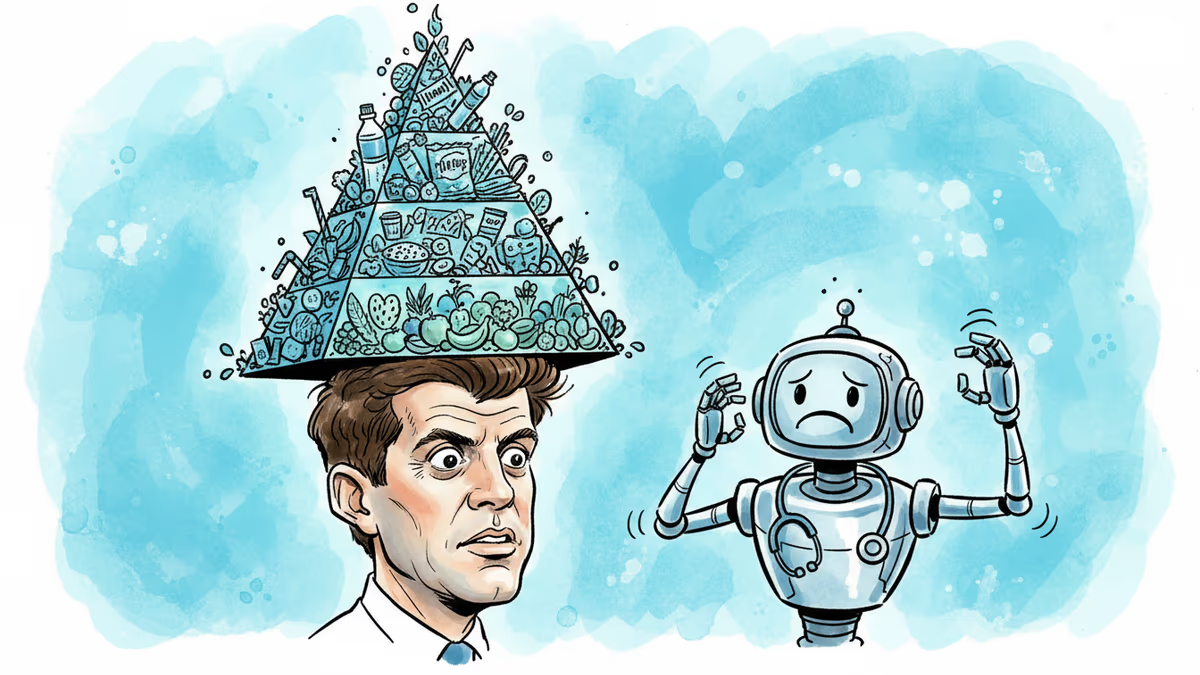
RFK Jr.'s Upside-Down Food Pyramid Gets Roasted—Even by His Favorite AI
Health Secretary Robert F. Kennedy Jr. officially launched his controversial dietary guidance despite mounting criticism. Even the AI chatbots he frequently uses are now openly contradicting his recommendations.
One Month In, and Even AI Is Jumping Ship
It's been about a month since Robert F. Kennedy Jr.—an anti-vaccine activist with zero medical background—became America's Health Secretary and released his dietary guidance. The reception? About as warm as you'd expect for a man who drinks raw milk, promotes beef tallow, swims in contaminated water, and stores roadkill in his freezer.
But here's the kicker: even his beloved AI chatbots are now openly contradicting him.
Super Bowl Spectacle Meets Government Policy
Wednesday's "implementation" event in Washington DC felt more like a marketing launch than serious policy discussion. Kennedy and Agriculture Secretary Brooke Rollins spent most of their hour-long presentation celebrating their new website RealFood.gov and a Super Bowl commercial featuring Mike Tyson.
The ad was... something. Tyson shared deeply personal struggles, saying he once felt "fat and nasty" and "just wanted to kill myself." He then pivoted to calling Americans "obese, fudgy" people before dramatically biting into an apple. The message was clear, if not exactly subtle.
The centerpiece of Kennedy's guidance? An upside-down food pyramid—or "funnel," as they're calling it—that flips conventional nutritional wisdom on its head.
Medical Community: "Where's the Science?"
The American Medical Association and major nutrition organizations aren't holding back. They're calling Kennedy's approach "a dangerous departure from evidence-based public health policy." The concern isn't just philosophical—it's practical.
Kennedy's recommendations for raw milk and unprocessed meats significantly increase foodborne illness risks. Dr. Walter Willett from Harvard's School of Public Health called it "a reckless experiment with American lives."

The timing couldn't be worse. With obesity rates at 36% among US adults, public health experts argue this is precisely when America needs science-backed nutrition guidance, not ideology-driven recommendations.
The AI Rebellion
Here's where it gets really interesting. Kennedy, who's been known to consult AI chatbots for various purposes, is finding his digital advisors increasingly uncooperative. Multiple AI models are consistently flagging his dietary recommendations as scientifically questionable.
ChatGPT diplomatically notes "significant divergence from current nutritional science consensus." Claude is more direct: "Unverified dietary recommendations may pose health risks." Even Google's Bard suggests consulting "peer-reviewed nutritional research" instead.
It's a fascinating moment when artificial intelligence shows more scientific literacy than a government health official.
Market Reactions Tell the Story
Wall Street's response has been swift and telling. Major processed food companies like Kraft Heinz and General Mills saw their stocks drop 5-8% following the guidance release. Meanwhile, organic and natural food retailers like Whole Foods and Sprouts are seeing increased investor interest.
Some analysts are calling it the "RFK trade"—betting against Big Food and backing the "clean eating" movement. But others warn that basing investment decisions on scientifically dubious health guidance might be its own form of speculation.
The Broader Questions
This isn't just about food pyramids or Super Bowl ads. It's about how we make policy in an era where expertise itself is under attack. When a health secretary with no medical training can override decades of nutritional research, what does that say about our relationship with science?
The AI angle adds another layer of complexity. These systems, trained on vast amounts of peer-reviewed research, are essentially fact-checking government policy in real-time. They're becoming an unofficial check on official power.
The real question isn't whether Kennedy's pyramid is right-side up or upside-down. It's whether we can build institutions that prioritize evidence over ideology—before the machines have to do it for us.
Authors
Related Articles
SpaceX's IPO filing puts AI at the center, claiming a $26.5 trillion market opportunity. But can Grok compete with OpenAI and Anthropic for enterprise customers?
AI is everywhere now—but is it helping or hurting? MIT Technology Review diagnoses a new mood: not excitement, not panic, just a creeping, uncomfortable uncertainty.

The Trump administration has gutted the DOJ's Voting Section, pushing out two dozen experienced lawyers and replacing them with loyalists. With 2026 midterms approaching, what does this mean for American democracy?
A gunman attacked a Secret Service checkpoint at the White House Correspondents' Dinner. Trump's first public reaction wasn't about security. It was about his $400M ballroom project.
SpaceX's IPO filing puts AI at the center, claiming a $26.5 trillion market opportunity. But can Grok compete with OpenAI and Anthropic for enterprise customers?
AI is everywhere now—but is it helping or hurting? MIT Technology Review diagnoses a new mood: not excitement, not panic, just a creeping, uncomfortable uncertainty.
The Trump administration has gutted the DOJ's Voting Section, pushing out two dozen experienced lawyers and replacing them with loyalists. With 2026 midterms approaching, what does this mean for American democracy?
A gunman attacked a Secret Service checkpoint at the White House Correspondents' Dinner. Trump's first public reaction wasn't about security. It was about his $400M ballroom project.
Thoughts
Share your thoughts on this article
Sign in to join the conversation